
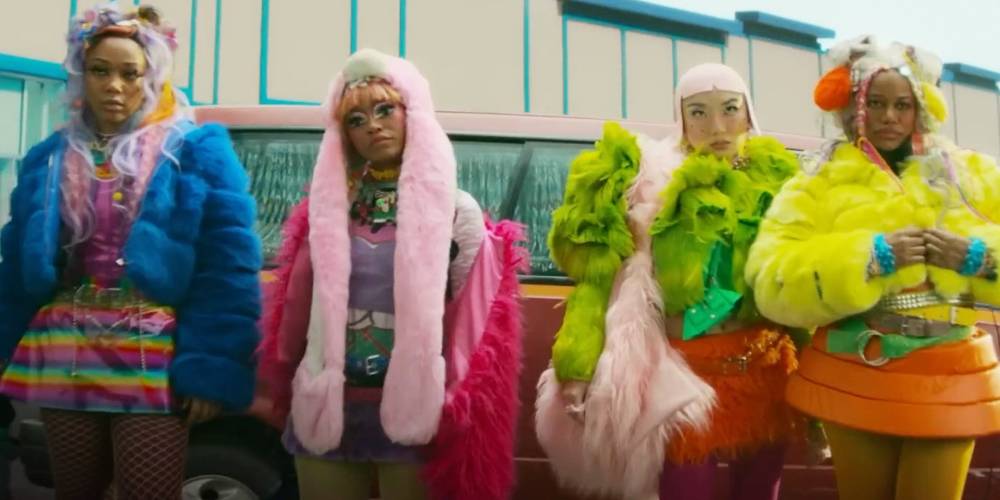
In 2018, rapper and activist Boots Riley released Sorry to Bother You, a clever satire that, while perhaps not wholly cohesive, offered a fresh look from a clearly exciting voice emerging on the scene. It’s been eight years in between projects (too long, I would say), yet he has finally returned with his sophomore feature, I Love Boosters. It’s that rare type of comedy, where the humor is broad yet the razor is precise, able to yield big laughs in between its big ideas. And it is, to date, one of the year’s very-best films.
San Francisco’s high fashion scene finds itself at the scourge of the Velvet Gang, a trio of shoplifters who take the overpriced clothes and sell them for a discount out of the chicken shop they use as an apartment. Led by the ambitious Corvette (Keke Palmer), she and her friends Sade (Naomi Ackie) and Mariah (Taylour Paige) make enough of an impact to catch the eye of world-famous fashion designer Christie Smith (Demi Moore), a billionaire whose influence ranges from the police force to the media. However, as the pressure rises before Smith’s latest fashion show, the Velvet Gang finds itself drawn into a series of vaster conspiracies, including sweatshops, organized labor, the Illuminati, and a literal demon.
It was clear from Sorry To Bother You that Riley had a strong sense of humor. What Boosters makes clear is that he really has a strong sense of humor, able to craft absurdly hysterical comedies out of his little moral parables – not unlike Charlie Chaplin’s Modern Times. Boosters is an absurd world, only a step beyond the world we inhabit. Through the likable Robin Hood-esque gang of hustlers, doing everything they can to make ends meet in a world slowly pricing them out of existence, we are thrust further and further into a Buñuel-esque farce. Riley’s deft script and light touch as a director manage to balance outrageous humor with humorous outrage.
Jokes could be as subtle as a series of intentionally tailored news interviews designed to demonize the poor and praise a ruling class who exploits them. They can be as broad as characters working in retail having to buy a new, expensive uniform every three months despite making minimum wage and racing for a thirty-second lunch break. Overall, these jokes tell a story about lower classes exploited by billionaires painting themselves as the victims even as their profits increase far beyond pennies lost by pauper pillaging or striking workers. And the sillier it gets, the smarter it gets.
Perhaps more impressive is how Riley has grown as a filmmaker since Sorry To Bother You. From physical comedy to impressive sets, every detail of filmmaking has dramatically improved. There are set designs of such rich light and color, it feels more akin to a Jacques Tati satire than a modern day comedy; yet it ultimately remains purely and hearteningly Riley, through and through. Meanwhile, one of the film’s best setpieces involves a highrise built on a tilt, forcing all occupants to fight gravity as they traverse the floor – it is a sequence on par with Buster Keaton. And when amplified by the jaunty, discordant score by art pop band Tune-Yards, the film creates a unique, delightful aesthetic unlike anything else today.
Unfortunately, despite the film’s near-perfect first two acts, it does seem Riley’s greatest shortcoming has yet to be corrected: how to land the plane. Gracefully, Boosters’ third act never goes fully off the rails or completely unravels, he still expands way too far and cannot quite reign it in. It’s still a delightful sequence, involving a car chase with constantly evolving cars and a gonzo Eric Andre. Yet it feels not only sloppier, but also incongruent from everything we’ve seen before. It all builds up to a conclusion that, while perhaps a more traditional happy ending, doesn’t feel earned, either in terms of narrative trajectory or audience ambitions for a karmic ending. Neither of the elements ruin the movie, or are in any way dealbreakers. They just indicate a need to hone finer details.
In terms of the performances, every actor meshes perfectly as part of a tightknit ensemble. Palmer’s Corvette is a tremendous lead, funny and cocky and intelligent as she deals with the weight of the world. Ackie and Paige are delights as the remainders of the crew. And LaKeith Stanfield is remarkably sexy as an enigmatic stranger who may or may not be a demon. Together, the team makes for a strong, likable group of protagonists.
Poppy Liu and Eiza González are strong as two activists the Velvet Gang encounters along the way. But the real stars here are the villains, ranging from the top brass, like an impeccably over-the-top Moore chewing up scenery, or Will Poulter as a pompous, effete store manager, to the more abstract, like bit parts by Jason Ritter, Kara Young, and an unrecognizable Don Cheadle as secretive parts of a grander conspiracy. Really, there are no weak links.
I Love Boosters is one of the year’s funniest, smartest, most precisely made features. I loved it when I first saw it last June. All these months and a second viewing later, there are still only a handful of films this year to surpass it. This is a textbook in how to make a film with a message: through humor, through heart, and through expert filmmaking. Riley is one of our most exciting filmmakers currently working, and if I Love Boosters is any indication, he is only getting better and better.
A-
I Love Boosters is now available on VOD


Add Comment