
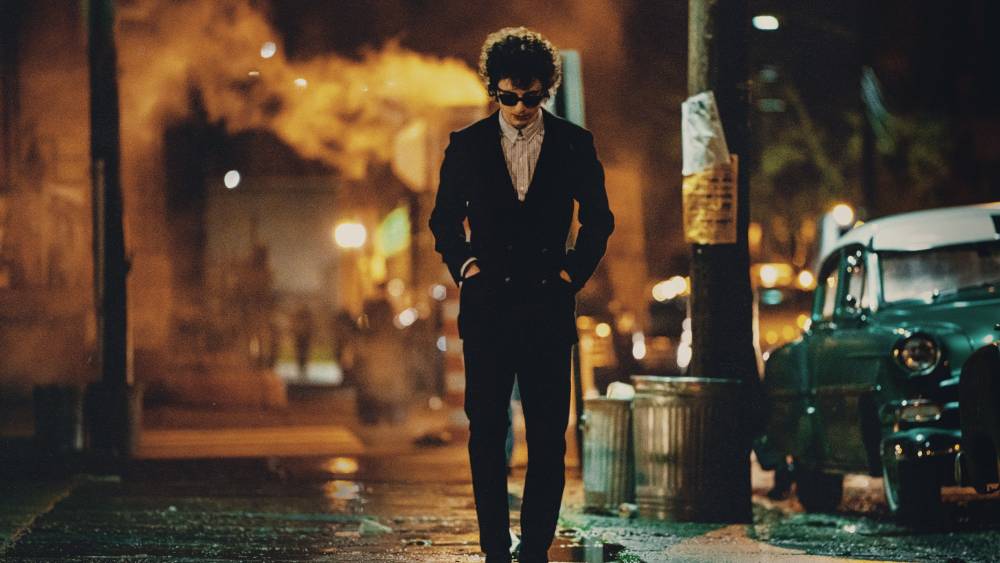
As tedious as formulaic storytelling may be, it is easy to overlook when in the hands of a master. After all, is a rom-com less charming, or a horror film less thrilling because we know the beats? The musical biopic has been brutally exposed by parodies like Walk Hard, and undergone scrutiny after Bohemian Rhapsody (which still made a boatload at the box office and earned four Oscars) and I Wanna Dance With Somebody (which fared considerably worse). Yet when done well, the genre still sings. And in the hands of someone like James Mangold, the Bob Dylan biopic A Complete Unknown is exactly that: a masterful, if familiar, look inside the mind of America’s greatest poet.
In 1961, Robert Zimmerman (Timothée Chalamet) came to New York with a guitar, a harmonica, and a few dollars in his pocket, determined to meet his hero, the recently hospitalized Woody Gutherie (Scoot McNairey). Changing his name and backstory to Bob Dylan, Dylan finds himself under the tutelage of legendary folk singer Pete Seeger (Edward Norton) and begins to wow the underground folk music scene of the city. As his fame grows and his relationships with Sylvie Russo (Elle Fanning) and Joan Baez (Monica Barbaro) buckle, Bob finds himself looking to expand his repertoire – at the risk of alienating the friends and fans who made him.
Biopics work when they actually offer insight into the artist – his drives, his flaws, what helped him change history, etc. A Complete Unknown works because Mangold is able to capture Dylan in his genius, insecurities, assh*lery, warmth, and desire to change – both the world and himself. Whereas most biopics would focus on how the musician’s childhood affected him, here we see how much Dylan himself is obsessed with the mystery. He constantly lies about his past, and the film often explores why he finds creating these stories more interesting than his own boring beginnings.
Part of this, the film explores, is Bob’s obsession with change, coupled with his own massive ego. He likes the idea of mystery because he feels that change is not only to better oneself, but a necessity to survive in the industry and the world. After all, we see the bespectacled Dylan in his iconic mid-60s era miserable in his complacency, playing his protest songs in the middle of rich people’s parties. He needs to keep evolving in order to properly express his music (graciously shown taking several years to complete, as opposed to simple strokes of genius as so many films often do), and it’s a fascinating look inside his mind.
Mangold, meanwhile, uses his workman-like style to bring a real grittiness to 1960s New York, and his editing adds a sly humor to the film’s 140-minute runtime (there’s a terrific cut between the making of the electric Highway 61 Revisited and Seeger’s banjo-focused public television show). And while he still uses the cliches of the genre – take a drink every time a character stares in awe when Dylan plays one of his iconic songs – there is also a playfulness as the cliches are undercut.
When Dylan plays “The Times They Are a-Changin’” for a stunned crowd, we also see Sylvie realize that Bob has changed too much to continue a relationship. And when the climactic performance of “Like a Rolling Stone” finally comes about, a lesser film would show Dylan slowly winning over the crowd with his electric guitar (after all, it is widely considered the Greatest Song of All Time). Here, the crowd of loyal Dylan-heads call him a Folk Music Judas and throw trash at him. It plays into the cliches of the genre while also offering a subversion. And sure, some more time could be spent on fleshing out Sylvie as a character, or utilizing real-life figures in ways other than their connection to Bob. But still, it’s a riveting enough story in spite of itself.
The film primarily succeeds on the backs of its actors, and not just because they perform their own music (something that lends an authenticity Rhapsody or the recent Maria can’t muster). Chalamet manages to properly embody Dylan’s mannerisms and little tics. In the grander moments, it admittedly veers closer to “impression” than “performance.” But in his little moments – his movements onstage, his incoherent ramblings when trying to appear smart, or negging Joan Baez from the stage, it comes close to genius. He is almost equally matched by Barbaro, whose star-is-born turn as Joan Baez is remarkable. She feels lived-in and raw in ways even Chalamet can’t match, and her voice is absolutely heavenly.
Amongst the other musician characters, McNairey is poignant as a dying, mute Gutherie touched and awed by this twerp who not only idolizes him, but may be better than him, while Boyd Holbrook provides laughs as a constantly-drunk Johnny Cash. The real heart, however, comes from Norton as Pete Seeger. Norton provides a soft-spoken mentor to the young Dylan, championing him at festivals and gigs before becoming overshadowed and abandoned by his protege. He feels honest and sweet in a way the explosive actor often doesn’t get to show. The ensemble rounds out with Fanning, who, despite less material than her costars, still makes the most of the enigmatic woman Dylan first loved.
A Complete Unknown is an example of a genre done right, a glimpse inside the mind of genius and an attempt to bring history to life. It manages to evoke a specific time and specific music of an era while exploring the mind of the creator. You won’t necessarily walk away with the same insight as, say, a full-length Dylan biography, or even the Coen Brothers’ Dylan-adjacent Inside Llewyn Davis. But you will be entertained, gain a new insight into the songs and the man, and perhaps come away with a new appreciation. And when wrapped up in a fascinating picture, what more can you ask for?
B+
A Complete Unknown will release tomorrow, on December 25th


Add Comment