
You know what’s rare, especially in this day and age? An optimistic science fiction film. 95% of most modern science fiction (really, a good percentage of all science fiction) is dystopic, either predicting a catastrophic future because of technology or commenting on our own current, pathetic state of events. But every once in a while, a science fiction film comes along that reminds us, “Maybe we aren’t all bad. Maybe, if we just opened our eyes and our hearts a little bit more, things will be ok.” In his follow-up to the 2017 breakout hit Columbus, Kogonada explores this very idea, using the notion of a broken robot to explore the very nature of human connection, memory, and the meaning of life.
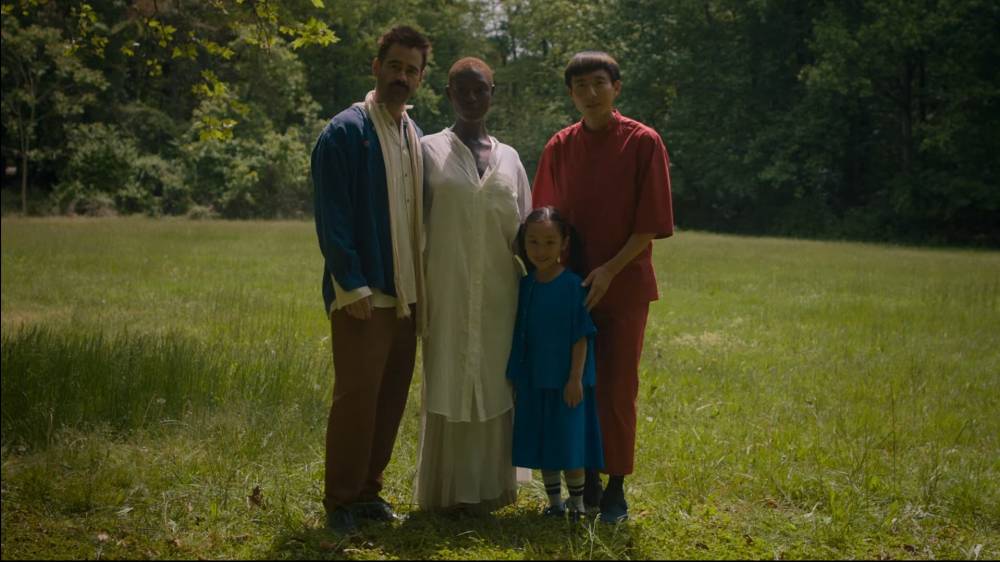
Workaholic Jake (Colin Farrell) lives with his wife Kyra (Jodie Turner-Smith) and daughter Mika (Malea Emma Tjandrawidjaja). Several years ago, when Jake and Kyra adopted Mika, they bought Yang (Justin H. Min), a “Big Brother” robot to help Mika learn to socialize and embrace her Chinese heritage. One day, however, Yang begins to malfunction, and eventually shuts down completely. Desperate to console his grieving daughter, Jake takes the android all over town, trying to find someone capable of repairing the model. Along the way, he discovers that Yang possessed a secret camera, capable of retaining “memories.” As Yang’s existence continues to hang in the balance, Jake – and everyone else in the family – begins to reflect on the time they’ve spent with Yang, the memories they seemingly missed, and what to do with their remaining time on Earth.
After Yang is the type of film that begs for repeat viewings, because there’s just so much going on with its story. Beyond just a sweet story about a man, his robot, and his child, the film also touches on, in no particular order, Big Tech, Big Business, the struggles of parenthood, grief and loss, the adoption process the importance of memory, and the meaning of life. Androids have always been a way of exploring what it means to be human, all the way back to Metropolis in 1927 (and even further, although the Maschinenmensch is perhaps the most famous early rendition), and Yang is no exception. The struggle to keep him alive and to remain his memories is seen through the lens of being human, of having fears and hopes and dreams, and striving to achieve them.
The film’s most significant arc is the revelation that the robots have “memories” – something hitherto unknown to this world – and the ramifications that entails for humans. It forces Jake to question everything he knows – and because he is the audience surrogate, it forces us to question ourselves. What would a robot deem “memorable?” How does that compare to what we humans deem memorable? What happens to those memories when we die? Do they become a part of the universe, or just disappear into the ether? And what are those memories worth – to us, and to the world in general? These are all questions that spring to mind over a five-minute sequence not even an hour into the film’s runtime. Imagine what this film will lead you to contemplate over its entire 96 minutes.
The film’s main focus seems to be on the adoption process and the blended cultural significance of that act, involving Mika. This is, indeed, a moving, heartwarming story – one where Jake learns to be more present in his daughter’s life, while Mika slowly grows to feel accepted by her surrogate family, thanks to a beautifully written and performed monologue by Yang involving tree grafting. And it’s hard not to think of the death of a pet or any other form of loved one when Mika, grappling with Yang’s mortality, asks with childlike wisdom, “Will we never dance again?”
But as with all allegorical science fiction, some of the best moments come through the satirical jabs at modern day life. It’s hard not to giggle when a robo-repair shop charges $250 for doing nothing, or the casual revelation that clones are not only a part of this universe, but they experience prejudice due to the controversial ethics of the practice. Kogonada laces his script and his film with little touches like these, so that every frame offers a choice of philosophy or wonder.
Visually, Kogonada continues with the visual flourish he brought to his debut film Columbus. It’s not a showy film, per se. It just holds its long takes on gorgeous naturalistic shots while the actors read from a strong, humanist screenplay. In fact, the only time it does engage in any semblance of dynamic filmmaking is the opening sequence, an extravagant national stress relieving exercise known as The Family Dance. Every character in the film is introduced in front of a brightly colored screen, performing a synchronized, choreographed dance routine.
The scene is the film’s greatest moment of innovation and, incidentally, its weakest. Not because the dance isn’t incredible – it is – but because as creative as the film may be, it never matches this level of innovation again. It promises a silliness and wonder the film has no interest in exploring, and while there’s nothing wrong with that, it’s hard to not view it as a letdown.
Still, what the film lacks in visual flourishes it makes up for in masterful performances. Farrell has always been a terrific character actor, yet it feels like he is just now finding his stride. Not only is he terrific in every moment of this film, he throws his entire body into the role, somehow appearing both as a hot dad and a man whose entire body is devastated by life at the same time. Turner-Smith doesn’t have the same amount of material as Kyra, but she does have a few terrific moments – particularly with Yang – that allow her to stand out. Haley Lu Richardson continues a string of terrific performances as the enigmatic Ada, while Clifton Collins Jr., Ritchie Coster and Orlagh Cassidy stand out in smaller characters who pop up along the way.
Among the younger actors, newcomer Malea Emma Tjandrawidjaja certainly tries her best as young Mika. I wouldn’t say her performance is the worst child performance I’ve ever seen – she certainly doesn’t hinder the film by any means – but I also don’t believe she adds to the film the way so many of her costars do. Which brings us to Justin H. Min as the eponymous Yang. Min is, without mincing words, marvelous as Yang. He manages to sound robotic without ever leaning into it, thus keeping his dialogue warm and human. He waxes philosophically throughout without ever feeling over-the-top or preachy – just a young robot trying to grapple with his place in the world, beautifully and smartly. It’s a difficult role to play, and without Min, I’m not sure the film works at all.
After Yang is a warm, beautiful film about love, loss, and life. It’s the type of bold swing we need more of in this day and age – in fact, I haven’t seen a film this refreshingly bold in vision since Her. I’m not sure Kogonada ever reaches the lofty heights of Spike Jonze’s 2013 masterpiece, but he certainly takes aim at reaching there. It is a beautiful film that will likely stand out all year as one of the best, and it certainly isn’t one you’ll want to miss.
A-
After Yang is now streaming on Showtime, as well as select theaters nationwide


Add Comment