
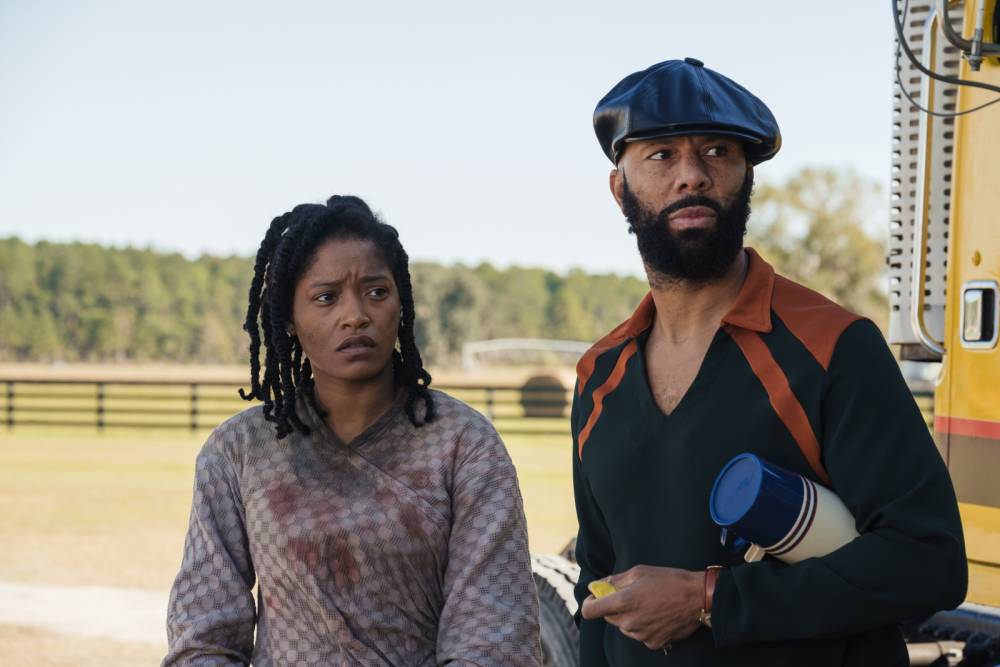
There’s truly nothing worse than watching a movie with a good idea make all the wrong choices. Such is the case with Alice, the first film by director Krystin Ver Linden. It’s sort of like a peanut butter and sauerkraut sandwich; there’s nothing inherently wrong with any one aspect of the story. But all together? It leaves a foul taste in your mouth. And when dealing with something as sensitive as slavery – and what’s more, tagging your completely fictionalized story as “true” (and not in a Fargo/Texas Chainsaw type way), it’s just going to do more harm than good, no matter the intentions.
Alice (Keke Palmer) is enslaved on a plantation in rural Georgia. After her husband Joseph (Gaius Charles) is shot (and presumably killed, although he pops up later in the film almost completely unharmed) and Alice strikes her captor, Paul Bennet (Johnny Lee Miller) in anger, she sets out to escape to the North for freedom. However, she doesn’t make it very far – in fact, she only makes it to the highway. You see, it is actually 1973, and Alice has been kept on a plot of land hidden from the world and willfully denying the outcome of the Civil War. Aided by a sympathetic former Black Panther named Frank (Common), Alice isn’t just content embracing the Civil Rights and Black Power movement – she wants revenge.
You might be asking yourself, “Why did he just spoil the big twist of the movie in that synopsis?” Well, I’ll tell you: while the film spends forty minutes trying to build up to the big 1973 twist, the marketing has done nothing to hide it. It was billed at Sundance as the “modern-day slave movie,” the tagline spoiled everything I just told you – hell, the director talked about it in the pre-film introduction. So if you’re not bothering to hide the “twist,” why should I bother avoiding that spoiler?
In fact, this raises a whole new set of questions. For instance, if the film isn’t really interested in the “twist” as it stands, why bother utilizing it at all? Why not just start the film with her escape, and focus on Alice turning into a Blaxploitation hero? Ver Linden spends so much unnecessary time on the plantation, establishing atrocities most audiences already know (and the ones that don’t won’t see this movie anyway), to build to a twist that’s not even well-executed. Why spend so much time establishing something we’ve seen before, and better, in order to justify a pretty tasteless revenge flick?
It certainly doesn’t help that Ver Linden’s screenplay is an utter disaster. Despite her claims of idolizing filmmakers as varied as Gordon Parks and Quentin Tarantino, it’s clear that she lacks not only her heroes’ knack for staging a shot, but also lacks their penchant for dialogue. Blaxploitation villains’ dialogue was notoriously thin and cliched (intentionally so), but it at least had meaning. The villains here speak in such trite justifications as “Time before people…forgot their place in the world…was a lot less confusing.” It’s somehow less egregious than Alice finding herself by subtly declaring “I am freedom!”
The whole film takes a dramatic turn in the final act when Alice, completely unprompted, decides to don a Pam Grier ‘fro and free her fellow slaves. While the heel-turn is out of step with the rest of the film – she read one American History picture book that somehow taught her the entire Civil Rights Movement in one afternoon – it at least promises some sort of cathartic resolution. And at first, it seems like a step in the right direction – beating up racist white people, editing by Byron Smith begins to resemble the film we’d been promised, and beyond.
But even as the film begins to correct itself, there’s still a realization that it’s all too late – this turn happens less than 20 minutes from the end of the film, far too late for anything interesting to save what’s come before. Not that it matters, though. Just as quickly as the film rights its own course, so too does Ver Linden sink the project once again. The ending is so jumbled it offers no sense of cathartic release. There’s a couple of quick fistfights, the occasional drawn (and unfired) gun, and eventually all the bad guys are tied up, unharmed, waiting to be arrested by the police. Right, because if there’s one thing Blaxploitation films have taught us, it’s that the police (especially Southern police, who had to have had some idea of what’s been going on) are going to suddenly do the right thing.
The odds were slim that the acting could have saved this film even if it had been modestly decent. Sadly – or thankfully – that’s not a question we have to worry about, as every actor gives the worst performance of their career. Palmer in particular is devastating, because she had so much potential so extravagantly wasted. She overacts in every scene, whether she’s a petrified slave, an action star “badass,” or whatever the hell the middle portion of the film is supposed to be, where she basically responds to 70s-era objects with a Hocus Pocus-esque sense of irony.
Inexplicably, she fares better than Common, who proves once again that he cannot and will not ever learn to act. Not even the great Johnny Lee Miller can conjure about an original, interesting performance as Alice’s former captor – he’s basically doing a poor man’s impression of Michael Fassbender. Every performance is so wildly unstable, to the point any line utterance renders feelings of anger and disdain, never empathy or exhilaration.
Alice is an utter failure from beginning to end. I could criticize any number of things about Ver Linden’s film for another ten thousand words. I could criticize the gaps in logic, or the poor writing, or the acting, or any number of details. But honestly, what pisses me off the most was the final blurb: “Dedicated to the real life cases.” Not only is this an egregious stretch of the truth (the “real life cases” involved legal loopholes involving sharecropping, not secret societies where everyone dresses in 1800s garb), but it’s an insult to real peoples’ suffering. This is just a bad film in every sense – bad morality, bad writing, bad directing, bad action, bad acting…just bad.
F
Alice will premiere in theaters nationwide March 18th


Add Comment