
There comes a point in every filmmaker’s life where you can kind of see everything come undone all at once. Never has this been more true than with David O. Russell, le enfant terrible of the screen who enjoyed two periods of success separated by a decade before watching everything come apart because of his temper, his actions, and above all else, his own hubris. His newest film, Amsterdam, boasts a massive ensemble of talented performers, and yet none of them can overcome the film’s central problem: its writer and director.
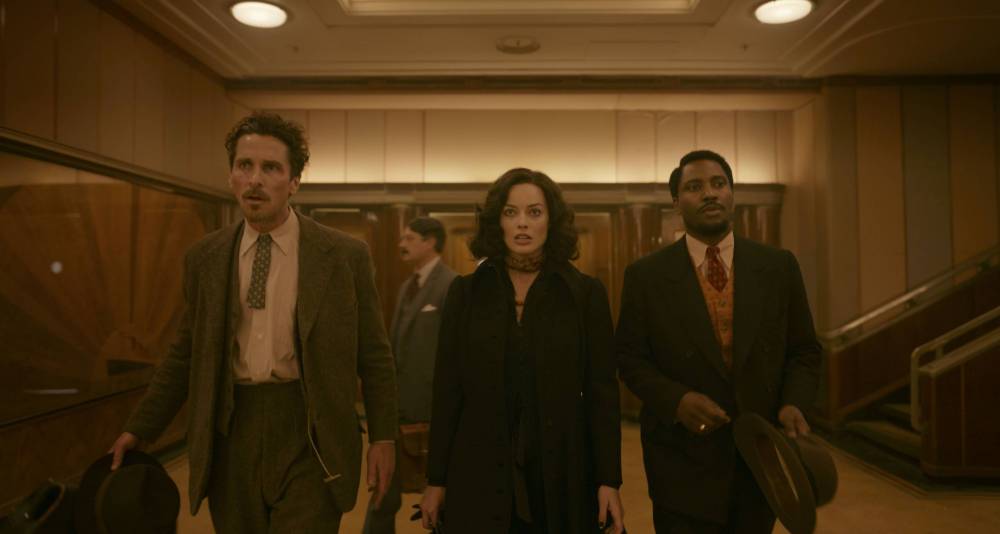
During the final days of World War I, Dr. Burt Berendsen (Christian Bale) and Harold Woodsman, Esq. (John David Washington) are both grievously wounded on the battlefield. Their lives are saved by Valerie Voze (Margot Robbie), a bon vivant nurse who entices the duo to join her on a trip to Amsterdam. For months, the trio boozes, creates art, and helps veterans before Burt eventually decides to rejoin his apathetic family back home.
Now 1933, Burt and Harold have reteamed to open a local clinic for veterans still denied benefits all these years later, helping them get the healthcare they so desperately need. However, their seemingly mundane lives are soon upended when Elizabeth Meekins (Taylor Swift), the daughter of an old war friend, shows up to request an autopsy of her father, whom she believes to be murdered. Their routine investigation soon leads them to uncover a murder – a murder for which they are the two prime suspects. In order to clear their names, the duo must investigate a vast conspiracy that threatens the entire nation – and puts them back in touch with their old friend Valerie.
Now it’s impossible to write about Amsterdam without addressing the Russell-sized elephant in the room. David O. Russell has spent his nearly three decades in the industry almost exclusively making enemies, having belittled and harassed almost every actress he’s ever worked with and eventually taking a “sabbatical” when the 2014 Sony hack revealed that he groped his niece, confessed to it, and got off because the Florida police didn’t know how to process the 19-year-old trans victim. Whether or not you want to see a David O. Russell film knowing all that is a choice between you and your God.
Yet even if you’re capable of separating the art from the artist and/or are completely unaware of these allegations walking into the theater (most audiences wouldn’t know a director by name nowadays), it doesn’t excuse Russell’s sin of hubris. Despite his cinematic successes coming from small family dramas and intimate character studies, Russell is still completely convinced that he has the fortitude as a writer and director to craft a massive ensemble comedy. And therein lies the problem with Amsterdam.
This film is a giant collection of puzzle pieces all jammed together, despite the pieces not only never fitting, but also come from different boxes altogether. John David Washington and Margot Robbie are delivering lines like they’re in an ultra-serious Casablanca remake, while Christian Bale is basically a cartoon character. Andrea Riseborough and Anya Taylor-Joy are in a 1930s class comedy while Mike Myers and Michael Shannon are bumbling spies. And then there’s Alessandro Nivola losing his damn mind in the best way possible. None of these plots fit together, and never complement each other, and yet they are meant to coexist inside the same meandering, nonexistent plot.
It’s almost as if Russell decided to make his own meandering, plotless homage to Peter Bogdanovich. But whereas a director like Paul Thomas Anderson or Steven Soderbergh can pull off sprawling, such writing and directing ability were never in the irascible New Yorker’s wheelhouse. He has packed so much story into the two-hour runtime, that he forgot to include anything to justify it. Every twist is predictable, there are no funny lines; hell, even the characters themselves are barely characters. Almost everyone in the film is introduced with a monologue explaining explicitly who they are and what their motivation is – all shot through dramatic close-ups as if to say “Look which celebrity is here? Please clap!”
What’s worse, the film builds up to a series of “morals” that barely make sense for the story that preceded them. At best, these themes are pedestrian, like the belief that the worst thing about fascism is the “lack of imagination,” and that good art can beat fascism. At worst, it seems as though the film exists solely for its director to let off steam – at one point, a character declares, seemingly unprompted, “Just because everyone’s saying it doesn’t make it true.” You want to know just how bad this script is? The film’s prologue actually includes the cliché, “Hi, I’m Burt. You’re probably wondering how I found myself in this situation. Well, it’s kind of a funny story…”
Perhaps the script would have been more tolerable if the direction and editing had shown even an ounce of imagination. Here, it’s as though a third-rate television commercial director were suddenly given their big break. The camera is placed haphazardly in several sequences, there’s no sense of dynamic tension, and what’s worse, the editing is so sloppy, the film is almost unwatchable. One minute the characters are rushing through backstory and exposition, the next there’s a seven-minute-long musical number that is forgotten as quickly as it’s sung, followed by a dream sequence that makes absolutely no damn sense to the rest of the plot. Those songs and dream sequences happen approximately 30 times, and it is amateur work of the highest order.
Amsterdam’s saving grace is its very game cast of terrific actors and actresses. Bale in particular is quite good as the living cartoon character of a protagonist. The Oscar-winning actor has truly never embraced this level of physical comedy before, and it turns out he has a real panache for theatricality. He throws himself into every pratfall, and even lurches his body in ways that earn a laugh at his mere presence. His physicality overcompensates for young Washington, who manages to convey emotion with his provocative eyes, yet is forced to deliver every line in a monotone.
As for Robbie, she is unsurprisingly very good as Valerie, which is a blessing and a curse. It’s a blessing because having Robbie in the film guarantees memorability and wit. It’s a curse because the role is so clearly beneath her – not to mention the fact that she clearly looks no more than 30 throughout a film that spans almost two decades. Still, she’s consistently great here, especially when she gets to f*ck with Anya Taylor-Joy’s snooty rich girl.
Mike Myers and Michael Shannon show up a handful of times as two ridiculous bon-vivant spies, and quite frankly, I’d like to see the duo continue their shenanigans in the future with a better director. Chris Rock equally has some great lines in the film, as does an over-the-top yet still lovable Alessandro Nivola as a rookie cop investigating. Taylor Swift is surprisingly decent, although she’s not in the movie very long. In fact, the only real surprise is Robert De Niro, who refreshingly gives his best performance in almost a decade here as a fiery war general.
Amsterdam is a tonal misfire in almost every way behind the scenes. There was an interesting story to be told here; one that could have spoken to the world of today in a way that Russell clearly thinks he’s accomplished. After all, it’s a classic story about individualism and hope in the face of uncaringly rich politicians. But such a story needs a deft hand; one that could improve this script and understand how direction works. I may not be able to judge Russell’s behavior, past or future. But I can judge his filmmaking, and one thing is abundantly clear: he is not up for the task.
C
Amsterdam is now playing in theaters


Add Comment