
When you think of the name Leos Carax, if you think of that name at all, you think of the absurd. After his groundbreaking post-modern opus Holy Motors, Carax had established himself as both a student and a critic of the Old Guard. It’s a label I don’t think he was too happy with, as he has described in great length during interviews his desire to make a classical musical. And when it was announced that he would team up with Ron and Russell Mael of the band Sparks (the subjects of the fabulous recent documentary The Sparks Brothers), it seemed like he would have his chance. As it turns out, the brain-child Annette is something much more complicated – and fantastical – than this seemingly simple desire. For the end result is an original opera, played out in fantastic detail on the silver screen, and even if it doesn’t always come together, it’s the type of big, broad swing that we need more of in this day and age.
In modern-day Los Angeles, the entertainment industry – and the world at large – is obsessed with the whirlwind romance of provocative stand-up Henry McHenry (Adam Driver) and famous opera star Ann Desfranoux (Marion Cotillard). Behind the scenes, it’s pretty clear that they deeply love each other, although Ann clearly has concerns about Henry’s anger issues. The couple quickly ties the knot, and Ann gives birth to a daughter, Annette (Devyn McDowell). However, as Ann’s career begins to skyrocket, and Henry’s career begins to spiral, the young family soon finds themselves on a collision course with a horrific accident, a supernatural gift, and a downward spiral of exploitation and destruction.
There’s a lot going on in Annette, and at first glance, it could seem masturbatory on Carax and Sparks’ part. And maybe it is. But much of it is owed to its predecessors in the operatic realm. Audiences may soon tire, after two and a half hours, of repeated refrains and calls-and-response (there’s an early song that consists almost entirely of the line “We Love Each Other So Much” sung in different ways). Is this a sign of laziness from the Mael brothers? Or is it in the history of arias and recitatives, as used by Mozart and Handel and Wagner? Is the presence of Carax, Sparks, and the cast singing an opening number about the idea of making a movie a visual wank with no clear message, or an homage to overtures and onstage choruses in Greek tragedies who often break the fourth wall? I think a fair argument can be made in all regards, and audiences looking for a Golden Age musical are sure to be disappointed. But having become a regular patron of the operatic scene in recent years, I don’t know how you can interpret this film as anything other than a grand modern-day opera, complete with Big Emotions, surface-level themes, and a great deal of care and intellect. This isn’t a film you can analyze or judge or even casually watch. Like the opera, it is a place where you are meant to feel the story, with every emotion and action heightened to an 11. And as off-putting as it may occasionally be, it also makes for a more unique experience.
Of course, while operas tend to wear their emotions on their sleeve, they tend to live and die on the strength of their thematic core. And when it comes to the themes at the center of Annette, things tend to get…interesting. Carax and the Maels often tackle deep subjects in rather subversive, brilliant ways, like the toxic masculinity that drives so many men in Hollywood (and the comedy scene). Their takedown of child exploitation in the industry is itself both brilliant and unsettling: to represent the way so many show parents use their children as puppets to their own exploitative means, the infant Annette is portrayed by a hilariously terrifying wooden puppet, which is showered with praise while famous and cursed at when reluctant to perform. It’s such smart commentary wrapped inside a ridiculous joke. But while this type of commentary is so incisive and intelligent, there are so many subjects treated with…less care. For example, the Mael brothers’ hatred for show business is barely contained, with a Greek Chorus of talk shows popping in solely to be invasive. Performance comics and their ilk are treated with utter disdain, as audiences laugh in inhuman harmony as Henry delivers the most unfunny punchlines you’ll ever hear (ironically, his best joke is the one that gets him “cancelled”). And the difference in “low art” vs “high art” is spelled outright, as Henry’s comedy “kills” his audience, while Ann’s opera “saves” her audience. You really want to know how obvious the writing is here? The “everyman” protagonist is named Henry McHenry. It’s the ultimate juxtaposition between deep commentary and shallow observation.
Perhaps the themes wouldn’t seem so shallow if the songs by Sparks had just a tad more life to them. Don’t get me wrong: the actual music on display here is, like most of Sparks’ work, thoroughly impressive. It’s well beyond the fun sung-through ditties of rock operas like Tommy and well into the territory of The Marriage of Figaro and Carmen. No, the issue here is the lyrics. The majority of these songs just lack the band’s signature wit. This is a group that once wrote an entire album of songs about sex with one exception: a song called “Tits.” You’d think that the songs here would be equally witty. But outside of the opening song “So May We Start,” a commentary on the obviousness of opera, the emotional themes of the story, and a series of jokes about trying to make a movie, the songs simply describe what’s already going on, with limited sarcasm or humor present. You can basically divide the music into three groups. There’s the actually witty songs (no surprise that these are the best), like “I’m An Accompanist” or “You Used To Laugh.” Then there are the “serious” songs that fit the operatic tone, including straight-up arias for Henry and Ann, a #MeToo song that sounds like The Furies, and the climactic “Sympathy For The Abyss” that, like many operas, may feel lyrically on the nose, but emotionally will move you to the core. But when you get to everything else – the repeating lyrics, the overt statements of What’s Going On, and the lack of humorous or thematic heft, it just doesn’t feel as groundbreaking as the group’s satiric Hollywood opera The Seduction of Ingmar Bergman.
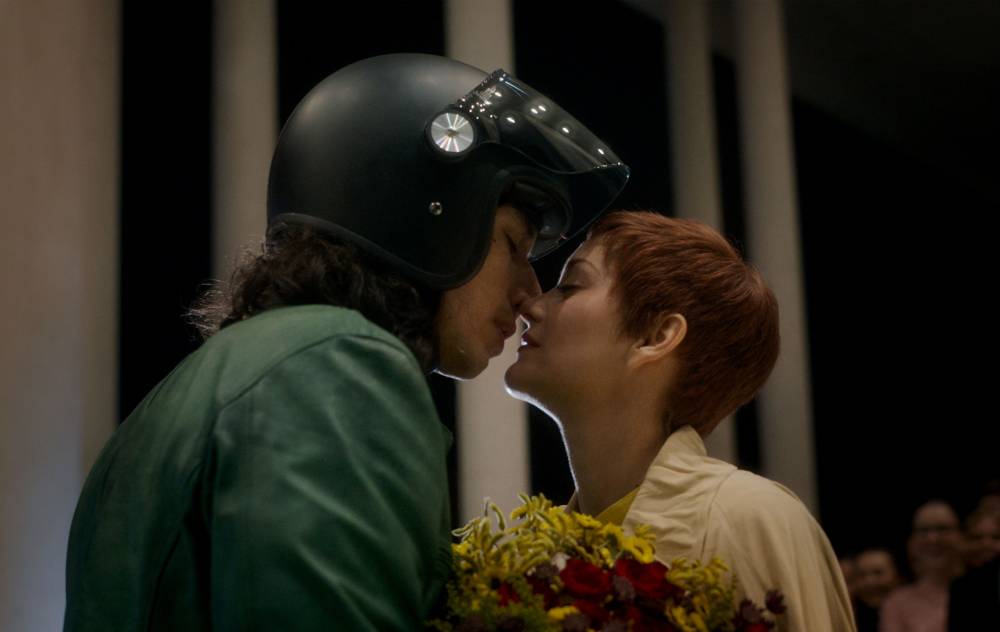
Thankfully, when the music doesn’t seem to hold its own weight, Carax jumps in with his trademark directorial style to keep things moving. Perhaps the greatest weapon at Carax’s disposal is his sense of humor, often abetted by Sparks’ own weird sensibilities. Leaving aside the fact the film opens with the director himself looking into the camera while recording the score and instructing the audience “not even to fart” during the film’s duration. No, Carax finds opportunities for jokes at every turn. There’s the classic Hollywood kissing scene in front of a curtain meant to imply sex, only for the film to then cut straight to a relatively graphic sex scene (a scene that Carax then cuts back to MANY times). Later, when the audience finally turns on Henry, he tries to beckon the backup singers onstage to reprise his previous song about laughter, and the four girls have to come running out completely unprepared. Hell, Carax is even a master of visual gags – I refuse to believe the shot of the 6’2” Driver trying to climb into the crib with baby Annette is anything other than a joke about the actor’s height. Oh, and who can forget the puppet, which seems so intentionally discomforting that you surpass shock and terror and end up laughing at the Uncanny Valley.
In fact, Carax’s direction is so intelligent, it is sometimes difficult to tell if a stylistic choice is a joke, an intentionally simplistic bit of foreshadowing, or something deeper altogether. For example, one sequence finds Henry driving down the road on a motorcycle, imagining Ann playing all the famous operatic leading ladies – Carmen, Othello, La Traviata, Madame Butterfly, and beyond – all of whom die tragically. Is this but a simple joke on Carax’s part, telling viewers “Yeah, you know where this is going.” Or is it a commentary on the fact that we have to keep repeating this story, because toxic men who cannot control their emotions continues to be eternal? The fact that both answers are equally possible is a sign of Carax’s genius. This craftsmanship extends to all of the film’s flourishes, with most of his signature stylistic choices on display. There are constant fourth wall breaks, characters run through screens and backdrops, and impeccable staging and use of space.
Carax thanks King Vidor during the film’s closing credits, and that may be the thing that makes the most sense here. Despite its operatic nature, this is a film where the visuals must be heightened because words just can’t adequately do the emotions justice. Therefore, the cinematography by Caroline Champetier and production design by Florian Sanson are crisp and lush, giving the film a gorgeous, hyper-realistic sheen. It particularly works during moments like the terrific storm sequence, staged exclusively with classical effects, resulting in a scene that will truly blow you away. My one complaint with Carax’s direction is the commitment to the bit. While he certainly does take several major swings, there are several moments that seem to drag on and on and on. While the emotional core can often carry these sequences a great deal (I cannot stress enough that this is a film you feel more than watch), it often feels like filler in between Carax’s next major swing. This is not something I expected to say about a film with a singing puppet baby, several fourth wall breaks, and an action setpiece set during an old-timey storm, but I can’t help but wish that the film had either embraced the gonzo or focused on the story, as opposed to this weird in-between.
As for the acting, I’d say everyone pulls their own weight here, and then some. Adam Driver once again gives an all-timer performance. He is an actor of pure, raw emotion, so when he plays unhinged characters like Henry, it works all the better. And he does truly shine here, understanding how to milk both the comedy and the tragedy in equal form – also, he raps during his comedy show, which may be the most humorous part of the ordeal. Meanwhile, Cotillard has a smaller role than you’d expect, but she is so great in every minute onscreen. She does this thing with her eyes where she can convey the act of covering up her fears and frustrations with her husband using only a smile in order to focus on love. Plus, her three arias (when she does her own singing) are objectively the best sung in the entire film. And rounding out the main cast is Simon Helberg as The Accompanist, Ann’s accompanist who longs to be a conductor and may hold an important secret. It may come to a shock to those who only know Helberg from The Big Bang Theory that the actor is this good at his craft, but he’s truly remarkable, delivering some of the film’s true jokes with a deft hand while also bringing an emotional core to the performance. Oh, and young McDowell doesn’t have much to do for the bulk of the film’s runtime, but boy is her big scene a gut punch. My only complaint with the four (arguably the only actors with any real presence in the film, intentionally) is that I can’t quite decide if the film needed better singers. Don’t get me wrong, their performances are incredible. It’s just they have to talk-sing and whisper all their songs, and that’s just not something you can do in opera. There are times you begin to wonder if the decision hinders the film instead of helping it. But I digress.
Annette is a massive swing, there is no denying. It is not a film for everyone. I’m still contemplating if it is a film for me. But what you can’t deny is that this is a film by a director who knows what he’s doing. He has studied his craft, knows the language of opera, and has created a marriage not seen since Ingmar Bergman put The Magic Flute on the big screen. I walk away from this film the same way I do after a particularly good opera: I forget some of the recitatives, I lament the length, but I feel myself swept up in the emotional core, the daring performances, and the lush craft of it all. I hesitate to use the word “great” to describe Annette. But it is quite good, and when coupled with filmmaking you aren’t likely to see anywhere else, I think that’s quite an accomplishment.
B+
Annette is now streaming on Amazon Prime


Add Comment