
With the days of Harry Potter and The Hunger Games long behind us, studios have been scrambling to capture the audiences that once religiously turned out every few years for a fantastical adventure filled with magic, wonder, and a couple of plucky upstarts. Thus far, all have failed, to varying degrees of hilarious embarrassment. However, few have fared as spectacularly poorly as Artemis Fowl, Kenneth Branagh’s adaptation of the beloved crime-fantasy series of the early aughts. The man who once brought us Shakespearean epics, one of the more whimsical Marvel entries, and arguably the best live-action Disney adaptation yet has now found a new low, filled with shoddy attempts at humor, piss-poor CGI, and one of the more laughably bad scripts in recent memory.
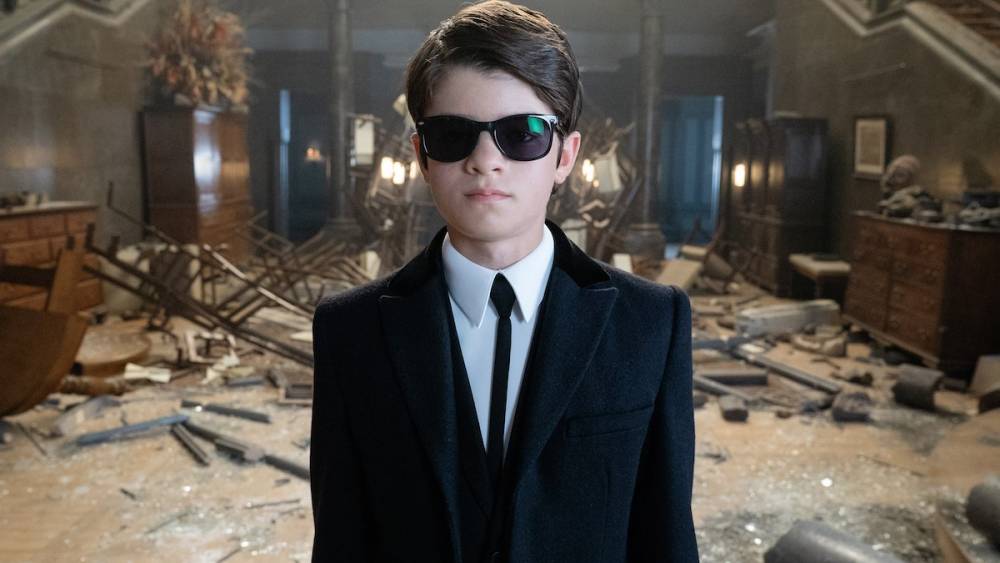
Artemis Fowl II (Ferdia Shaw) is a 12-year old supergenius living off the coast of Ireland with his father, Artemis Fowl I (Colin Farrell). A wealthy businessman with a penchant for crime, Artemis II’s world changes when his father goes missing. Through his father’s workshop, Artemis II (who will henceforth be the only Artemis I refer to, because this is already too dumb for me) discovers that the Irish fairy tales he’d been read as a child are, in fact, true (I stand corrected). As it turns out, there’s an entire world of fairies living beneath our feet, and they want nothing more than to reclaim the Aculos, a magical do-hickey that does…something, the plot never really explains. Hunted by the strict police force known as LEP. Recon (oh my God), their leader Julius Root (Judi Dench) and a young, feisty recruit named Holly Short (Lara McDonnell), Artemis and his friends (including a trusted bodyguard played by Nonso Anozie and a disturbing dwarf played by Josh Gad) must locate the Aculos, battle off his fictional enemies, and save his father – and fit all of this exposition into a crisp 90 minute plot.
The greatest flaw of Artemis Fowl is the lack of characters that are interesting in any sense of the word. It’s been a while since I read the novels (it would be pre-Harry Potter, which I first read in 2002), but what first drew me – and most readers – to the stories was the complex protagonist. The Artemis of the novels is a complex, selfish thief who doesn’t care about those around him, and slowly shifts into an empathetic hero. That is, sadly, not the protagonist written by Conor McPherson and Hamish McColl. To them, Artemis is not an impressive, creative, unique character with an emotional journey. Instead, he’s just another pretentious kid genius with no filter and an already innate sense of morality. He’s basically Young Sheldon, yet somehow less interesting (at least Young Sheldon has an interesting family story built around it). The decision to change Artemis from a cocky, assh*lish criminal mastermind to an Asperger’s-adjacent goodhearted supergenius not only hinders Shaw’s performance, but hurts the narrative arc overall. Are these people actually thieves? What is their objective? Why should we care about Artemis if he doesn’t grow or change during the story? By diminishing the character growth, the audience loses all incentive to care about the story.
And it doesn’t stop there. Every character the screenwriters throw at us is at best, tedious, and at worse, unbearable. Holly is a whiny elf-child that is willing to leave a crowd of people to die to save one child. Dom lacks anything resembling a personality. Judi Dench plays a strangely Irish (for no discernible reason) police captain that implements the magical world’s own “stop and frisk.”And don’t get me started on Josh Gad’s Mulch Diggums, who I’ll be getting to in a moment. In fact, the only interesting character in the entire film is Tamara Smart’s Juliet Butler, the group’s 12-year-old best fighter who’s supposed to be Artemis’ equal in every way. Too bad she’s not allowed to do literally anything – they literally only use her to cook, and she never fights. Not only is this a hilariously poor example of character development, it’s incredibly offensive – Juliet is a young Black girl who is admittedly the most talented of the group, and she’s solely used as a maid. These are unbearable characters that represent everything wrong with this film.
Of course, perhaps the unlikeable, uninteresting characters are meant as a distraction from the fact that the story is completely incomprehensible. It is somehow too slim, yet completely overstuffed, leaving the narrative a completely confusing clusterf*ck. This is, in many ways, the longest 90 minutes in my entire life. McPherson and McColl have tried to condense too much into the film’s compact running time, without any sense of understanding or deductive clues. You see, unlike, say, Star Wars, which gave enough context clues for audiences to follow along with having to explain every detail of the fantastical universe, Artemis Fowl somehow both over and underexplains, hoping that viewers can understand moments that worked well on the page, but just don’t work when spoken out loud – and especially not when narrated by Josh Gad. After a while, the audience will realize that the details that confuse them will never be explained, and it’ll be easier to just give up than try to analyze – and ultimately, it kills any chance of us caring about the story. Not that we would want to – the “magic” here mainly centers on how sunglasses are the only thing that can stop magic, and that Einstein and Hawking predicted that fairies could freeze time.
Artemis Fowl just continues to throw new plot detail after new plot detail at its audience, unconnected to anything that came before, in the hopes that by moving the plot along at a breakneck pace, the audience won’t be able to dissect the plot and realize that the entire story is horsesh*t. After all, it’s taken a novel about a tween brat who realizes the world is bigger than his own preconceived ego and boiled it down to another daddy issues schlockfest. This is a film that states, and I quote, “I believe in fairy tales. But what I really want…is to believe in you, Dad!” The fact I didn’t turn this film off after this declaration is a greater act of magic than anything performed by a character in this film. And yet, the greatest slap in the face has to be the third act, which devolves from a kid-genius heist film (I guess? It doesn’t really do anything for an hour of its runtime) into a weird Elvish recreation of the Normandy beach scene in Saving Private Ryan. Suddenly the film with no stakes becomes a film with all the stakes. As the film rushes through its climax so quickly it’s impossible to follow, one may realize the fatal blunder: at the end of the day, the entire 90-minute runtime tells a story that should have been a better fantasy film’s first act. Nothing happens, characters are introduced at a snail’s pace, and suddenly they have to throw all the stakes into the final twenty minutes. Perhaps if the film hadn’t strayed so far from the novels, it could have made these sequences work, and condensed the bare bones structure into something salvageable. But alas, it is instead an incomprehensible film that is more of a slog to decipher than Tristram Shandy.
And then there’s the filmmaking, which is a complete mess in every sense on its own accord. I’ve spent a lot of time throughout this review bashing McPherson and McColl’s writing abilities, which, to be fair, is completely deserved. These two should be tried for war crimes. They’ve stuffed their fantasy/sci-fi hybrid with oh-so-topical gluten jokes and wonderful lines like “I spy?” “You spy or you die!” But they shouldn’t share that cell in The Hague alone. Normally-brilliant director Kenneth Branagh is equally guilty for how he commanded his team, and he cannot be let off the hook here. Branagh steals from a litany of better fantasy epics, ranging from Harry Potter to The Matrix to Marvel to Spy Kids, and yet can’t make any of it work in a coherent fashion. Each aspect of the filmmaking from the score by Patrick Doyle to the cinematography by Haris Zambarloukos, is some of the sloppiest I’ve seen since the start of this site, but the area I particularly want to criticize is the CGI. This is a $125 million production, and yet I bet I could recreate most of these effects with striking accuracy for $12.
The best case scenario for Artemis Fowl’s effects is that they are boringly simple. The worst case scenario, which happens often, is that they look ridiculous. In a year of great comedies, I haven’t laughed harder at any film than I did when Foaly, a horrifically digitized centaur, tries to run as dramatic music swells and the actor (Nikesh Patel) whinnies. And don’t get me started on the sequence where Josh Gad dislocates his jaw, eats dirt, AND SH*TS IT DIRECTLY INTO THE CAMERA. It is…a horrifically visceral sequence, one of shock and terror. But it also strikes to the heart of the problem with Artemis Fowl: it is a film filled with horrible CGI described by a terribly written voiceover and delivered by a miserably awful Josh Gad. In many ways, its closes cinematic equivalent is the 2017 film The Book of Henry, which got Colin Trevarrow fired from Star Wars. Not even the few cool touches the film offers up – from a cliched, but well executed use of “O mio babbino caro” to a well-executed visual joke of Butler wearing his bodyguard suit underneath a gilly suit – can save it from its own worst impulses. This is extraordinarily bad filmmaking, the kind that makes for cult classics like Zardoz or Battlefield: Earth, and there’s no saving it.
As for the acting, I wish I could say the actors try their best with the rotten material. Alas, it is untrue. Lead actor Ferdia Shaw should quit acting today, as his performance of a supergenius 12-year-old lacks the gravitas of Young Sheldon, let alone the great intellects of cinematic history. Still, he can hold his head high knowing he never stoops to the level of Josh Gad, who gives one of the worst performances I’ve seen in recent memory as Mulch Diggums the Giant Dwarf. Gad is unbearable in the role, playing it as an unholy cross between Hagrid and Jack Sparrow – which makes it all the worse when he is elected to be the film’s primary narrator, forcing us to listen to him time and time again. I still can’t get over how much he relishes over his delivery of “Clap your hands if you believe in fairies,” as if he’s been granted his own Die Hard “Yippie-kai-yay” moment. Nonso Anozie is mildly middling as Butler the Bodyguard, while I can’t even review Tamara Smart’s Juliet because she barely registers. Meanwhile, Colin Farrell barely registers as Artemis Fowl I, but at least he fares better than the film’s “main” villain, who does nothing to further the plot and is played inexplicably by the great Hong Chau.
I do want to give Lara McDonnell some credit – she is not necessarily a bad actress. Unfortunately, not even a performer like Judi Dench could make the nonsensically awful role work. And speaking of Judi Dench, let’s address the elephant in the room here. Much was made of Dench’s performance in last year’s trainwreck Cats, for which she received a Razzie nomination. I’m here to tell you she deserved the Oscar for that film compared to her performance here. Speaking with a gravelly Irish accent that will grate on you within 30 seconds, Dench is buffoonishly terrible as LEP commander Julius Root. I could break down each and every scene to prove my point, but I needn’t look any further than a sequence where she steps out of a war tank, armed with an array of weapons, and declares in her terrible Irish accent, directly into the camera, “Top o’ the mornin’ to yeh!” Each and every actor in this film should fire their agents or reconsider their career.
Artemis Fowl is a cartoonishly massive failure across the board. Its story is middling and incomprehensible, the acting immensely subpar, and the CGI pales in comparison to what most 14-year-olds are currently creating on YouTube. I am honestly baffled at the suggest that this film was supposed to have a full theatrical release and play in theatres all over the world – it simply would have been laughed out. I’d draw the comparison to a bad Disney Channel Original Movie, but to be honest, most of those hold up far better than this abomination. Hell, if you showed me Halloweentown and asked me which film, based on the effects, acting, and story, would have and should have played in theaters, I would get it wrong every time. I can’t know with any certainty if the Artemis Fowl books would lend themselves well to a visual adaptation. I’m not sure if they even hold the place in the pop culture lexicon they once did, having been drowned out in between Harry Potter, Twilight, and The Hunger Games. But whether the series ever earns its rightful place in the public lexicon or not, and eventually earns its own proper adaptation, I do know one thing: this film is not that adaptation, and it will go down in history not only as a new low bar for adaptations, but for film in general.
D
Artemis Fowl is now streaming on Disney+, should you be so desperate


Add Comment