
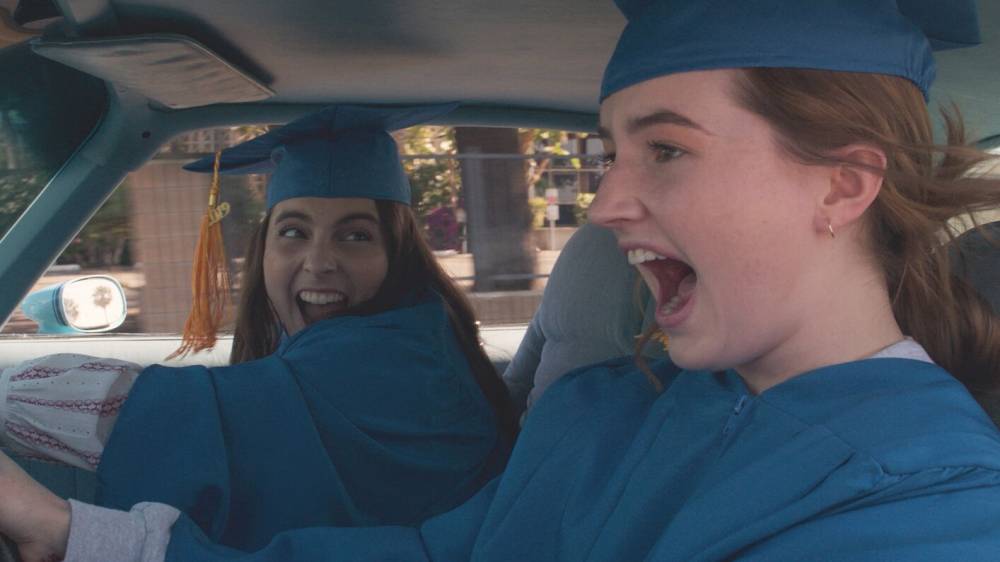
One of the most common questions posed by dumbasses on the Internet is: “In the modern “woke” age, can you even make a good comedy anymore?” My first response to this imaginary-yet-oh-so-real assh*le is, “Shut the f*ck up.” My second, more tempered response would be to watch Olivia Wilde’s directorial debut, Booksmart. While Booksmart isn’t quite the perfect comedy, it does demonstrate how comedy can evolve, tackle things in a newer, more mature light, and still maintain a raunchy edge to follow in the footsteps of its clear forefathers, American Pie and Superbad. In a tacky tagline that I already apologize for writing, it may be the first “woke” comedy of the modern era.
Molly (Beanie Feldstein) and Amy (Kaitlyn Dever) have been friends since kindergarten. Determined and passionate, the girls have spent their high school years forgoing the usual party scene and social gatherings in order to get into Ivy League schools, and mostly bond over their more party-centric classmates. However, Molly has a rude awakening when she realizes that the students she had looked down upon and condescended to all these years are also going to Ivy League schools – they just understood how to balance school and fun. With only one day left before graduation, Molly and Amy decide to have a wild night out at the craziest party of the year – and in doing so, find themselves on a Bloom-esque journey through the streets of L.A.
It’s both disingenuous and not wholly incorrect to compare this film to Superbad. You see, at their core, both Booksmart and Superbad tell the story of social outcasts determined to attend one party before graduation, find themselves dragged throughout town on a series of wacky misadventures, flirt with their crushes, get seriously drunk, and inevitably find their friendship tested but ultimately strengthened. However, there’s a difference in depth (and humor) that separate the two – if Superbad is Homer’s Odyssey, then Booksmart is Joyce’s Ulysses. For Booksmart only uses the formula as a jumping-off point, a way of critiquing themes and ideas about modern day society in a way its predecessors never did. One of the most interesting ways Booksmart subverts the expectations of the genre is the way it undercuts the “nerd” fallacy – the famous takedown in high school movies (and in real life) that serves as a dream cushion to fall back on in hard times. You see, no matter how many times the bookworms tell themselves “Our brain power will be more viable in the future, we’re the only ones who can escape this crummy town, one day all these fools will be working for me,” and so on, that’s just not the way of the world. The real world has become a popularity contest where intelligence is now frowned upon, and even if that weren’t the case, intelligence is just as viable in the jock world nowadays, and popularity and extracurriculars are just as important for padding resumes. Using this notion as a starting point for a teen comedy is not only realistic – it’s actually a pretty ingenious premise.
However, what’s perhaps the biggest accomplishment of Booksmart’s subversions is that it proves definitively that woke humor can be just as good (if not better) than your typical anti-PC comedies. Before you get all “Oh god, what is he talking about, that sounds boring” on me, allow me to explain. I’m not saying that Booksmart is some sort of trite, biteless romp that lacks personality or passion. What I’m saying is that Booksmart is a film that captures the modern era in its multifacetedness and branches out to capture a (perhaps idealized 2019). Dever’s Amy has already been openly gay for two years, preventing the need for an over-the-top coming out moment. Unlike American Pie or Superbad, no characters are called slurs – or worse, sexually harassed/assaulted. Gender-neutral bathrooms and modern sexual and political politics are presented as they should be – casual moments of passing dialogue, presented without overt political upfrontness or pandering attempts at brownie points. And most important of all, every character is treated with respect and kindness. No matter how many insults, curses, or comebacks these teenagers and adults hurl at each other, they are all presented as genuinely decent, likeable people. The douchey rich kids have adorable crushes and respect for their fellow students, the skaters and the jocks hang out in general harmony, the gay drama students use their flamboyancy as a personality, not a crutch (like Sean Hayes’ Jack McFarlane, the humor arises from their personalities, not their sexualities, avoid crass stereotypes), and more. Hell, even the characters portrayed by Will Forte and Lisa Kudrow subvert the expectations of such a comedy to receive humorously humanistic portrayals: as the religious parents of a gay daughter, one would expect a film like this to portray them as laughably dumb or unnecessarily cruel. But that isn’t the case – indeed, thanks to sharp writing and Forte and Kudrow’s portrayals, they create a pair of parents who love their daughter, support her sexuality, embrace their religion, and are just generally dorky because of their nature. It’s a decision that makes this film hyper-specific and fairly refreshing. This film shows audiences exactly what modern comedies with modern sensibilities can do: keep the raunch, lose the sketchy jokes, and allow the characters to fall in love and f*ck over Harry Potter houses as opposed to foreign exchange students and creepy uses of the Internet. What’s not to love?
Now, as for the filmmaking, I do have some thoughts. Most of the script works really well, thanks to the deliveries by the actors – especially Feldstein and Dever – but the film struggles to maintain the balance between strong jokes and strong dialogue. I mean, sure, there are tons of great lines and jokes that will generate true belly laughs – Jared, the rich loser of the school, has a license plate that proudly reads “F*KBOI,” and one of my favorite lines comes in an argument between Molly and Amy, where Molly counters Amy’s claim that they have fake IDs with, “We have fake college IDs, so we can get into the 24-hour library!” But while the jokes are routinely excellent, it’s the passing dialogue in between that tends to wane. The film struggles to move the plot from joke to joke, and it creates an uneven feeling that, say, The Breakfast Club, Eighth Grade, or the excellent Edge of Seventeen never had. This sense of unsure unevenness is also present from time to time in Wilde’s first attempt at direction, but I do want to give her credit: she takes so many risks and makes so many unique choices, her direction grows on you in a way you wouldn’t expect. Every time the editing feels a little too rushed, or a line doesn’t land the way she hopes it will, Wilde throws in an intelligent, insane sequence of visual flourishes, as a way to elevate the story above the flailing material. For every sequence that doesn’t work, there’s a fantastically over-the-top introduction to Jared and Gigi, “The 1 Percenters.” For every moment the editing feels a little too rushed, Wilde throws in a clever Claymation sequence. For every joke that falls flat, she’ll throw in a straight-up La La Land homage. And for every clichéd sequence that relies to heavily on tropes, there’s a stunning, surreal sequence shot like the swimming pool scene here. And even when you can see the punchline coming a mile away (for example, a sequence involving driving in a teacher’s car whilst a pornographic video plays “for research”), Wilde directs it so brilliantly you’ll still find yourself gasping and laughing. One of my favorite moments involves not only a spirited rendition of “You Oughta Know” by Dever, filled with angst and longing and heart, that is immediately followed by George the Gay Drama Student declaring, “Wow, she’s really good! Obviously she has no breath control, but she’s still pretty good.” And in the film’s emotional climax, Wilde chooses to cut out the sound, keeping the audience from witnessing a traumatic argument – it’s not the choice many directors would make here, and it makes the film better because of it. If Booksmart is good for anything, it’s proving that Wilde is a talented director with a bright future.
Booksmart’s other great strength is the talent of its performers. And while the veteran stars are clearly all great – your Forte and Kudrow, your Jason Sudeikis and Jessica Williams – this film clearly belongs to its young actors and actresses. Beanie Feldstein has been tearing up Hollywood since her breakthrough in Lady Bird, and she’s very clearly making a case that she is the next generation of Hollywood. Her Molly is a fiery, funny, lovable cross between Superbad’s Seth, Sixteen Candles’ Samantha, and Election’s Tracy Flick. Few actresses could have handled a role like Molly so perfectly. Meanwhile, Kaitlyn Dever proves once again that she may be the greatest foil in Hollywood – with a mix of lovability and sarcasm, she’s been playing off talents of all ages in Hollywood for a decade, including Brie Larson, Miles Teller, and Tim Allen (one could even argue she out-acts him). Here, she gets a true chance to shine, as well as to show some emotional range – and she’s great for it. Few teenagers get a chance to shine outside the main duo – Noah Galvin is great as George, Skyler Gisondo is both sweet and dorky as Jared, Victoria Ruesga is both sweet and wholly believable as skater Ryan, and Molly Gordon has a few zingers as “Triple A.” However, there are two performances I really want to talk about, because they damn near steal the movie. The first is but a cameo from classic underactor Mike O’Brien as Pat the Pizza Guy, who delivers every line with such panache he will stick with you long after the film (and a final reveal is pretty hysterical as well). However, if there’s one performance you’ll be talking about after seeing this movie, it’s Billie Lourd as Gigi. The way Sixteen Candles had Farmer Ted, Fast Times at Ridgemont High had Spicoli, American Pie had Stifler, and Superbad had McLovin, Booksmart has Gigi. Lourd steals the show every time she winds up onscreen – oftentimes magically appearing like a demented, but goodhearted, demon – and is so funny, delivering every line with such charisma, that were I to overthink it, I would make the case that I only like this movie because of Lourd. She’s that good, folks, and I can’t wait to see what she does next.
Booksmart is a fun little experiment in the high school comedy genre. It’s not necessarily groundbreaking in any way other than its choices not to break new ground, but it does offer audiences a chance to engage with a template they love: high schoolers gone wild. Now, whether you’ll like this movie or not is a challenging question. As is the case with Superbad, your mileage with it may vary. If you love this sort of raunchy comedy with a sweet heart, then this is the movie for you. If you’re not a fan, you probably won’t like it, although take solace in knowing it’s an improvement on the genre with several belly laughs. And if you’re in between, then know it’ll pass the time, but you’re probably not going to get much out of it. I doubt I’m going to be clamoring to see Booksmart again, but I’m glad it’s good, I had fun with it, and I hope it’s the start of an illustrious career for Olivia Wilde the director, as well as Beanie Feldstein, Kaitlyn Dever, and of course Billie Lourd.


Add Comment