
In theory, no film is more unnecessary in 2020 than a sequel to Borat. While the original film is one of the most incisive, exciting, hilarious satires in the history of Hollywood, Sacha Baron Cohen’s magnum opus about the underside of post-war America – both positive and negative – has been devolved by simpletons and rubes into a series of catchphrases – it’s a shame that a film that wished to expose the underlying racism of sexism of both right and left America has been reduced to its ironically sexist comment delivered in borderline racist accents. Given its newfound legacy – as well as its overwhelming popularity – Borat Subsequent Moviefilm is a film that should not exist. And yet, it does – and not only does it exist, but it also proves itself as just as necessary, timely, audacious, and hysterical as its predecessor – and maybe even moreso.
Fourteen years ago, Kazakh reporter Borat Sagdiyev (Baron Cohen) released a documentary about his “cultural learnings” of America. The film became an international hit…but made Kazakhstan a laughing stock. As punishment, Borat was sentenced to the gulags, while his producer Azamat was executed, skinned, and turned into a chair. However, Borat was recently freed, as his knowledge of America gave him a significant advantage for a top-secret mission: to find an in with the Trump Administration by offering Vice President Mike Pence a pet monkey in exchange for financial aid for Kazakhstan. Borat soon arrives in the United States, where he encounters two major roadblocks: first, he has trouble traveling anywhere due to his newfound celebrity. And second, his fifteen-year-old daughter Tutar (Maria Bakalova) has stowed away, and “accidentally” eaten the pet monkey for sustenance. Now short a bribe, and with limited time to redeem himself, Borat sets out on a road trip in a variety of disguises, through a global pandemic and a series of strange beliefs, to offer a new bribe to a member of the President’s inner circle: his daughter as their new child bride.
When Borat was released 14 years ago, it served a very important purpose in American culture. In the aftermath of 9/11, the spirit of togetherness convinced the culture at large not to criticize those who hold intolerant opinions towards the Other. After all, we’d just been attacked, we all needed to be on the same team. Through Borat, Baron Cohen satirized both the intolerance and the indifference that bred it – yes, it was horrible to hear a Southern rodeo owner talking openly about killing all the Muslims and homosexuals, but it is more disturbing that most Americans would willingly shrug such statements off (and, to a further extent, believe that someone from a third-world country would actually look and act like Borat). One would hope that, after seeing America through the eyes of a “foreigner,” we would have tried to reach the root of the problem, and come together to solve these issues. However, something funny happened that Baron Cohen could not have foreseen. When faced with their own bigotry, the people once treated with ridicule realized they had two options: apologize, or double down. If they were to apologize, they would have to begin the painful process of atonement. If they were to double down, they would have the opportunity to grift off their assh*lery for years, through television appearances and playing the victim. The opinions that once made you a nationwide laughing stock now gets you a speaking slot at a National Convention, and people just shrug at the notion of literal Nazis marching the streets of Virginia, Minnesota, Wisconsin, and Washington.
So with the entire concept of indifferent intolerance now shifted in the public eye, we must ask ourselves, “What role can Borat Sagdiyev possibly play in the national discourse?” Well, as it turns out, he can still show us a great deal. Where Borat set out to show Americans the things they may not have known about their country, Subsequent Moviefilm sets out to make sure people can’t ignore it. Want to plead ignorance to QAnon, even as supporters start to win Congressional races? Baron Cohen makes you confront their very real, very horrid beliefs. Don’t understand how the anti-mask “civil rights” activists draw a direct line to trying to kidnap the governor? We are drawn straight into such a protest, where Cohen gleefully leads them in chants to murder Democrats, Dr. Fauci, and journalists while crowd members Heil Hitler. I will admit I do have some sympathy for the individuals interacting with the “normal” Borat. Considering how iconic the character is, it’s hard to believe anyone would go along with the joke if there wasn’t some hope for clout and 15 minutes of fame from it. But even then, it’s one thing to go along with a famous character as he tricks you into searching porn or laughingly nod along as a famous character known for his misogyny makes misogynistic jokes. It’s another to “play along” by writing the Neo-Nazi slogan “Jews Will Not Replace Us” on a cake for someone. Borat Subsequent Moviefilm eliminates our ability to plead ignorance, rubbing our noses in the aspects of society we either undercut or ignore entirely.
Of course, the fun of Baron Cohen’s films is less the “gotcha” moment as much as it is how he gets them. After all, we already know he’s going to confront Roy Moore over his pedophilia on his show, or rub the South’s homophobia in their faces in Bruno. The fun is watching him conjure up a “pedo detector,” or turn a wrestling match into a softcore romantic scene in front of frothing fans. And thankfully, it is clear that Baron Cohen hasn’t lost his touch. His awful, bawdy sense of satiric humor is still fully intact, whether he’s crafting a throwaway joke (there’s a killer Justin Trudeau bit in the first five minutes of the film) or railing against the toxicity of influencer culture. Cohen and Bakalova put together a string of incredible bits, from slowly coaxing a Southern Baptist reverend into admitting he’s not morally opposed to incest to a terrific moment involving the strange tradition of debutante culture. I’m not sure what’s better, Cohen and Bakalova catching the older Southern “gentlemen” who most likely railed against Cuties openly hitting on a supposed 15-year-old, or the terrific dance the duo performs that takes shock value to the next level.
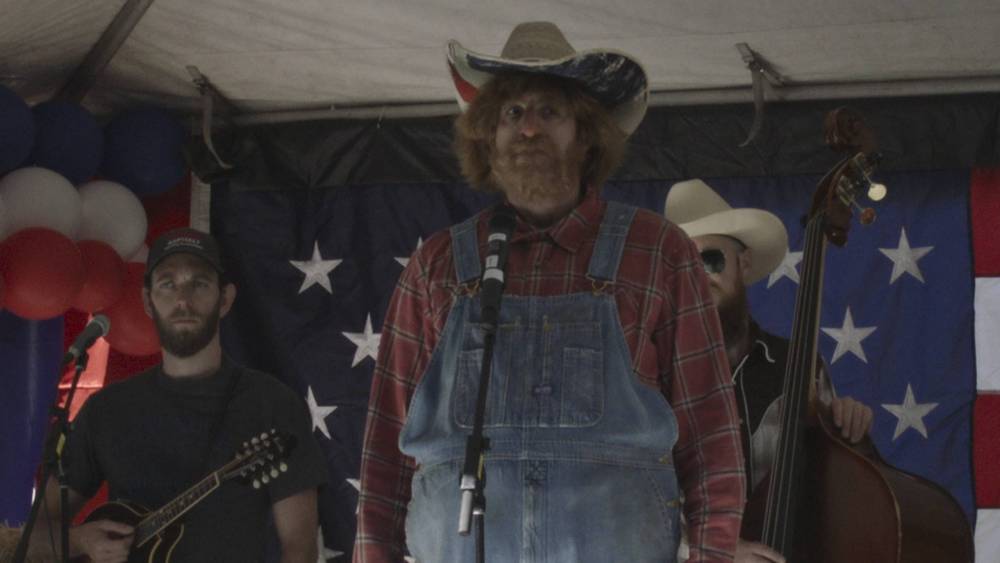
In fact, half the fun is watching just how far he’ll go for the bit. His now-infamous sing-along at an alt-right Nazi rally is one of the funniest moments of the year (partially because the heinous song is ridiculously catchy). In the most audacious moment in the film, Baron Cohen lives with two gun-toting QAnon conspiracy theorists undercover for an entire week. I don’t know what’s more shocking – his ability to stay in character and get them to say things on camera, or the strange pathos he finds in two men willing to take a foreigner off the street during a pandemic who have clearly been brainwashed by Facebook rabbit holes (Cohen’s ultimate target, and bitter archenemy). And of course, there’s the much talked-about scene involving President Trump’s personal attorney, Rudy Giuliani. There are so many questions involving this scene, and I’m already walking a thin line between not wanting to spoil it and realizing that it is more than likely everyone knows all about it by now (although his last month, from the Four Seasons to his appearance at the Michigan Senate, has sort of put the whole thing on the back burner), but I’ll say this: the first question that should be asked is how did the filmmakers even get this interview in the first place? Why did Giuliani not realize something was amiss much sooner than he did? Where was his common sense to stop him from doing the things on camera that he very clearly does (although he does so in a way that provides plausible deniability)? And what world are we living in that this was no longer the top story the day it came out? Cohen has crafted some terrific bouts of comedy, and thanks to a game partner in Bakalova, they make for some of the most memorable moments of the year.
Now, Borat films have always been underpinned with a sense of optimism, in spite of all its crass uncovering of humanity’s most horrific traits. And Subsequent Moviefilm carries on this tradition beautifully. This of course refers to the film’s overarching plot about a father-daughter road trip, which subtly suggests a metaphor for an outdated father learning the horrors of the modern world that his daughter has to navigate firsthand. But I also refer to the random individuals that Borat and Tutar encounter, who may suffer at the hands of the filmmakers and yet emerge with their dignity and humanity not only intact, but amplified as well. Some of the best moments of the film involve Borat’s interactions with normal, goodhearted people, not only because there are no stakes, but because the simple bemusement of the participants fills us with hope about our future. After all, look at cell phone salesman Brian Patrick Snyder and the man who ran the fax store – they ask no questions, despite the extremely vulgar (but admittedly funny) scenarios Cohen puts them through, and still warmly receive Borat despite his clear intentions of messing with them. And enough words cannot be said about True American Heroes Jeanise Jones and Judith Dim Evans. Jones’ no-nonsense tough love and inspirational words for the young Tutar emerge as a warm, hopeful moment in an otherwise bleak film, but it’s Evans who will make you cry, welcoming the antisemitic Borat into a synagogue with open arms while telling him the story of her survival of the Holocaust. In a day and age where it seems all humans are terrible and there’s no hope for civilization, Jones and Evans stand as a beacon to all of how we can and should live our lives.
None of these bits, jokes, or plots work, of course, without the magnetic talent of Sacha Baron Cohen and first-time performer Maria Bakalova. Baron Cohen is, as always, a pure joy as Borat, both thanks to his commitment to the character and to his natural ability to improvise. Half the fun of the film is watching what he’ll say next, never missing a beat whether he’s up against an average Joe or a seasoned politician. However, it’s impossible to pretend otherwise: the real star here is Maria Bakalova. Bakalova’s Tutar simply is the film, and I don’t think it’s fully grasped how capable she is of improvising both on her own and against Cohen’s Borat at the age of 25. Even with the original Borat, it was a character Cohen had crafted for over a decade. Bakalova commits herself to every bit, whether she’s graphically describing her body to a room full of older women, performing a “moon dance” at a debutante ball, or transforming into a Tomi Lahren-esque figure to score interviews with both Trumps and the aforementioned Giuliani. It says a lot about her performance that Cohen breaks for perhaps the only time in his entire career during a moment where they dance together – not only does he let out an uncontrollable chuckle, but the look of sheer joy and respect he has for her and her talent is unmaskable. In fact, my only complaint about the film’s cast is the absence of Luenell, an irreplaceable part of the original film’s ensemble. Oh well, c’est la vie.
Borat Subsequent Moviefilm is a triumph, both because of what it says and what it accomplishes. It’s a film that should not exist, and yet exists beautifully and brilliantly. It also manages to comment on today’s climate in a way few films have successfully done. It’s a film that will make you laugh, then make you think, then make you laugh some more. Going into Borat Subsequent Moviefilm, I couldn’t imagine the possibility of an enjoyable Borat 2. Now, I can’t imagine a world without it.
A-
Borat Subsequent Moviefilm is now streaming on Amazon Prime


Add Comment