
While technically a reboot of the South Korean satirical horror Save the Green Planet, Bugonia feels like the film Yorgos Lanthimos has wanted to make his entire career. From his earlier, bleaker works in Dogtooth and The Lobster to his broader, yet more incisive breakthrough works like The Favourite and Poor Things, Lanthimos’ throughline has involved blending violence, psychological thrills, and comedy to dive deep into that which makes us human – for better or for worse. Bugonia is both an indictment of where the human race has ended up, and every possible way in which it is broken. Yet more importantly, even underneath its weighty subject, it functions as a spellbinding psychological thriller, headlined by three perfect performances.
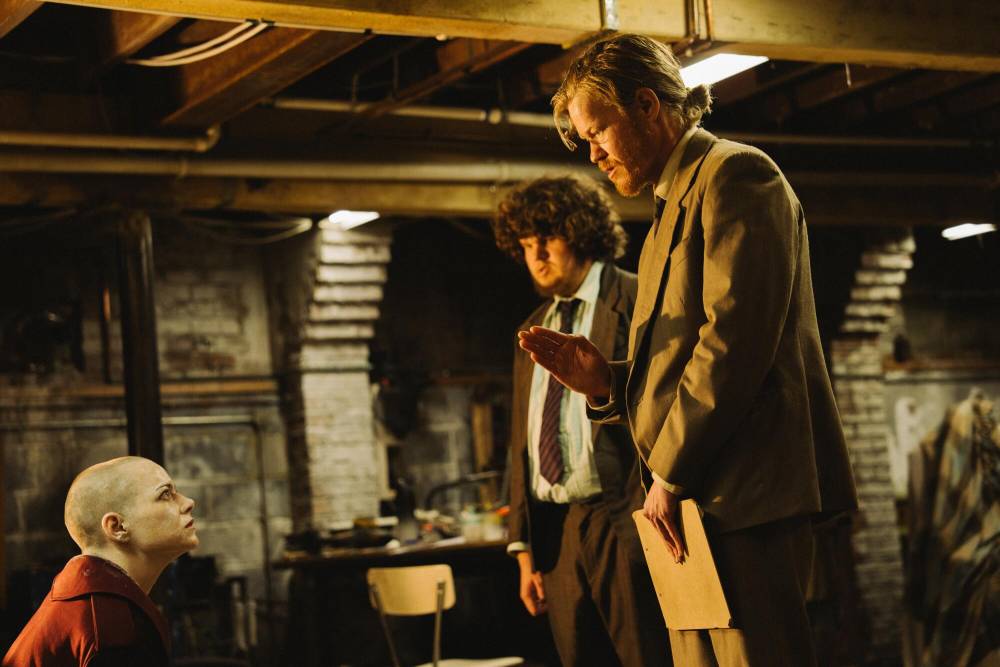
Teddy Gatz (Jesse Plemons) has seen the light. After watching his small Georgia town crumble around him and his beloved bee colonies slowly die, he has come to a terrifying conclusion: that aliens are among us, and are preparing for their final takeover of the human race. Alongside his cousin Don (Aidan Delbis), the pair launches a last-ditch effort to save humanity: kidnapping pharmaceutical CEO Michelle Fuller (Emma Stone), whom Teddy is convinced is secretly the alien queen. Despite Michelle’s protestations that she is, in fact, not an alien, the trio embarks on a psychological game of torment – one that will tackle issues including class, abuse, radicalization, and beyond.
Part of the success of Bugonia lies in its straightforward, engaging story. Similar to Hitchcock’s ability to explore human nature and weighty subjects inside simple thrillers, Will Tracy’s adaptation works even stripped of its larger themes and metaphors. At its core, this is an acerbic, twisted, straightforward story about a fight for survival against broken people, in which no person is innocent and everyone has hidden motives. In fact, the film arguably works best when it’s not focusing on the World of Now, and instead on these three humans and their interactions, a microcosm of humanity’s ability to hurt each other, whether have or have not.
Yet Bugonia is not just a mere thriller. It is a parable, tackling a litany of thorny subjects in a simple fable. One could argue that the central conflict is a battle between rising hot-button issues: the She-EO whose motto is “gaslight, gatekeep, girlboss” (she preaches a “new regime” while using corporate speak to deliver the same exploitative outcomes) against the Reddit conspiracy theorists. Yet unlike so many films that would resort to cookie cutter stereotypes, Tracy’s characters have personalized idiosyncrasies and ideologies. Much as real-life assassins and domestic terrorists rarely fit neatly into any one category, all three characters are made up of a messy assortment of beliefs: incel, late-stage capitalism, faux feminism, QAnon, antivaxxers, anti-billionaire ideology, and so on.
Lanthimos uses talking points that would, in a lesser film, make up the entire character to instead explore the nuances of humanity, and what drives people to hurt others. Is it the inherent evil within humanity, destined to destroy itself? Or is it the f*cked up nature of the world around us. After all, all our star players have troubled backstories, filled with personal grudges, traumatic childhoods, and beyond. It is designed to test us, to see if we are able to empathize with these flawed characters, and inherently our fellow humans at large. It is difficult to do. Hell, one could argue he himself barely wants to. But it is the central crux of the film, and an interesting, introspective journey itself.
It’s worth noting that Lanthimos’ cinematic eye makes Bugonia pop in completely surprising ways. For starters, I’m not sure I’ve ever seen VistaVision – the lush film stock that brought musicals and epics to life in the 50s – look evil before, yet its beauty inexplicably emphasizes the innate horror of the story. Meanwhile, everything about the musical choices, from the unsettlingly ethereal score to two distinct musical choices – one being Green Day’s “Basket Case,” the other being Marlene Dietrich’s cover of “Where Have All The Flowers Gone?” – matches the film’s off-kilter energy: equal parts unsettling and hysterical. It’s the textbook definition of strong, story-driven filmmaking.
The film benefits from its three leads all bringing their A-game. Emma Stone in particular is fascinating here, as every sequence must be presented as a question mark while still representing a full-fleshed character. Is she a desperate victim trying to survive? A sociopath looking to psychologically torture her own captors? Or is she, in fact, an alien? Plemons, meanwhile, is great as always, balancing the absurdity of the character with not only a broken inner child, but also an underlying menace. Newcomer Aidan Delbis is perhaps the film’s only redeeming character, swept up in his cousin’s schemes yet with a pure heart. And it’s worth noting that podcaster Stavros Halkias shows up in a small, strange role as layered as it is unsettling.
Bugonia manages to pull off the Hitchcockian feat of using an entertaining, sharply taut story to explore deeper themes of humanity. It may not be the best of Lanthimos’ recent entries, but it certainly demonstrates why he’s a modern day master. This is a film exploring humanity at its worst, through engaging setpieces and pointed conversations, reminding us the ways that great art can makes us feel, for better or worse. Bugonia is a film of the now, serving less as a warning of where we’re headed as a society so much as where we already are, and forcing audiences to grapple with where they’re allegiances lie. It’s a film worth seeing multiple times, and I can’t wait to revisit and see how my interpretation changes.
B+
Bugonia is now streaming on Peacock


Add Comment