
The goal of cinema is to elicit human emotions. While this can certainly mean “to educate, or elicit sadness,” so often the best films move us towards the entire spectrum of experience: laughter, love, sex, anger, ambition and madness. These are emotions that Luca Guadagnino has always excelled at capturing in his films, and that is particularly the case with Challengers. Released earlier this year, few films have stood out quite like Gudagnino’s sexy, thrilling tennis love triangle, expertly crafted from the top down.
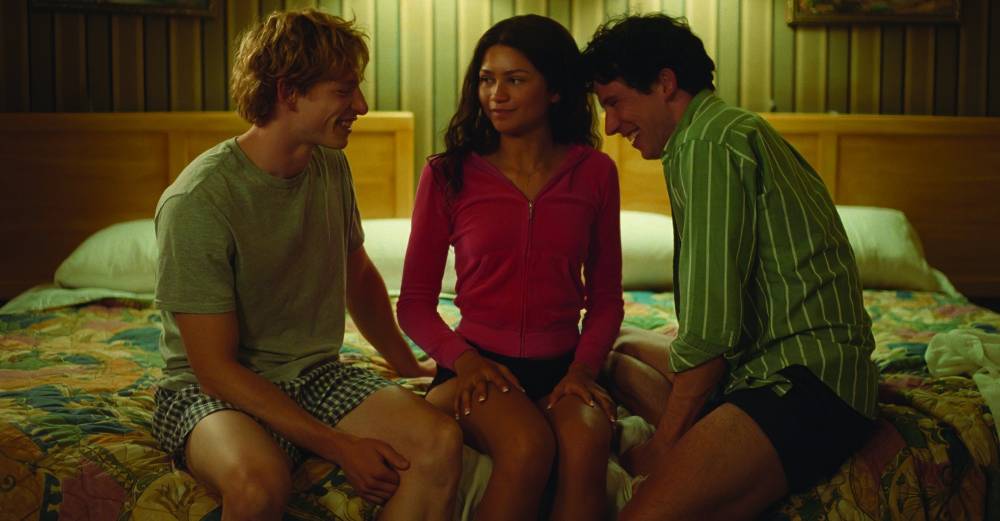
Years ago, Tashi Duncan (Zendaya) was the hottest tennis star on the planet. At 18, she was already expected to become one of the greats. While at the U.S. Open, she meets Junior Doubles Champions and best friends Patrick Zweig (Josh O’Connor) and Art Donaldson (Mike Faist), who instantly fall in love with her. Initially, Tash picks the more talented and cocky Patrick. However, after a bitter argument and a tragic accident, Tashi’s career ends in an abrupt fashion, Patrick is cut from both their lives, and ultimately Tashi marries Art and becomes his coach.
In the present day, Art is one of the biggest names in all of tennis, with Tashi by his side. However, with his heart not in the game, and still unable to win the U.S. Open and earn his Grand Slam, Tashi forces Art to enter the New Rochelle Challenger to boost his confidence with an easy win. However, things become complicated when Patrick, still struggling to find success and living out of his car, also qualifies, setting the former friends on a collision course on the court.
There’s an inherent central metaphor that drives Challengers: the contradictory intersection of love, passion, and determination. This is a story about three people who share a common passion – tennis – and the ways in which their emotional conflicts and own determination both draws them together and pushes them apart. As Tashi explains after meeting the best friends, “tennis is the only way to really know someone.” It is, to her, a universal language that reveals the soul, more intimate than sex, and it consumes everything. It’s what destroys her relationship with Patrick, and it’s why she never fully connects with Art.
This is the world of those wholly invested in their passion. Whether it’s art, sports, politics, etc., Guadagnino is exploring the world of those who can only relate through their own blood, sweat, and tears. In many ways, this is the comedy/romantic version of Whiplash: people who let their personal lives become consumed by the artistry of their craft. And honestly, Guadagnino brings this to life. With Reznor and Ross’ techno-infused score (the music of the club, of dance, of life itself) and Sayombhu Mukdeeprom’s next-level cinematography (the camera BECOMES the ball!), he helps understand why people would love this world, and why our characters love it.
Yet it’s not the ways Guadagnino explores these themes that makes Challengers so exhilarating. No, it’s the ways that he and screenwriter Justin Kuritzkes explore the characters, and their messy interpersonal dramas. These are characters who all love and lust after each other, and every decision (good or bad) grows out of that “three-pointed love triangle,” as the film’s marketing dubbed it. These are two best friends who love each other deeply, are shown finishing sentences and anticipating each other’s needs, ultimately driven apart by their dream woman. Tashi, meanwhile, finds herself drawn between the two: Art provides the stability that she needs to balance out her passions, while Patrick demonstrates the raw ambition and sensuality she desires.
Watching their back-and-forth is electrifying, as the characters make terrible mistakes, and betray each other, and let their hormones cloud their judgment. And yet, it is hard to fault any of them. You get why they make the decisions that they do, even as they infuriate you. You understand Tashi’s frustrations with both men that she loves, why Art is willing to betray his oldest friend to woo his crush, and why both Tashi and Art constantly find themselves drawn to Patrick’s raw sensuality. It all culminates in a tennis match whose build-up remains the funniest moment of the year, before giving way to the year’s greatest climax. It is…movie magic.
All of this works because the three leads so perfectly command the screen. Zendaya gives her most mature, intelligent performance to date, as a woman in command of herself physically, mentally, and sexually, yet incapable of controlling herself around the two men who love her. Faist, meanwhile, is impeccable as Art. He’s the least confident of the two, and he portrays himself as appropriately in the shadow of first his best friend, then ultimately his wife, yet he finds ways to let his inner workings shine through. And then there’s O’Connor, who gives the best performance in the film as the raw, uncontrollable Patrick. Every line, every look, every motion oozes confidence, passion, sexuality, and yet with a vulnerability behind the eyes. It is a masterful performance in a film full of them.
Challengers demonstrates the zenith of what films can be. It is visually and audibly a bombastic embodiment of the senses, a call to yearn, and lust, and cheer, and feel. Every detail milked on the screen is designed to elicit an emotion, from the score to the camerawork to the editing to the performances. Is it a little long in the tooth, with too much slow-mo? Perhaps. But a truly great film isn’t perfect – it merely invests you enough to distract you from the flaws, like a magic trick. And Challengers is, indeed, a magic trick of a film.
A
Challengers is now streaming on Amazon Prime


Add Comment