
I’m not going to sugarcoat things: 2021 has been an overall pretty dismal year in many regards. This proclamation extends to art, as I can count the number of films I’ve loved this year on one hand. When a year feels this overbearingly abysmal, it makes the truly astounding films stand out all the more. Thus is the case with Coda, the award-winning film from the Sundance Film Festival that I sadly did not get a chance to see back in February. Perhaps it was fate that I saw it now, because it not only allowed Sian Heder’s film to stand out like a firecracker; it made it feel like the breath of fresh air to save 2021 as a whole.
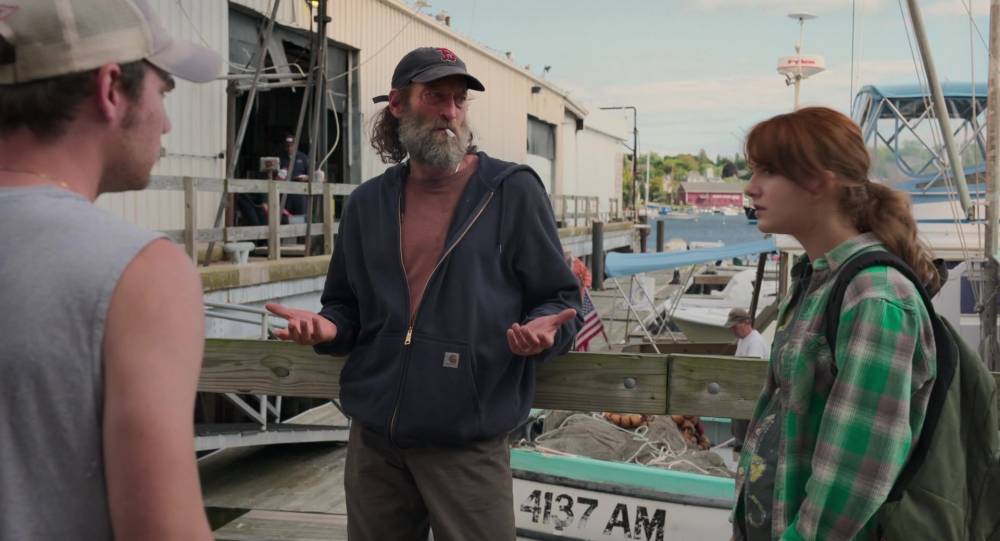
Ruby Rossi (Emilia Jones) lives a tough existence, although she’d never let it show. She’s the sole hearing member of a family of deaf fishermen, including father Frank (Troy Kotsur), mother Jackie (Marlee Matlin), and brother Leo (Daniel Durant), so she is required to translate for her strange, but loving family as they haggle with fishmongers, operate their boat, and traverse daily life. However, things change as Ruby, in an effort to win the affections of her cute classmate Miles (Ferdia Walsh-Peelo), joins her school’s choir, run by pompous Berklee alum Bernardo Villalobos (Eugenio Derbez). And despite his gruff exterior, Mr. Villalobos makes an important discovery: turns out, Ruby’s an excellent singer. This comes as a shock to her family, who obviously have never had much need for music. And this puts Ruby at an important pinnacle at the crossroads of her life: will she pursue music and finally escape her small Massachusetts town? Or will she choose to stay with her family, who recently started their own fishing company, and have been ordered by the government to have a hearing individual on deck at all times?
Coda works for the same reason all feel-good films work: it is an original twist on a well-worn formula. The key to tugging on heartstrings is not the universality; it’s the specificity. The more honest and personal a story, the smarter and more relatable it becomes. Coda is the typical story about a young person in a tight-knit family about to leave the nest for the first time, but the twist here is the way Ruby connects and interacts with her family. Whereas the typical story would involve the parent’s fear over an artistic field, or, in the case of disability, that their child would be viewed as different, Coda flips the formula on its head by making the parents the deaf individuals. This opens up a whole new world of possibilities.
It makes Jackie’s dismissal of her daughter’s singing stem from a belief that it’s an act of rebellion. After all, why else would a child from a house of deaf individuals want to sing anyway? But it’s deeper than that – it’s a fear of losing her daughter to the unknown, to an art she will always be ostracized from. It’s why Ruby’s family relies on guilt to keep her trapped – not because the family can’t survive without her, but that they don’t want to survive without her, due to their tight-knit bond. As I said, all stuff we’ve technically seen before, told in a new and exciting way.
What also helps the film’s unique take stand out is the treatment of deaf individuals. Coda is unique in the way that deafness is a part of the film, and yet not its focal point – or at least, it is not focused on their “suffering.” Too often films like this can devolve into suffering porn, where the characters are miserable and suicidal because of their affliction. Here, while being deaf doesn’t make their lives particularly easy, it is never treated as a handicap. The family’s biggest struggles are what happens when their daughter goes away to college, and how they fight back against Big Business taking advantage of their small fishing company and government regulations put in place to protect the corporations. The only time their deafness becomes a real issue is when they face hefty fines is Ruby goes away to college. There’s no bullying for being deaf, no mockery, no self-loathing and pity.
In fact, the only person with a sense of bigotry, hilariously, is Jackie – as an act of self-preservation, she cuts off ties with hearing individuals before they have the chance to be cruel to her, which, when coupled with her own stuck-up ways, creates some hilarious and fun interactions. It is this warmth – not to mention the casting of actual deaf actors – that warmed me that much faster to this film than, say Sound of Metal. Both films touch on the realities of being deaf, utilize a great deal of sign language, and try to capture a warmth the hearing world often can’t see. But whereas Sound of Metal was interested only in the cliches of the deaf drama – the woe-is-me weepiness of the ordeal – Coda is interested in finding the universality within the cliches, delivering a warmer, brighter story. In short, by being more ordinary, Coda becomes all the more extraordinary.
The film is elevated throughout by Heder’s funny, lived-in script, which highlights the humor and intelligence present in each and every character. Heder fills her screenplay with individuality, crafting jokes out of these characters and their interactions. There’s the parents’ general horniness and love for each other, revealed from the jump and reoccurring more than once. The family’s unique relationship is introduced through sign-language insult fights that tell us who these characters are, what their sense of humor is like, and how much they love each other. There’s the sassy teacher with a heart of gold who is obviously here to earn some laughs, and yet earns them through minor touches (quietly taking instruments away from tone-deaf students during rehearsals) as opposed to hamming it up. Even the obvious moments, like a misunderstanding involving the sign language expression “Nice to meet you” and a much more vulgar alternative, still feel fresh and cute.
But what’s really present in this script is a living, beating heart. Heder uses each and every moment as a source of characterization, never treating these characters’ emotions as a joke even as they’re earning laughs. There’s a scene where hot-headed brother Leo tries to have a drink with the local fishermen, but because he cannot integrate with their spoken banter, he decides to get into a fight – because it’s the one universal language they all understand. Ruby, meanwhile, shows her hand even when she doesn’t realize it. When asked to describe how it feels to sing, she can only answer in sign language. Even with the ability to speak, and the greater ability to sing, this is still her truest form of communication – as different as she may be, her family is still a major part of who she is. And in one of the film’s most powerful moments, Frank sits underneath the stars and has his daughter sing just for him while he feels her vocal chords and picks up on the vibrations. It’s a sweet, beautiful moment that will hit you right in the gut just as easily as the rest of the film can make you laugh.
I’d be remiss if I didn’t take a moment to praise Heder’s direction as well, because it is every bit as impressive as the writing or the acting. Heder possesses a light touch throughout, whether it’s working with cinematographer Paula Huidobro to stage a gorgeous shot of the ocean and the night sky, or through a hilarious bit of juxtaposition at Berklee between an ill-prepared Ruby (training in modern voice) against a sea of overdressed opera singers. But what’s most impressive is the sound design. While not as innovative or as memorable as Sound of Metal’s Oscar-winning sound work, Heder still pulls out some neat tricks to drive her point home. Sounds are amplified at the Rossi home to show the effect being the only hearing person in a house full of deaf people has on Ruby.
And during one crucial sequence, when Ruby delivers her first big solo at the school concert set to “You’re All I Need To Get By,” the sound cuts out completely, demonstrating what her family will always lose out on because of their condition. Like the Rossis, we can only understand the impact through context clues – fellow audience members swaying, crying, etc. Oh, and speaking of “You’re All I Need To Get By,” the film’s musical choices are inspired – consisting of Marvin Gaye and Etta James and beyond. It all climaxes with Joni Mitchell’s “Both Sides Now,” and as you can imagine, it is an emotionally cathartic experience. You can bet your ass I cried.
Beyond the great script and filmmaking, Coda works because of its remarkable ensemble. Emilia Jones is a charismatic, exciting lead. Every beat, saying, song, and emotion feels natural and earned, as opposed to dictated by a script. It also helps that the rising star isn’t just a great actress – she’s also got a helluva voice. I don’t think it needs repeating that Marlee Matlin, the youngest Best Actress winner of all time and who once outshone a cast of legendary thespians in The West Wing, is terrific as the feisty, complicated matriarch of the Rossi family. Daniel Durant is doing some remarkable work with the least-flashy role of the bunch – his tough older brother struggling to prove himself to his family has a few terrific scenes, both comedically and emotionally. But for me, the real stand-out of the bunch is Kotsur. Kotsur not only has this distinctive, emotive face that draws your attention in each and every scene, but he’s got this wealth of emotion and dad energy that will make you laugh and break your heart over and over again.
As for the rest of the cast, Eugenio Derbez is hilarious as the over-the-top music teacher. It easily could have been a cliched, fussy role (as he’s given us before in Overboard and Dora and the Lost City of Gold), but Derbez dials his energy back to a 7, opting for sarcasm and heart over outbursts and scenery chewing. As Ruby’s best friend, Amy Forsyth has the same charming energy as Olivia Thirlby in Juno all those years ago. I loved her arc and her delivery of some hilariously vulgar lines – she speaks and acts like a real teenager, despite being six years Jones’ senior. And as the cute dipsh*t love interest, I couldn’t get enough of Sing Street’s Ferdia Walsh-Peelo. Walsh-Peelo is so good at playing an idiot high school boy in his naivete and earnestness.
There’s one moment in particular of his that I keep coming back to in its brilliance: after a fight with Ruby over an unintentionally horrible decision, Walsh-Peelo’s Miles dramatically declares “I will text you every three minutes until you talk to me!” When it is pointed out that this logic is “psychotic,” his entire body deflates as he replies, “Then…I will NOT do that.” It is such a real teenage thing to say, and that reaction is exactly how a teenage boy would reply. It is a cherry on top of a good performance in a film of good performances.
Coda is, for lack of a better word, impeccable. It’s the type of feel-good family story that made Billy Elliot and Sing Street hits all those years ago. I’m a simple man to please: give me a well-told story with great jokes and great characters played by great actors, and I’ll go with you anywhere. The fact it is such an important stride in deaf representation barely registers; you can strip this movie down to its core components and it still works just as well. This is the type of film I love, and the type the world needs right now. And I’m so glad it exists; I can’t wait to watch it again and again and again.
A
Coda is now streaming on Apple TV+ and showing in select theaters. Give it a watch after you finish Ted Lasso


Add Comment