
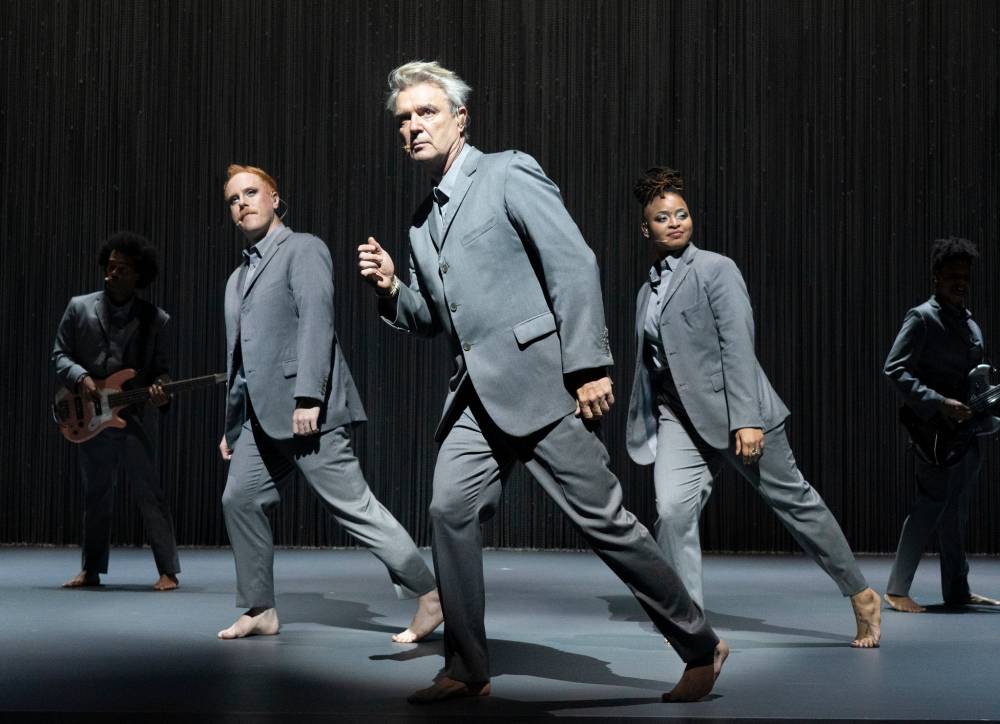
I’m not sure it’s exactly fair for me to review David Byrne’s American Utopia. The Talking Heads are one of my favorite bands (maybe my favorite band outright), Byrne one of my favorite stage presences, Stop Making Sense one of my favorite documentaries, and Spike Lee one of my favorite filmmakers. So combining all of these factors together, on Broadway, for an album I’ve already called one of the Best of 2018 (and potentially the decade), is something of a perfect storm of trigger words for my body’s stores of serotonin. But even if I wasn’t coming into this show as a member of the choir Byrne wishes to preach to, I still believe I would give this film the rave it deserves. Byrne and Lee have combined the visual wonder and musical audacity of Stop Making Sense with a charismatic plea for humanity, and it serves as a positive, intellectually stimulating celebration of the human spirit in a world that seems shrouded in chaos.
The basic premise of the show, which functions as a cross between concert and theatrical presentation, is relatively simple: David Byrne has stripped a stage down to its bare essentials and created a blend between a Ted Talk and a Best-Of. Throughout the show, Bryne shares his musings on his career work, observations on the state of the world (which only became more chaotic after filming, thanks to Covid-19, conspiracy theorists, and a Presidential Election cycle that featured two migraine-inducing debates and a never-ending post-election cycle), and his ultimate faith in humanity evolving and improving. These thoughts lead into a series of songs, both old and new, that help put his views into melodic form, and which create a vision for Byrne’s dream for the world – a loving, artistic utopia. While the opening 15-minute “prologue” mostly features Byrne alone on an empty stage, he slowly finds himself joined by his performers and bandmates, including two background singer/dancers portrayed by Tendayi Kuumba and Chris Giarmo, and eventually a full orchestra playing handheld, cordless instruments.
To describe a philosophy as “childlike” is typically considered a condescending insult, implying a false sense of idealism. Yet not only is it accurate to describe Byrne’s moral beliefs here to be “childlike,” it is inherently a net positive. Byrne, who at 68 still maintains a wonder over the little things in life (he attributes his fascinations and descriptions for little details that excite him to his Asperger’s diagnosis), spends the show operating with the innocence of a child, shaking his too-long hair while singing Dada words and inviting us all to join him in a dream for a world powered by love, wonder, and human connection. To paraphrase one of Byrne’s descriptions, to watch the show is to witness “An anthropologist from Mars learning about the beauty of the world, the warmth of connection and the joy of music.” American Utopia functions as a jubilant party celebrating life, human accomplishment, and music, inviting the audience to join that journey. The show shifts effortlessly from songs off the Utopia album, like “I Dance Like This” and “Every Day Is A Miracle” to older songs that relate to Byrne’s overarching morals on society, politics, and life itself, like deep cuts “Don’t You Worry About The Government” and “I Zimbra” as well as obvious choices like “Once In A Lifetime.”
Of course, while the show is inherently uplifting and optimistic in nature, Byrne is ultimately a realist, and isn’t afraid to thrust himself into political debates. There is a fine line between optimism and naiveté – a difference any Talking Heads fan would know by looking at the full title for “This Must Be The Place.” And Byrne isn’t afraid to contextualize his greatest hits with the realities of their political messages, regardless of the listener’s desire to just “have a good time.” After all, “Life During Wartime” (not featured here) is about being a refugee, “Once In A Lifetime” is a condemnation of yuppie culture during the Reagan years, and, as explained by Byrne during the presentation here, “I Zimbra” is inspired by the Dadaist movement, which was itself inspired by an economic depression and the rise of nationalism – both fears and clouds that hang over the world today. He reflects on his own failures and shortcomings, pointing out that he was incapable of understanding “Everybody’s Coming To My House” as an uplifting political ballad due to his own struggle to see oversocialization as a positive thing, instead directing viewers to this Detroit high school’s performance as an alternative.
And in the film’s most exciting performance, Byrne takes a bold stance in support of Black Lives Matter a full two years before it became politically popular to do so. He challenges his audience with a performance of Janelle Monáe’s “Hell You Talmbout,” which centers the names of those killed by police brutality and racial discrimination in the last two decades – the names George Floyd, Breona Taylor, and Ahmaud Arbry aren’t even mentioned because the already-four-minute song was written and performed before the events of this past summer. What ultimately prevents Byrne from ending up in the same category as, say, Demi Lovato or Eminem (“AWFUL HOT COFFEE POT”), is that Byrne looks not towards blame, but towards solutions. Chalk it up to that childlike wonder, but what’s so refreshing and vital about Byrne’s stances is his ultimate desire not to focus on “this one man is bad,” but instead confronting systemic issues that must (and can) be fixed, and doing so by confronting the underlying uncomfortableness. Empathy is American Utopia’s greatest weapon – after all, the neurological factoid that “[what] people like looking at most is other humans” is the entire reason for the show’s barren stage and proclamations that “Every Day Is A Miracle.” Utopia weaponizes empathy and fights hate with love and creativity without debasing its creators in the process.
Tying the production together is the electrifying direction of Spike Lee, an unlikely but ingenious partner for Byrne’s vision. While the two are artistically different animals (Byrne is more an abstract scientist while Lee is a fiery preacher), their creative sensibilities here complement each other perfectly. Lee directs this production impeccably, paying tribute to the groundwork laid out by the late Jonathan Demme while utilizing his own kinetic energy to place the viewer front and center. Lee understands Byrne’s desire to allow for the performers’ freedom, and matches this freedom in each cut and camera angle. You never know where on the stage you’ll end up next, whether witnessing a dramatic turn during “Burning Down The House” from behind or following the band into the audience as they enter the crowd playing “Road To Nowhere.” Lee also embraces Byrne’s desire to place emphasis on the other performers, allowing the camera – and thus the audience – to form connections to Kuumba, Giarmo, and the rest of the international ensemble (my personal favorite is the charismatic guitarist Angie Swan). And I can’t say enough about the sound mixing, which captures the beauty of the melodies, whether in a tech-heavy piece like “I Dance Like This” and “Lifetime” or on an acapella piece like “One Fine Day.”
But the smartest decision here is the incorporation of the audience. Obviously the crowd makes for an important piece of the show’s tapestry – not only do they laugh at (most of) Byrne’s jokes, but they know these jams. You’ll feel less guilty clapping when the opening notes of “Burning Down The House” kick in when you see the audience do the same thing. But what’s more important is the way Lee and Byrne critique the crowd. They are both fully aware that The Talking Heads’ core demographic – and this show’s main audience – are affluent white liberals, who profess progressive politics while still feeling uncomfortable with their own culpability in societal issues like Black Lives Matter. By making them a part of the emotional response and call-out of, say, “Hell You Talmbout” (into which Lee crushingly incorporates a slideshow of portraits of the deceased’s families holding their loved ones’ pictures), Lee and Byrne point out the necessity for the audience to not just listen to these words and songs, but understand and act upon them. Otherwise, all meaning is lost. American Utopia is another feather in the cap of Lee’s oeuvre.
I’m sure by now my attempts at justifying my love for this documentary and this music with pseudo-intellectual jargon has put you to sleep, so allow me to make this clear: American Utopia is a warm, joyful party. Yes, it will make you think, and yes, it will challenge you to make your world a better place. But it is ultimately a charismatic, exciting, smile-inducing party that you desperately want to be a part of. I used American Utopia as my escape from the election the other week (unfortunately it dragged on for a week, so I was only able to spare myself a few hours of coverage), and it was the perfect choice. I got to relax in my living room for an hour and forty minutes, curl up under a blanket, and listen to David Byrne’s exhilarating music tell me that everything was going to be alright. Whether you’re a fan of The Talking Heads, Broadway, or philosophy, American Utopia will grant you peace of mind. And ultimately, that’s all we can hope for in this life.
A
David Byrne: American Utopia is now streaming on HBO Max


Add Comment