
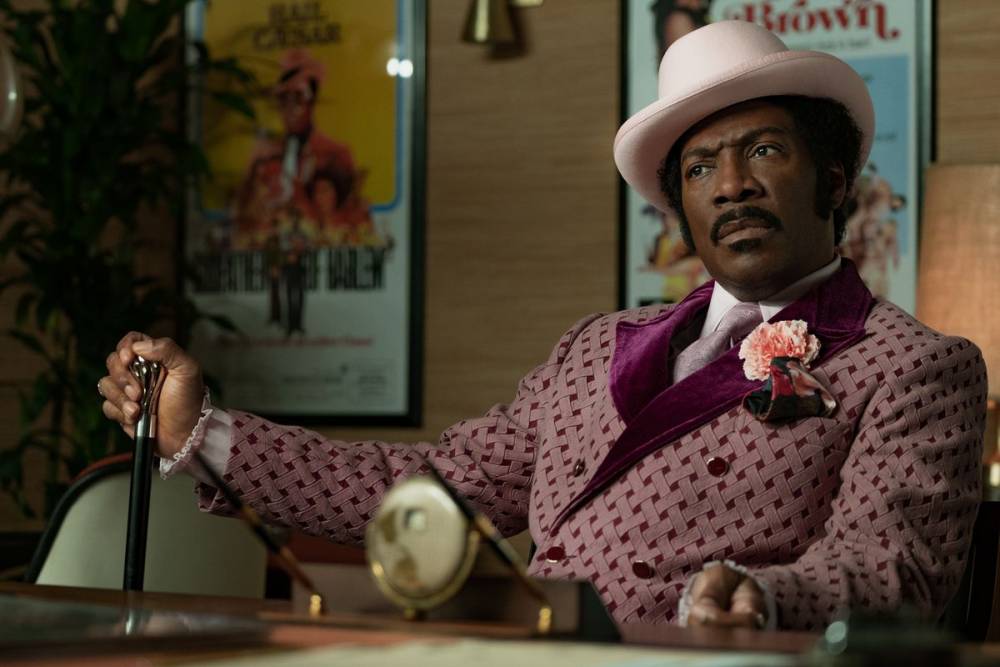
Scott Alexander and Larry Karaszewski have come to be known in Hollywood as the cult whisperers. Known for their talented ability to take weird-but-true stories and turn them into comedic goldmines, they have brought the stories of Ed Wood, Larry Flynt, Andy Kaufman, and O.J. Simpson to screens large and small. Now, at the request of Eddie Murphy and Netflix, they have turned their eyes to yet another larger-than-life, oft-forgotten genius: Rudy Ray Moore, aka the Blaxploitation legend Dolemite. It’s a choice that makes sense on paper, but not so much in execution. And it takes a while for the duo’s story to find its own groove. But once it does, Dolemite Is My Name becomes one of the biggest crowd-pleasers of the year, thanks to the game performances of its talented cast.
In the early 70s, the nearly fifty-year-old Rudy Ray Moore (Eddie Murphy) had reached the end of his rope. Despite a flourish of showmanship and a passion for the arts, he’d failed to break into any industry he’d attempted – singing, dancing, comedy, and so on. However, having noticed an open market with the African-American community (the biggest stars of the time had made it by appealing to mostly-white audiences), Moore goes for broke by creating an outrageous, offensive character based on the homeless street poets of L.A.: Dolemite, an extravagant pimp who speaks in rhymes, woos the ladies, and wins his fights. With the help of his friends, including musician Ben Taylor (Craig Robinson), Jimmy Lynch (Mike Epps), Theodore Toney (Tituss Burgess), and the great singer Lady Reed (Da’Vine Joy Randolph), Moore turns Dolemite into an underground cult sensation. And using the goodwill from the cult scene, Moore pushes himself to his creative limits: by turning Dolemite into a feature-length film, created by African-Americans for African-Americans.
Something that’s evidently clear about Dolemite from its very first scene is that it stands tall as an ode to black culture. Of course I mean this on a surface level, considering the film traffics in talented, oft-ignored comics of a ranging caliber, including Murphy, Epps, Robinson, and Wesley Snipes. But I also mean that at its core, Dolemite is about the unrecognized culture developed within a community of disenfranchised, wildly creative geniuses never given the chance of their contemporaries. Dolemite exists in a time where African-American entertainers were forced to play things straight-laced if they wanted to get a major gig. If they so much as messed up once – played a sexy song, told a dirty joke, etc. – their career was over, and it would keep African-Americans out of the industry for decades. It’s an attitude that disgusts Moore every time he sees Redd Foxx or Chuck Berry hamming it up for the white viewers, or is best summarized by Moore’s religious aunt: “Why don’t you be more like that nice Bill Cosby? He’s so sweet and family oriented!” Moore wanted to return black entertainment to the black community – as he famously notes in the film, “Every city in America has the same four blocks as us. And those blocks are going to love a Dolemite movie.” When Keegan-Michael Key’s Jerry Jones notes, “There’s a lotta talented brothers and sisters who wanna act but can’t get hired,” it reads both as a commentary on the real world, where African-American actors and actresses struggle to find substantial roles, as well as a commentary on the cast themselves – when was the last time you saw Mike Epps, Chris Rock, or Wesley Snipes anchoring a film? We get like three Holmes and Watsons a year, and yet Mike Epps isn’t capable of equally failing spectacularly?
Perhaps the best demonstration of black culture’s influence on the film is demonstrated in Moore’s influence for the character – the homeless poets of the street. Ignored by society and left to fend for themselves inside the empty husk of the center for black culture, several homeless African-Americans kept themselves entertained – not to mention begged for money – by improvising freestyle poetry about folk heroes and dirty limericks. The genius of Moore – and Dolemite himself – is that the character is derived from these poems, and therefore connected to audiences familiar with these street folk. And in an added commentary on the creation of black culture, these poems that Moore immortalized could later be seen influencing the hip-hop community, thus giving birth to one of the fastest growing genres of music in history. Even Moore’s determined drive can be traced back to a wholly black experience – he escaped life as a sharecropper, forever implanting him with a drive to prove the people who think he can’t make something of himself wrong. Moore’s mission is a simple one of personal triumph, but he ties himself to the much-larger narrative of an entire community trying to develop their own culture. It can be seen when our team of protagonists is left out in the cold after seeing the very-white The Front Page, which lacks stories and experiences that African-American viewers can relate to. And in a brilliant moment near the end Bob Odenkirk shows up to help explain to the naïve-ish Dolemite – as well as white viewers at home – exactly why Blaxploitation films became a hit (with white viewers fleeing to the suburbs, the movie palaces of old were predominantly filled with black audiences, who desired entertainment catered to them). Dolemite is about a focal point in African-American culture, when a pendulum began to swing and move their niche passions to the mainstream. And it is fascinating because of it.
It’s easy to find the first act of Dolemite Is My Name slow – for the most part, it’s an incredibly straightforward biopic, resembling even Bohemian Rhapsody in its simplicity and birth-of-a-star storyline. However, all of your doubts and trepidations fall away as the film moves into its main focal point – the making of the Dolemite motion picture. For while the “We’re Making A Movie” story has been nearly done to death by this point in Hollywood, there’s something so incredibly earnest in its simplicity (from Ed Wood to Brigsby Bear and beyond) that you still yearn to see it done, especially when it’s done this well. There are few words as charming in all of cinema than when a naïve protagonist stands up to look upon a group of friends and declares “We are here to work together to make a movie!” At the heart of it all, the film begs the question, “Is Moore more akin to Tommy Wiseau or Ed Wood? Or is he a creative genius, like Andy Kaufman?” He shares all three of their delusions of grandeur, after all. You could easily make a film exploring this question, and it would have been just as interesting. But Alexander, Karaszewski, and Murphy know that this isn’t the interesting question about Moore’s legacy, and the film shines because of it (although it does take an aside to compare Moore’s guerrilla style of filmmaking to John Cassavetes). However, there’s certainly evidence in favor of Moore as creative genius. I mean, look at the way the film paints his creative prowess. Having failed at every chance for fame he’s ever had – including singer, dancer, fortune-teller, stand-up comedian, and so on – the film portrays Moore as using these failures to influence his chance at fame. Moore knows the entertainment industry well enough to scam his way into success. For example, knowing that comedy albums will sell better if the audience laughs harder, he gets the crowd he’s recording recklessly drunk before taking the stage. When he’s turned down by Black Hollywood due to his heavier weight, he goes out and hires people who look like him, knowing that a variety of body shapes and types would appeal more to audiences than the stereotypical handsome man and attractive woman. The film shows all of Moore’s quirks as “flying by the seat of his pants” hunches, but all in a respectable, exciting way.
Of course, where the film really sings is when Moore and his team actually begins making the movie. For while we know that Moore’s insane genius will carry the day and create a riveting (if cheesy) Blaxploitation epic, it is the journey to this destination that makes things work. For Moore knows nothing about the film industry. When writing the script, he just keeps pitching ideas stolen from popular movies of the time – “The Exorcist is the highest grossing movie ever! Let’s throw in an exorcism! Enter The Dragon is popular right now, let’s have a kung fu battle!” He’s unfamiliar with the terminology of the set, to the point that he recoils in horror when he learns that the Director of Photography is known as “DP.” And when it comes to the actual filming of the material, Moore’s ignorance on the subject results in some of the funniest material you’ll see this year. He breaks in the middle of scenes to ask if the movie’s ready to watch yet. He gets winded performing kung fu battles, for which he can barely perform an introductory move. And when he worries he’ll be unable to perform a sex scene properly, he returns to his comedy roots to ham it up to epic proportions – all to the chagrin of Wesley Snipes’ self-serious director D’Urville Martin. At the heart of it all, Moore is kept sane by surrounding himself with the best people for the job, despite their talents – he hires people from acting classes to perform, white UCLA students to work crew, and makes his friends producers, to their general shock. It’s the type of buddy-comedy that makes this genre – and this film – such a joy to watch. In fact, if I have one complaint about the “Making a Movie” plot, it’s that they didn’t put enough emphasis on the creation of a character. One of the film’s best scenes involves Rudy rehearsing over and over to get the attitude, rhythm, and dialogue right, all while the score crescendos. But outside of this early scene and a moment where he explains the concept of a bit to Lady Reed, the film doesn’t really go into this key element of Dolemite’s creation. And yet, at the end of the day, this is but one slight critique in an otherwise-excellent film.
Obviously, Dolemite wouldn’t work without the terrific performance of Eddie Murphy. Murphy has always been a highly charismatic actor, and here he uses that charisma much in the same way that Jennifer Lopez did earlier this year in Hustlers. Murphy uses that fast-talking persona he’s perfect for four decades to play Moore as a talented huckster, capable of bullsh*tting his way through any scenario to moderate success. It’s a role that he balances perfectly between comedy and pathos. For example, he can nail a visual gag on command, as he does when he smiles into the camera or pulls out a stack of cash to buy off hobos, only to reveal they’re all singles. However, he’s also incredibly cathartic in the role, especially during a scene where he’s rehearsing in an empty studio and confronting a picture of his father he feels is judging him. It’s the type of scene designed for an Oscar reel, and Murphy nails it. However, what makes Murphy so perfect for this role is the way he ties his own legacy into the character, as well as the narrative. Moore was famously an influence for Murphy, and served as his mentor up until the time of his death, making this film a passion project for the comedian. Portraying Moore is Murphy’s way of showing us the pain and process behind being a fast-talking comedian. It’s hard not to read into the context when Murphy opens the film ranting about how James Brown f*cked over his career, considering Murphy spent much of his adult life trying to escape the shadow of his Saturday Night Live characters. And when Moore has a breakdown in the film listening to critics bash the film he worked so hard on, it’s hard not to imagine the real-life Murphy hearing the reviews he’s gotten for the past two decades. The film closely ties Murphy and Moore together, and thankfully, the performance is strong enough that the gambit pays off.
In terms of the other performances, the entire cast brings their A-game. Keegan-Michael Key gives a hilarious turn as a stuck-up, über-serious writer/actor. Among Moore’s cadre of performing friends, Epps gives a solid performance while Tituss Burgess and Craig Robinson find different ways to stand out among the ensemble. Ron Cephas Jones plays the hobo that inspires Dolemite, and he gives the same level of commitment to his monologue as he does to the Shakespearean work he’s performed. Kodi Smit-McPhee plays one of the white UCLA students working on the Dolemite production, and his reaction shots to Murphy’s manic brainstorming are some of the funniest of the film. And in terms of cameos from comedians and musicians inspired by Rudy Ray Moore and Dolemite, I was excited to see Odenkirk, Chris Rock, and Snoop Dogg (famously inspired by Dolemite) show up, even if only for a few minutes. However, there are two performances I want to single out, because they are so fully committed beyond the expectations of the project. The first is Wesley Snipes, who goes fully against type in what may be one of the funniest performances of the year. Snipes portrays a self-serious actor who remains committed to a vision of directing a film. His insufferability is only matched by his abject horror at watching the amateur production he’s signed himself onto. It’s a joyous, humorous performance that I did not expect from the dramatic action star. And then there’s Da’Vine Joy Randolph, making her cinematic debut after a successful career on Broadway. Randolph is the heart of this picture, stealing every scene she’s in away from even veterans like Eddie Murphy. She is perfect in the role, and the scene where she utilizes her terrific voice to sing “Ballad of a Boy and Girl” with Murphy is one of my favorites of the year. This is a great ensemble.
Dolemite Is My Name is perhaps the funniest film released this year. It knows how to walk the line between historical treatise, comedic Hollywood satire, and cathartic biopic. It’s hard to think of another film this year this competently directed, acted, and crafted, from the cinematography to the terrific costumes by Ruth E. Carter. It’s the type of film that can work for everyone – black audiences will love the return of Murphy to his former glory and the history of the culture they worked so hard to create. And white audiences will find something new to learn while never feeling lectured, as well as entertained by the hysterical material. At the end of the day, I keep referring to a final scene in the movie, when a young boy comes up on the street to rhyme with Rudy after the premiere of Dolemite. It’s a simple enough moment, but there’s poignancy there – you can see a whole generation of children finding a hero they can look up to, and see the birth of new comedy stylings, musical genres, and beyond in this one exchange. That is the magic of filmmaking, and that is the magic of Dolemite Is My Name.


Add Comment