
When a filmmaker of a certain caliber comes out with a new film, it is impossible to avoid attaching certain expectations to the work. Odds are, Quentin Tarantino won’t be making a romantic comedy his next time out. When a director drastically shifts from the expected, there can be a general feeling of disappointment that the film is lighter, or sillier, than originally expected or anticipated – case in point, Jim Jarmusch’s Airplane!-esque The Dead Don’t Die, critically reviled by critics expecting a deep exploration from the visual poet. I mention this to preface my defense of Ethan Coen’s Drive-Away Dolls, a film most Coen fans desperately wanted to be the Oscar winner’s next crime caper and instead offered a silly, endearing crime road trip rom-com.
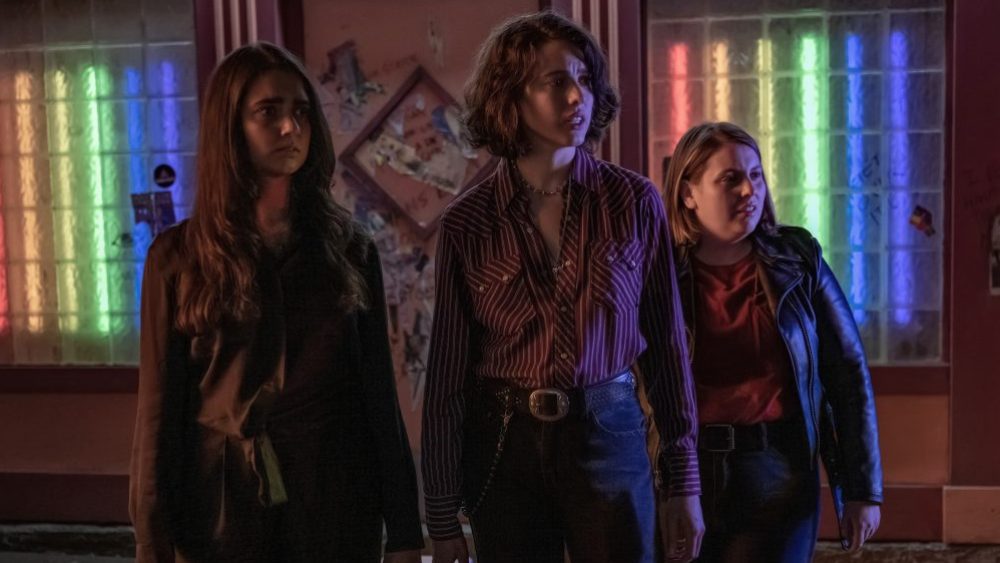
In 1999, best friends Jamie (Margaret Qualley) and Marian (Geraldine Viswanathan) find themselves in a rut. Free-spirit Jamie has just broken up with her girlfriend Sukie (Beanie Feldstein) while high-strung Marian has thrown herself into her work, having been single for quite some time. When Marian decides to visit her aunt in Tallahassee, Jamie decides to tag along, hoping to convince her friend to hit the lesbian bar circuit on the way down. However, hijinks and danger ensue when the drive-away car they rent (a service where a person rents a car for free in exchange for driving it from one city to another) is revealed to possess a mysterious briefcase wanted by a trio of killers – a trio who will stop at nothing to retrieve it.
What’s fascinating about Drive-Away Dolls (credited onscreen as Drive-Away Dykes, and written by Coen and his ex-wife Tricia Cooke) is that it jumps between several different genres, and yet consistently excels at each one. It is, at the same time, a film noir, a sex comedy, a mismatched road trip, and a romantic comedy. One minute you have a striking mystery filled with shocking violence, the next you get the funniest MacGuffin you’ll ever see. Screams of terror are juxtaposed with screams of carnal pleasure. And then there’s our main duo, bickering over a series of detours so Jamie can get laid only to end up at a Linda Rondstadt-themed lesbian soccer team makeout party (the greatest sentence ever typed) that goes from hilarious to heartbreaking in the blink of an eye.
And therein lies the heart of the film, straight out of that “Blue Bayou”-inspired sex romp: the central romance. While the film initially positions Jamie and Marian as a mismatched friendship trapped on a buddy road trip – think Planes, Trains, and Automobiles by way of Midnight Run – the end result emerges as something far more wholesome. In that one scene, their relationship is recontextualized, and their screwball comedy dynamic begins to shine through, growing organically and touchingly. It also grants them the opportunity to flip roles as they change each other and their situation grows menacing. It’s still silly, yet there’s a true beauty and sexuality found in their friends-to-lovers journey.
It helps that Coen, a student of classic Hollywood genre filmmaking, has such a keen command over the film’s technical aspects. This extends far beyond the script he crafted with Cooke, which is filled with such witty and funny dialogue. No, this extends to every detail of the craftsmanship, which so lovingly recreates the feeling of a properly sleazy 70s sex thriller. Coen and Cooke (who serves as the film’s editor) utilize a 70s-style B-movie template, straight out of the works of Russ Meyer. This allows for ridiculous edits, campy camera angles, and weird dream sequences that, for most of the runtime, inexplicably feature Miley Cyrus. Hell, just for good measure, they even throw in the classic Lynchian road shot (a camera passing down a dark road illuminating the dotted yellow lines). None of it is serious, yet it shows a dedication to the craft in every absurd detail.
The film is equally heightened by the acting, particularly by Margaret Qualley as Jamie. Qualley transforms Jamie into a quintessential Coen protagonist, much like Jeff Bridges and George Clooney before. She’s basically Ulysses McGill from O Brother, an id-driven, smooth-tongued hero whose loins and heart move faster than her brain. She is so funny and so dedicated, transforming her free spirit into a three-dimensional being. Viswanathan, meanwhile, has a harder role with a less forgiving character. Marian is not as interesting as Jamie, and I wish they’d let Viswanathan use more of her trademark sarcasm, but man, it is still fun seeing her as the straight man; not to mention she brings real heart to the aforementioned Linda Rondstadt scene. Most of the other major roles barely amount to more than cameos, but I do want to shout out Colman Domingo as the villainous Chief – he’s having a ball playing the heel, and understands the film’s campy roots.
I’m not going to sit here and pretend Drive-Away Dolls is a masterpiece. It’s not, and to call it “perfect” or “important” or “major” in any way. But while monumental works of art are always appreciated, they are not the most essential goal of cinema. The goal of cinema is to, through a visual medium, make us feel. To empathize, yes, but also to laugh, and cry, and become aroused, and hand ourselves over to our basest instincts. Drive-Away Dolls has more in common with the tawdry low-budget sexy crime flicks of the 1970s. But there’s a reason those films have an audience: they’re fun, and that’s all one can hope for.
A
Drive-Away Dolls is now streaming on Amazon Prime


Add Comment