
I have no delusions of grandeur, I am well aware that filmmakers do not read my site. The odds of one of my hundreds of daily readers being a big Hollywood auteur are slim to none – probably impossible. But watching Dune: Part II last winter, I couldn’t help but shake the feeling that he had, somehow, Denis Villeneuve had read my critique of his previous entry. In 2021, I gave Dune a mixed-positive review, praising the visuals but finding myself dissatisfied with the insufferable self-importance on display. It seems my criticism have been heard, as Dune: Part II embraces the wonder of the world Frank Herbert created. And it is a wholly better film for that very reason.
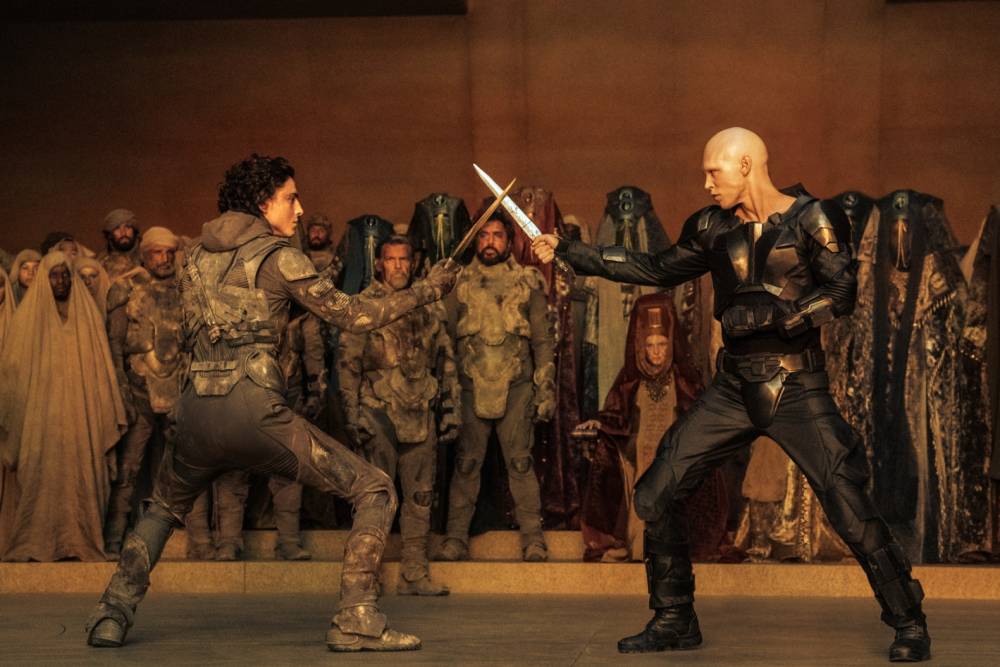
Having barely escaped with their lives in the aftermath of the coup that wiped out their nation, Paul Atreides (Timothée Chalamet) and his mother Jessica (Rebecca Ferguson) find asylum with the Fremen, the native people of Arrakis engaged in a centuries-long conflict with the colonizing empire. Guided by tribe leader Stilgar (Javier Bardem) and freedom fighter (and love interest) Chani (Zendaya), Paul soon ingrains himself in the fight against the Harkonnen clan (Stellan Skarsgård, Dave Bautista, and a terrifying Austin Butler) and their puppet master, Emperor Shaddam IV (Christopher Walken). However, as Paul becomes embroiled in a centuries-old prophecy, the fate of the universe soon hangs in the balance.
Across the board, Dune: Part II feels like an improvement over its predecessor. Villeneuve has developed a lighter hand to the story, letting the fantastical elements shine through. Characters ride the gigantic sandworms so ominous and shadowed in the first film. There’s a magic juice made from drowned baby worms. The action sequences are more expertly staged, the characters more deeply felt. Hell, even when the film delves into its own murky religion (a sticking point from the first film, which treated the source material the way Mel Gibson treats The Bible), it does so with a sense of self-awareness – Bardem’s devout Stilgar defends his theory that Paul is the Chosen One with lines taken verbatim from Life of Brian.
Yet even with this sense of wonder, Villeneuve never loses sight of the stakes. This is a story about oppression and rebellion, of vengeance and loss of innocence, of geopolitical struggle. Villeneuve and co-writer Jon Spaihts manage to fit into a 160-minute runtime a litany of scheming factions, epic battles, and the complicated, manipulating nature of prophecy. It all unfolds at a breathtaking pace, never dragging or feeling extraneous, until you are immersed in this world. The stakes feel real, the characters understandable, and the sense of tragedy real and imminent. It speaks to the golden rule of fantasy: if you embrace the whimsy, it makes the stakes that much more striking.
Not much at this point needs to be said about the technical prowess of these films – like its predecessor, Dune: Part Two is a dazzling display of filmmaking. The cinematography by Greig Fraser improves on his already-stellar work. For starters, you can actually see the Sand Worms now! Along with the set designers, the team introduces us to vast deserts, immaculate throne rooms, and, in one stunning sequence, a black-and-white Colosseum that looks unlike anything else all year. And while it has been overplayed to the point of near-parody, Hans Zimmer’s score provides an epic feel to this tale of power struggle, rebellion, and colonial exploitation. Simply put, few films all year have been this put together.
Across the board, the performances maintain a sense of dutiful grandiosity. No one here goes for subtle, and that’s ok – the film would suffer if they did. Chalamet finally finds himself in Paul Atreides, both in his early scenes trying to avoid his destiny and his latter scenes, where he has become consumed by power. Bardem and Josh Brolin serve as Paul’s most ardent supporters, one devout and one a letch, and both are effective; meanwhile, Skarsgård and Dave Bautista have a blast as scenery-chewing villains. And then there’s Butler, having the time of his life as the villainous Feyd-Rautha. As the anti-Paul, Butler leers and snarls every line with appropriate insanity. He’s having the time of his life, and is the film’s secret weapon: a villain you love to root against.
Really, the film’s weakest element – and it certainly must be called out – are its female characters. Sadly, Rebecca Ferguson doesn’t have quite as much to do this outing, mostly looking on approvingly at her son’s journey, but she is still effective. Zendaya starts out strong, and Villeneuve gives her a powerful new conclusion, but sadly there’s only so much one can change from Villeneuve’s book. Florence Pugh and Léa Seydoux mostly exist for exposition. And while I won’t spoil Anya Taylor-Joy’s role in the film, I will say that the attempt to address the book’s most insane character (who could never work on film) feels more egregiously stupid than if they’d cut her altogether. Still, it’s an excellent ensemble nonetheless.
Dune: Part II is a towering visual achievement, finally capturing the scope onscreen the way fans have hoped for so long. Villeneuve has delivered on the promise of the first film. It is an operatic vision of tragedy and power and humanity, yet also manages to dazzle with a world unlike any seen before. Villeneuve has shown that you can portray epic stakes and difficult subjects without sacrificing whimsy, wonder, and spectacle. It is a vast improvement that proves what science fiction can do when executed correctly, and it stands tall as not only one of the year’s best blockbusters, but one of the year’s best films.
A-
Dune: Part II is now streaming on Max, as well as most VOD platforms


Add Comment