
Well, if there’s one thing you can’t say about Denis Villeneuve, it’s that he doesn’t swing for the fences. After the modest success of Prisoners and Sicario, and the big-budget spectacle of Arrival and Blade Runner 2049, Villeneuve has set out to accomplish a feat long thought impossible: a cinematic adaptation of Frank Herbert’s Dune; the Moby Dick of sci-fi novels. Spanning thousands of pages and unparalleled amounts of world-building, Dune has been such a challenge to replicate onscreen that neither a miniseries nor the vision of David Lynch has succeeded in making it work – and legendary director Alejandro Jorodowsky was driven insane even trying. So how has Villeneuve fared in his effort, backed by the entire bankroll of stars and money available from Warner Brothers? Well, I’ll say this: while his efforts with the story and themes are a little muddied at best, Villeneuve has managed a feat of spectacle and cinematic achievement not likely to be replicated for a long time.
In the year 10191, Duke Leto I of House Atreides (Oscar Isaac) is named the new ruler of the planet of Arrakis. Arrakis is a key stronghold in the empire, as it is the only known source of “spice” in the galaxy, an energy source that powers the universe’s ability for interstellar travel. However, Arrakis is also an inhospitable host planet, already having driven away its previous ruler, Baron Harkonnen (Stellan Skarsgård) thanks to its scalding temperatures, giant sand worms, and a native people known as the Fremen who are constantly at war with their brutal rulers. Leto has dreams of forging peace with the Fremen and fueling the universe. But as it turns out, the Emperor has struck a deal with Baron Harkonnen to completely eliminate House Atreides. The resulting coup leaves few survivors: Duke Leto’s concubine Lady Jessica (Rebecca Ferguson), a skilled swordsman named Duncan Idaho (Jason Momoa), and Leto’s young son Paul (Timothée Chalamet), a gifted nobleman plagued with visions of a brutal future, involving himself as a Messianic figure alongside an enigmatic Freman woman named Chani (Zendaya).
Many critics have fawned over themselves to compare Dune to the classics of the sci-fi/fantasy epic genre. It has been called the next Star Wars, the next Lord of the Rings, the next Mad Max: Fury Road, and so on. Ironically, these exact similarities drive home Dune’s greatest weakness, as opposed to its strengths. And that weakness is a discernible lack of fun involved with the production. The reason Star Wars is a classic is it never takes itself too seriously. The same goes for Mad Max: Fury Road, which was more intrigued by the notion of a flame-throwing guitar than it ever was with worldbuilding. Even Lord of the Rings, the most “serious” fantasy epic out there, does so in a deceptively light-handed way. While the stakes may be life or death for Middle Earth, Peter Jackson never forgets that he’s creating a world of magical elves and trees and dwarfs. This sense of wonder helps audiences invest in the world their living in, as opposed to keeping them at arm’s distance to gawk.
It’s a shame that Villeneuve fails to bring any sense of wonder to this world, the way he did with Blade Runner 2049 (a film that includes a holographic threesome and a 50-foot Elvis). It’s not like he didn’t have the opportunity. This is a world with giant people-eating sand worms, where spitting is considered a holy gesture, where talking desert mice wander throughout the terrain, and where, in the middle of a giant sand planet, a random bagpiper marches around greeting the local population. For God’s sake, Jason Momoa plays a man named Duncan Idaho. This is an insane world! And yet, Villeneuve can’t help but treat the material with the same reverence of the Bible – so much so that 50% of the dialogue is Messianic prophesies and allegories.
I don’t mean to imply that Villeneuve doesn’t give this film a beating heart. Every action set piece is perfectly staged and executed, from an early sand worm rescue to a Pain Box magic test, to the breathtaking execution of the Harkonnen coup. But without an underlying sense of whimsy – Mad Max’s flame-throwing guitar, the underlying zombies in Game of Thrones, or the sense that anything is possible in Lord of the Rings – the film ends up feeling more like a history assignment than an adventure. And at 2½ hours, it’ll make you feel every minute of it.
Of course, it is possible that Villeneuve’s efforts to instill fun were sabotaged by the screenplay, which he wrote alongside the Forrest Gump screenwriter Eric Roth and the infamous Joe Spaihts (of Passengers and the Tom Cruise Mummy fame). Their script is, at times, borderline atrocious, opting for bland Messiah talk instead of any in-the-moment character building. Every other line is a faux-Biblical reference. There’s more Messianic prophesies here than in Passion of the Christ – and that’s pretty hard to do. This is already bad enough, but it becomes more worrying (or hilarious) when viewed in the grander scheme of the Dune saga. Villeneuve has indicated that he wants to expand this story out into a trilogy. And without spoiling anything, embracing all these Biblical allusions at face value is, at best, missing the point of the series completely.
Of course, I suppose I would take the Biblical allegories if the rest of the screenplay consists of Spaiths’ obnoxiously on-the-nose dialogue – when we first meet Chani, a member of a local tribe oppressed by a tyrannical regime, she lazily comments via voiceover “Who will our next oppressors be?” And…that’s it for the political commentary. Move it along, folks! Gotta get back to the Messiah and his underwritten mother! The best thing I can say about the script is that the actors, for the most part, are committed to selling it, but as opposed to the enchantment and quotability of, say, Star Wars and Lord of the Rings, Dune’s script sorely misses the mark.
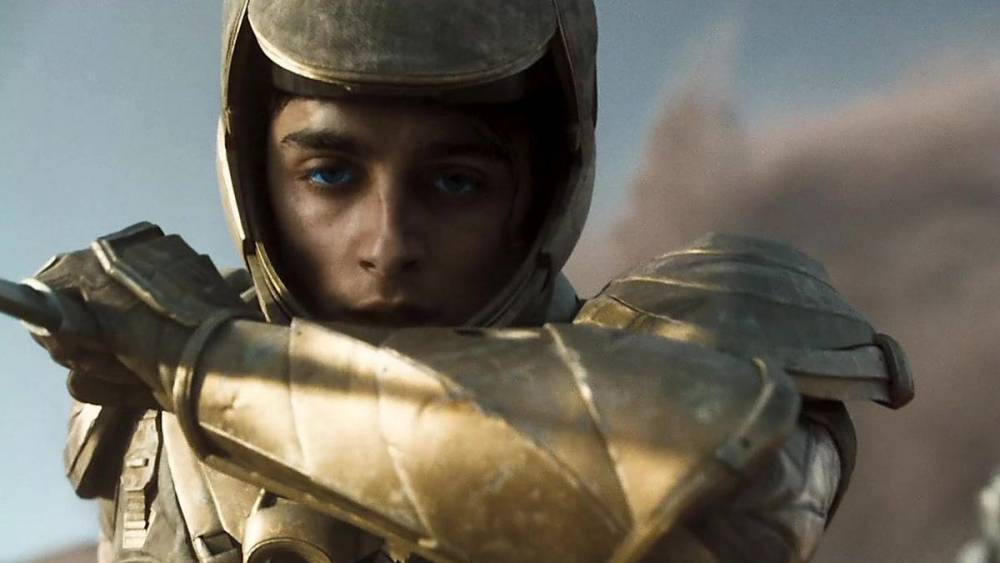
However, while the story issues are a hindrance at becoming fully invested, that’s not to say Dune isn’t a masterful achievement in its own right. Because it really, truly is. Villeneuve, at least on a technical level, has crafted a masterpiece. Everything in this film, from the top down, is simply stunning, from the effects to the production design to the cinematography. Greig Fraser’s camerawork simply devours the screen, dazzling the viewer with a visual aptitude so few other cinematographers understand. He is aided by the effects work of Paul Lambert, the genius behind Blade Runner 2049 and First Man. Lambert’s effects are ingenious because they are so subtle, possessing a realism even in the massive CGI set pieces that never overplays its hand. To be honest, it is the least CGI has bothered me since the Pirates of the Caribbean series. The sand worms are badass, and the general aesthetic of flying ships and massive vessels is otherworldly.
Speaking of those vessels, I am unbelievably impressed by the work of production designer Patrice Vermette, who may be one of the film’s two unsung heroes. Vermette possesses a sense of wonder in his attention to detail, and whether he’s creating the Arrakis vehicles, the Atreides’ technology, or the galaxy’s weapons (which are, hilariously, mostly swords), each new creation is unfathomably brilliant. The film’s other unsung hero? Hans Zimmer, who I can only assume is pissed he hasn’t won an Oscar since The Lion King, despite a stellar three decades of memorable scores. Zimmer’s score here is utterly engrossing, worthy of the film’s size and scope, and perhaps more fun than it has any right to be, combining elements of bagpipes, rhythmic chanting, beating drums, and beyond to craft one of the most innovative scores in years.
I do want to tackle the sound design, but I also need to put a caveat in my critique. While creative, the sound design in Dune constantly implies a poor mixture, where you can’t hear the dialogue over the booming soundscape – a fatal error when 80% of your film’s dialogue is exposition delivered in whispers. However, it is worth noting that the faux-IMAX screen I saw the film on has some of the worst speakers in my state, and the projection was so clearly off that a key scene was dark beyond recognition (a scene I’ve seen on HBO Max and seemed properly lit otherwise). So while it is a critique worth sharing, it may not be the fault of the filmmakers.
As for the acting, I will say this: while not necessarily the great ensemble of the great fantasy epics of yore, at least the actors here try to commit. Some fare better than others. For example, Chalamet doesn’t give a bad performance, per se, but his pursed-lip whisperings and constant moodiness lack the complexity and commitment of, say Oscar Isaac or Josh Brolin. Brolin in particular is given some of the worst dialogue in the script, but he’s so committed it barely even registers. As the film’s second-lead, I was disappointed at how underwritten Ferguson’s Lady Jessica was – and so delighted at her caliber as an actress that she manages to commit to every scene, so that when her role does begin to pick up steam, she absolutely demolishes everyone else onscreen.
Perhaps the better actors in the film are the ones who understand that the film requires a lighter touch, even if Villeneuve isn’t interested in providing one. For example, Jason Momoa is horribly miscast as Duncan Idaho, portraying him as Aquaman In Space. But that miscasting can, at least on occasion, works to his advantage – the sheer weirdness of a man who clearly doesn’t belong draws your attention each and every scene. Skarsgård and Dave Bautista (not to mention the great character actor David Dastmalchian) completely ham it up as the bad guys, opting for a cross between the terror of Hannibal Lector and the campiness of Geoffrey Rush in Pirates of the Caribbean. Equally campy is Javier Bardem, who, for my money, gives the best five-minute performance out of anyone. And Sharon Duncan-Brewster portrays a neutral government agent forced to make a choice, and quite frankly she may be the most charismatic performer in the entire film.
There are three actors in particular I want to talk about, for a variety of reasons. The first is legendary stage actress Charlotte Rampling as the Reverend Mother, a witch-like religious leader who appears in one scene to test Paul’s aptitude as the potential Chosen One. Rampling commits in that special way that makes Shakespearean actors so good at sci-fi. She has maybe two scenes, tops, and they are the two best in the film. Meanwhile, character actor Stephen McKinley Henderson – so great in Fences and Lady Bird – steals the show as the chief of security for House Atreides. Henderson brings a wit and intelligence to the role that quite frankly may have saved the first half of the film.
And finally, I want to talk about Zendaya. Zendaya has been the focus of the film’s marketing, which makes sense based on her A-list status and her character’s future in the saga. But here? She is solely expected to smile and look pretty. Which is bad enough, but the film also undercuts her dialogue and refuses to direct. It was shocking to discover that one of the most charismatic performers on the planet came off as totally wooden and disengaged. Villeneuve is usually a competent actors’ director, so I’m not sure what happened here, but my God, was it painful to watch.
As Dune comes to a close, after a two and a half hour Part One, a character remarks, perhaps ironically, “This is only the beginning.” And emerging into the light of day afterward, it is hard to deny being intrigued at where the story goes. For despite Dune’s messiness on a story and spectacle level, it is undeniably a technical triumph, unlike anything we’ve seen on the big screen in years. Now, could this film have been a masterpiece? Perhaps. I’m sure there’s a perfect version of Dune that just went full Lawrence of Arabia, filled with whimsy throughout a four-hour runtime, maybe even with an Intermission and Overture, just seal its operatic nature. But it is not my job to review the film that could have been. I am to review the film I got. And regardless of its annoying, glaring flaws, I am surprisingly eager to return to the world of Arrakis again. And that is the sign of a good movie.
B+
Dune is now playing in theaters, and will stream on HBO Max through the end of the month. Do what makes you feel safe


Add Comment