
The list of truly iconic, monumental concert films is short and noteworthy. Woodstock. Stop Making Sense. The Last Waltz. Monterey Pop. In fact, several of these films were so groundbreaking, it feels as though nothing could ever come close to these classics. Yet somehow, magically, inexplicably, a film has managed to join these ranks – and all for an artist who’s been dead almost 50 years. Baz Luhrmann created EPiC: Elvis Presley in Concert as a supplemental to his 2022 smash hit, utilizing inexplicably rediscovered footage discovered during production. Yet in doing so, even as Luhrmann’s first documentary, he not only may have crafted the best film of his career. Luhrmann may have reinvented the entire genre forever, creating narratives out of completely thin air.
During the research phase of writing 2022’s Elvis, Baz Luhrmann discovered 68 boxes of footage hidden within Kansas salt-mines, all never-before-seen footage from the King of Rock n’ Roll’s life, including pristine footage of the legendary Vegas residency. The footage, however, came without sound. Luhrmann carefully synced the footage with preexisting recordings, and filled the gaps with interviews of Presley discussing his life and work. The result crafts a unique concert experience, on that feeds Elvis’ stage show through his own personal life – and vice versa.
Looking at EPiC solely from a technical feat, it is almost a modern miracle. That this footage was found in such pristine condition, forgotten to the ages, is impossible. Yet it is in the recreation of the concert experience, syncing other sounds and audio in a fluid and flawless manner, that takes this over the edge. Not only does the replacement audio flawlessly match the found footage, it is elevated through the editing process to place audiences front and center for Elvis’ most iconic show. It’s a tremendous accomplishment by Luhrmann and especially editor Jonathan Redmond, who have not only salvaged something from the past, but turned it into something greater.
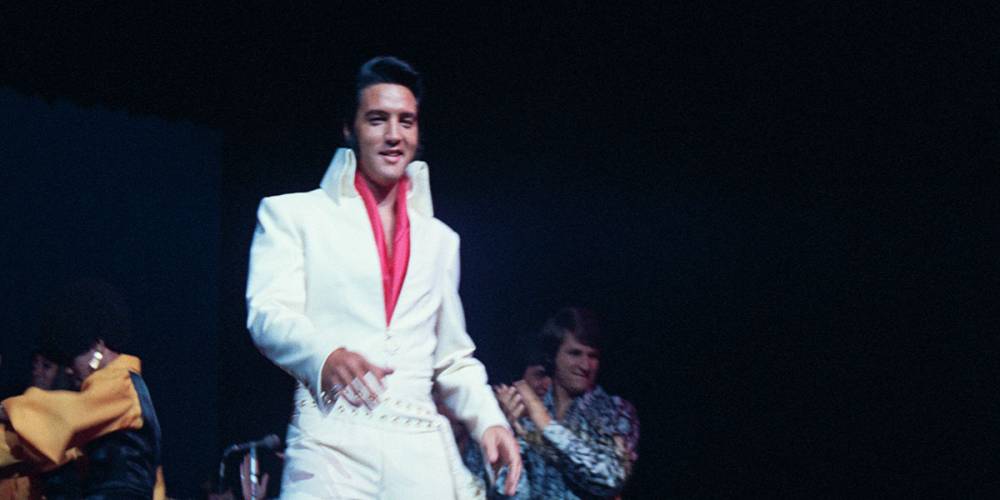
Like Stop Making Sense, this footage is designed to put you front and center for one of the greatest concerts of all time. The camera lingers on Elvis’ showmanship and the audio amplifies his iconic baritone, and with Luhrmann’s pace matching the gyrations and audience interactions, it evokes the grandiosity of one of the iconic Vegas shows while providing close-ups that the actual concert experience could never utilize. EPiC recreates one of the greatest concerts on Earth, executed by one of history’s greatest performers, and bombards the viewer with sights and sounds that feel fresh and raw – never once indicating viewers are watching almost 60-year-old footage.
Yet Luhrmann doesn’t just create one of the most exciting concert films of all time. No, he takes things a step further: creating a narrative where there was none before. Wherever gaps appear in the Vegas footage, Luhrmann and Redmond fill the gaps by showing Elvis rehearsing the number – or, in lieu of any footage, with interviews discussing the songs or order that Elvis has choreographed. In lesser hands, this would be a cheap gimmick; a filler to make up for material lost to the ages. Yet EPiC takes things a step further: instead, it creates a narrative where none exists. And in doing so, it createst the impression of Elvis explaining his own story and ethos, in a way no interview or film has accomplished before.
Luhrmann allows the footage to provide the illusion of Elvis explaining his own beliefs and ethos. We watch him rehearse over 150 songs, some only snippets, ranging from then-modern pop to Gospel spirituals. This material is matched with Elvis explaining that in order to customize the show for the audience, he can pick songs at random to suit the particular show. It provides insight into the mind of a showman whose entire devotion was his fans. Later, when discussing Elvis’ complicated feelings about politics and social ailments, footage of his contradictory feelings is paired with performances of “In the Ghetto.” Talk of faith is paired with the Gospel hymns he grew up idolizing. It plays as though Elvis is reconciling his own beliefs, passions, and influences with the very show he’s creating – masterful, as these interviews and performances were often years apart.
For the most part, Luhrmann takes a backseat to Elvis’ own words, letting the stars own charisma, humor, and humbleness speak for itself (one of the film’s best moments involves Elvis trying to escape a woman trying to tear his clothes off). His few instances of directorial imprint are done with both a sense of humanity as well as a wry sense of humor. Elvis’ love songs overlay the only images of Priscilla and Lisa Marie on display (in particular, Lisa Marie and his late mother), taken from other home movies. On the other end of the spectrum, a montage of Colonel Tom Parker is set to “The Devil in Disguise” – clearly the Aussie director’s hatred has not subsided since Tom Hanks’ hilariously monstrous performance in 2022.
EPiC is a remarkable accomplishment in the world of documentary filmmaking. It feels like history come alive; miraculous footage arranged not as a Frankenstein-esque resurrection of a dead star, but instead as a shining colossus unlike anything seen before. Over its 90 minutes, you watch Elvis’ entire journey play out – from the crystal-clear openers to the obvious glassy-eyed, drug-induced exhaustion of the show’s end. Yet the final images, of a sweating, near-comatose Presley entering the elevator having left it all on the stage, you can feel the love he feels for his devoted fans. Luhrmann allows the viewers to bask in that love, and in his own way, to let us give that love right back to the King of Rock n’ Roll.
A+
EPiC: Elvis Presley in Concert is now playing in theaters nationwide. It will premiere on VOD and streaming in the near future


Add Comment