
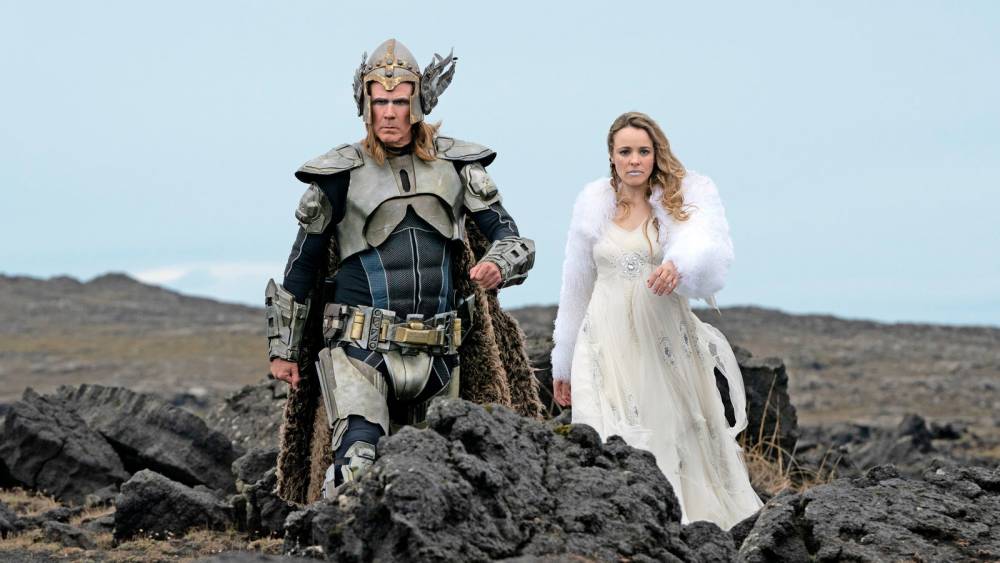
Big, brassy studio comedies have been a dying breed as of late. The best ones flop miserably, and the worst ones have fifteen minutes of fame before falling into a forgotten void. For this reason, I tend to avoid them like the plague, and it was exactly the reason I saw Eurovision Song Contest: The Story of Fire Saga a month after everyone else. Despite having grown up during the heyday of Will Ferrell’s memorable string of comedies (Elf, Anchorman, Talladega Nights, and The Other Guys, to name a few), a series of mixed reviews and general malaise (not to mention a terrible trailer) dissuaded me from giving it a shot. However, something interesting happened: the pandemic grew worse, and a lot of critics I respected (who hadn’t been paid to review it), along with an ever-growing number of fans at home, began clinging to this silly film about a sillier real-life song competition. And am I glad that I eventually gave it a shot; for not only am I still thinking about Eurovision all these months later, but it’s still one of the funniest, most pleasant experiences I’ve had at the movies this year.
Lars Erickssong (Ferrell) has loved the Eurovision Song Contest ever since ABBA’s “Waterloo” helped him overcome his mother’s death as a child. Now, forty years later, Lars manages his own band, Fire Saga, with the dream of writing a song that will transport him out of his small hometown of Húsavík, Iceland and onto the international Eurovision stage. Unfortunately for him, the entire town sees him as a joke – especially his drunken, embittered father Erick (Pierce Brosnan). The only person who believes in him is his bandmate Sigrit (Rachel McAdams), who possesses the voice of an angel, a fierce love for Lars, and a fervent belief in elves. After reaching the Icelandic finals as part of a fluke, Lars and Sigrit believe that their dreams are finally coming true. And when a freak accident kills all the other contestants, it seems like they may be right. And so the two childhood friends head off to Scotland, where they are soon embroiled in a series of adventures that include sexually charged Russian contestants (Dan Stevens), an economic conspiracy involving the Bank Of Iceland, and the ghost of a former diva (Demi Lovato). But through it all, three things keep Lars and Sigrit afloat, no matter how crazy things get: their love of music, their love for their country, and their love for each other.
The reason Eurovision works, like any great Will Ferrell venture, is the inherent sweetness located at its core. There’s something life-affirming about Ferrell’s best comedies, and it’s why films like Elf work better than, say, Step Brothers. Not only does Eurovision properly honor the unique, communal joy of the music competition it shares its name with, but it gives touching, empathetic stories to all its characters. While the average comedy might just portray Lars’ obsession with music as a joke, Ferrell and Andrew Steele’s screenplay instead uses music as a source of escapism. Music is what saved Lars from the depression of his mother’s death, and it’s why he wants to share that beauty with the world. Similarly, Sigrit’s naturally gifted voice is her way of expressing love not only for Lars, but for the hometown that’s given her everything she’s ever wanted. By building the story and the music around this general rule of sweetness and empathy, it compels the writers to build actual jokes, stories, and characters, as opposed to generic scenarios and characters. Dark moments are approached with a Scandanavian optimism, while triumphant moments feel earned and exciting. It’s hilarious to see the bouts of physical comedy whenever Lars and Sigrit attempt to perform their hit song “Double Trouble,” but when we finally see it succeed, it feels triumphant. Similarly, Brosnan’s Erick gets an arc most comedies wouldn’t even dream to craft. The moment we see him quietly and emotionally be won over by his son’s performance, followed by a true anguish of fear and support has more pathos than your average Oscar contender. And he’s not alone – every character, from the Stevens’ antagonistic Alexander Lemtov to the goofily obnoxious American tourists Lars berates, are granted moments of well-meaning amiability (even if the Americans dare to ask “So…is Eurovision like The Voice?”). There is an inherent, touching honesty to the film that adds to its enjoyability and likability.
Of course, none of this saccharine beauty overwhelms the fact that this is a funny movie. Smart comedy has mostly shifted away from the studio system and into the indie scene (What We Do In The Shadows, Lady Bird, Popstar, and the works of Lynne Shelton). The comedies that remain usually rely on some sort of gimmicky concept (THEY PLAY TAG! THEY FIST FIGHT! THEY’RE TEENAGERS GOING TO A PARTY!) or persona-based improv (most Judd Apatow movies) to sell tickets as opposed to jokes. Eurovision works because it sticks to the most tried-and-true method of creating comedy: a script. While the performers have the freedom to improvise their creative choices and more than a few jokes, the film trusts that it has a strong enough script and story to elevate the material, and doesn’t bog it down with unnecessary diatribes. The humor is both effortless and effortful at the same time, and in the best way. There’s a series of well-crafted bits surrounding the notion that Nordic people are fun and weird, presented in the purest way. There’s a recurring joke where Lars introduces Sigrit as “probably not my sister” that’s silly enough as it is without the added layers of their last names meaning “Erick’s son” and “Erick’s daughter” and a final payoff that never insists upon itself. And I haven’t even touched upon the fact that Sigrit BELIEVES IN ELVES. WHO LIVE IN TINY ELF HOUSES. AND POTENTIALLY MURDER PEOPLE TO APPEASE THOSE WHO HONOR THEM. Eurovision’s also a master of the sight gag, including a 12-year-old drummer, naughty statues, and not one, but two bits of physical comedy that stand tall as some of the best of the year. With the actors choosing to bring their A-game to a worthy script as opposed to trying to one-up each other through improvisations, it allows their performances to breathe, their strengths to move elsewhere, and the film to find its own power.
But the best aspect of Eurovision, more than its comedy or earnestness, is its music. Quite simply, the original music crafted for this film is not only a fantastic ode to the impressive musicality of the actual Eurovision Song Contest, it’s one of the best soundtracks (and albums) of the year. The reason Eurovision’s music works can be found in the opening song, “Volcano Man.” Earnestness can be one of the greatest sources of humor, and the sheer dedication on display from Ferrell, Stevens, and especially McAdams not only sets the tone for the film, but establishes a chemistry and honesty that carries it going forward. The performers use the creative freedom earned for them by the music and the screenplay to craft some of the funniest parody music since 2016’s Popstar, whether they be silly-yet-realistic (“Double Trouble”), so-real-it-hurts (“Lion of Love”), or childishly naughty (“Ja Ja Ding Dong”). As the case may be, “Ja Ja Ding Dong” may be one of the year’s best pieces of music, parody or otherwise, as it serves as a near-perfect running joke throughout the film. And yet, no matter how silly the songs or performances may get, the actors treat them with complete honesty. There’s a Pitch Perfect-esque “Song-A-Long” that pays tribute to the weird talent of the Eurovision performers (each random act to appear is a former contestant). And regardless of the silliness to come before, nothing will prepare you for the teary-eyed beauty of the film’s climactic number “Húsavík.” It’s such a beautiful moment it makes me physically mad. Even its samples are great – the aforementioned “Waterloo” drop is poignant and earned, as well as a moving series of Sigur Rós songs. Eurovision could only have worked if the soundtrack truly brought it, and it absolutely did, thanks to hit after hit after hit.
The performances in Eurovision, whether the actor did their own singing or not, also make up some of the best comedic acting we’ve seen in years. Ferrell may be a little too old for this type of role – indeed, he looks like he could be playing McAdams’ dad, not her best friend/love interest. But he still has that childlike quality that helped him break out in the early aughts, and his singing voice is adequate enough to carry the film. He’s also smart enough to take a backseat to the film’s real star: Rachel McAdams. McAdams has always been a gifted comedic performer, but has mostly played the straight man to a series of lesser stars (she single-handedly stole The Hot Chick out from under Rob Schneider, not that that’s a hard thing to do). Here, she’s granted the full freedom to go for it, and my God does she let it all out. She plays Sigrit as an earnest cross between Celine Dion and Björk that’s still somehow wholeheartedly original, thanks to the appealing nature of her personality. She milks every line she has, and delivers one of the year’s best when, after witnessing a massive explosion that kills her potential rivals, she casually responds, “The elves went TOO FAR!” Even if her singing voice is mixed with the more-gifted My Marianne, the performance doesn’t work without her little prances or postures, and I do not exaggerate when I say she should absolutely be in awards consideration for this role.
Meanwhile, Pierce Brosnan’s casting feels like a bit of metacommentary on his role in Mamma Mia!, and it works primarily because of the dramatic pathos he brings to it. Similarly, I fully endorse Dan Stevens’ efforts to rebrand himself as a sexy comedic actor after the years he spent on Downton Abbey. Stevens has an absolute ball hamming it up as a sexed-up Russian baritone, and his weird homage to the Wild and Crazy Guys makes for the perfect antithesis to Ferrell’s Lars. Demi Lovato isn’t necessarily the strongest actress, but she’s terrific here as an over-the-top stereotypical ghost who’s really bad at her job. Mellisanthi Mahut’s performance as a rival Greek performer isn’t the strongest bit of acting in the film, but she carries her scenes well, and she’s a helluva singer and dancer, so she manages to get by. And Graham Norton’s performance as himself is some of the best faux-reporting since Pitch Perfect, and he easily reminds us why he’s the greatest late night host out there right now. Even the small roles are perfectly cast, including the brother-sister duo of Natasia Demetriou (Nadja from the TV series What We Do In The Shadows) and Jamie Demetriou (The Rodent from Fleabag), as well as Hannes Óli Ágústsson as Olaf, the local who is clinically obsessed with “Ja Ja Ding Dong.” His passion is electric, and can only be matched by the enthusiastic audience.
Eurovision Song Contest is the type of earnest, lovable comedy that just isn’t made anymore. In many ways, it shares far more DNA with A Mighty Wind (an equally lovable film about weirdos who make really good music) than the average Frat Pack picture. It’s not perfect – it strangely feels like it should be reaching the halfway point less than a quarter into its two-hour runtime, and it admittedly begins to drag at the interim between the second and third act. But any time you feel your interest waning, Ferrell and director David Dobkin throw in a great song, or an emotionally moving moment, or let Will Ferrell scream at a group of well-meaning Americans for no reason. This is a funny, adorable film that not only accomplishes its mission, but goes the extra mile to perfect the technical bits as well.
A-
Eurovision Song Contest: The Story of Fire Saga is now streaming on Netflix


Add Comment