
When Jimmy Chin and Elizabeth Chai Vasarhelyi released Free Solo a decade ago, part of its major selling point (beyond that exhilarating cinematography was that Alex Honnold’s story wasn’t yet well-known. Part of the film’s appeal was its triggering of that morbid, toxic part of every human brain that wonders, “What if he falls?” In theory, we feel safe because, well, why would they release a documentary of someone dying? But the question lingered: what would they have done if they watched their friend die live onscreen? Well, we sort of have our answer, as their newest film, Everest: The Other Side, which both serves as a gorgeous vista and exploration of passion and loss, but also raises moral questions about the entire filmmaking process.
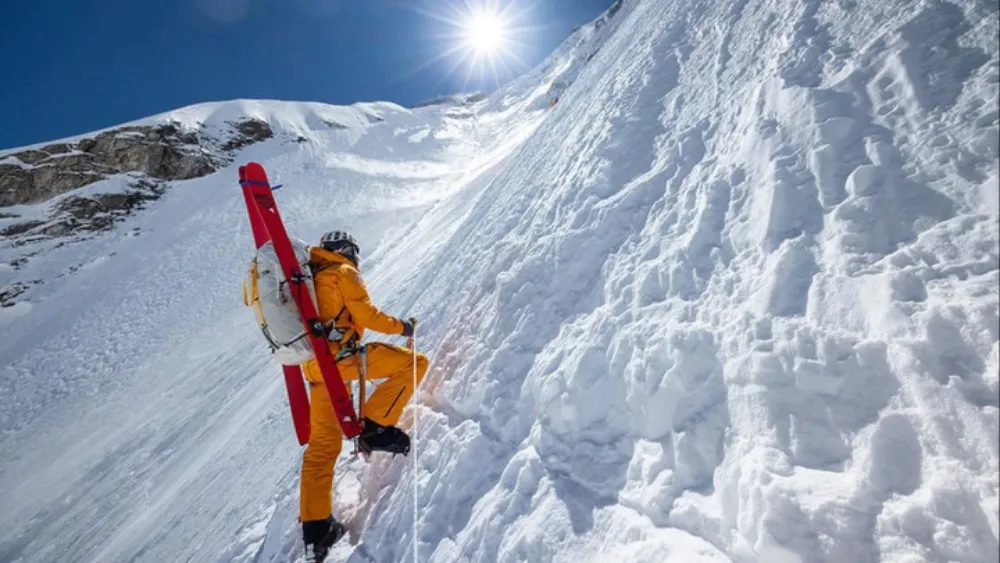
Everest: The Other Side follows ski mountaineers Jim Morrison and Hilaree Nelson. After meeting several years prior, the couple had summited and skied down several of the world’s highest peaks. Now, they prepare to embark on one of the most challenging endeavors in mountaineering history: they play to climb Mt. Everest, not up the easier Nepalese face, but the near-impossible Chinese face on the north side. Once they’ve summited, they will then ski back down to base camp – something never done before. The mission takes several years and unforeseen tragedies, but through the tragedy comes the drive to push this mission through.
For its first twenty minutes, Everest simply follows the lives of Jim and Hilaree and their hodgepodge family, and during this portion, it becomes clear that these two won’t be able to maintain the story on their own. Their personalities lack the same strange energy as Honnold, and the duo seems a lot more performative for the cameras than Honnold’s apathy. In fact, the only thing that seems remotely interesting is the glossed over timeline separating their relationship beginning and Nelson’s divorce from her ex-husband.
All feelings towards the couple, and towards the film, change twenty minutes in. While participating on a practice run on the 5th highest mountain in the world, Hilaree is caught in an avalanche while skiing and falls to her death. This is shown in the film, from getting caught to the recovery of her body. If you’re like me, it takes about thirty minutes to fully process this information and even focus on the film, as it raises so many moral questions.
Thankfully, the film explores many of these – Chai feels deep remorse and guilt, wondering why they make these kinds of film, and how many of their friends, while Chin mostly seems concerned with what will happen with the film. It remains unexplored in the film’s overt text, but a fun game is to see when the breaking point comes for the couple’s current divorce. The resulting film pivots to an exploration of grief and loss, and how to both honor someone’s legacy and pursue that uncontrollable passion that drives us all. Yet it doesn’t change the disturbing feeling not only felt in continuing the film without Hilaree, but actively showing her death.
Of course, both before and even after this monumentally conflicting decision, it is hard to deny the utter beauty of Chin and Vasarheyli’s filmmaking. Already gifted auteurs, here the duo successfully finds ways to strap IMAX cameras to drones, climbers, and beyond, in order to capture the scope and majesty of the immortal mountain. Beautiful vistas make audiences understand why so many climbers would risk their life on these hallowed slopes, as one feels each rock, each snowflake, and yes, each avalanche (as it turns out, the only time of year suitable for skiing Everest is peak avalanche season). It’s a truly majestic film in spite of its subject matter
And along the way, the film uses Jim’s grief and desire to push through to honor Hilaree opens up a new angle to the storytelling. Several of the documentary’s team were seriously injured or had lost someone just like Jim. One of the cinematographers had watched his father die in an avalanche when he was 15. Their Sherpa for the climb, the affable and skilled Yukta Gurung, breaks his leg during one of the attempts, only to push his recovery to try again the next year. It’s striking to see people so dedicated to a craft that could kill them, or had killed people they love. And yet, part of the beauty is exploring how grief and passion allow them an outlet for their pain
Everest: The Other Side is a moral quagmire of a film. It is utterly gorgeous, granting views of one of the world’s most renowned locations that the everyman could never dream of witnessing. And its story of passion and overcoming loss is certainly poignant. Yet I can’t help but think of the haunting images of Hilaree engulfed in the snow, or her coat surrounded in blood, and wonder: at what point does such footage go from honest to exploitative? And does that exploitation shadow every interview to come as performative and dishonest? I’m not entirely sure I have the answers, and it leaves me reeling over what type of film Everest is, and what it means to the world at large.
B
Everest: The Other Side is now playing in theaters nationwide. It will stream on Disney+ in the near future


Add Comment