
It’s hard to imagine a more clear example of “a match made in Heaven” than Guillermo del Toro taking on Mary Shelley’s Frankenstein; Or, The Modern Prometheus. While mostly associated with the (terrific) 1931 version that gave us a lumbering green oaf, Shelley’s original tale is a moral tragedy about one man’s lust for power, the mistake of trying to play God, and a broken creature capable of great thought and depth driven to violence by man’s own cruel nature. In other words, the exact type of story del Toro craves.
After almost 40 years in the industry, del Toro has finally adapted the novel himself, and it’s clear that he wants to make his the definitive version. Every adaptation, every theme, every interpretation is fully on display, mixed with new themes and visuals straight from the master’s monster-infused brain. The result, as it turns out, is a mostly rich bag. Del Toro has offered up an entirely new treatise on human nature. Yet the sprawling story has a few too many missteps to truly be the definitive work he’s looking for.
Up at the North Pole in the late 1850s, a Danish expedition ship trapped in the ice discovers a nearly-frozen man, soon identified as Baron Victor Frankenstein (Oscar Isaac). Shortly after rescuing the morose doctor, the Danish crew finds themselves under attack by a monstrous creature (Jacob Elordi), super strong and seemingly indestructible. After the Creature’s first attack, Victor tells the crew his story: a tale of scientific breakthrough, of hubris and tragedy, and an eternal warning for all those foolish enough to play God.
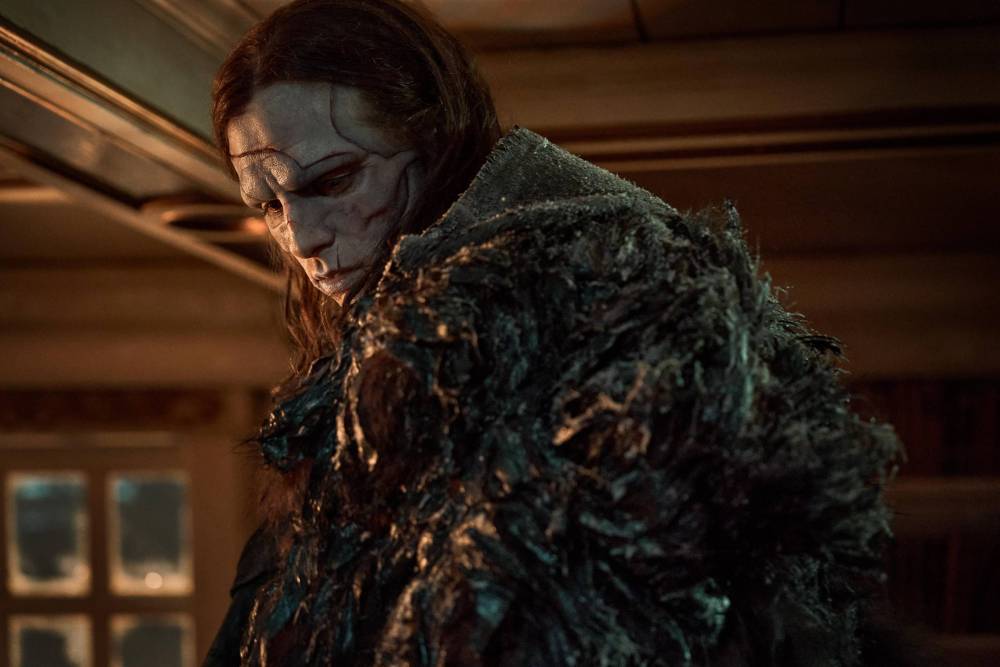
One cannot deny the sheer spectacle of what del Toro has accomplished here. While his Gothic tapestries are always visual treats, the epic scale is on display in every gorgeous moment. Lavish costumes, hulking sets, decimated battlefields, frozen boats, all tickle the imagination and capture the juxtaposition of looming horror and human tragedy. It all feels unique to del Toro’s vision while simultaneously blending the original with the homage. The design for Elordi’s Creature is unlike any seen onscreen to date. And yet, the allusions to the countless adaptations over the years still tip the hat to those that came before, from the electric nightmare of the 1931 classic to the Victorian classicism of Branagh’s take (I’d argue there’s at least one or two nods to Young Frankenstein, as well).
The juxtaposition of del Toro’s adaptation and his own natural sensibilities also creates a unique blend that adds to the film’s mystique. Obviously, themes of mystery, horror and tragedy involving a tragic monster born out of mankind’s own hubris are themes Shelley herself obsessed over, and clearly resonated with the Mexican auteur over the years. Yet beyond themes of ego, death, and humanity, del Toro manages to connect his own themes and messages to both highlight, and even contradict, original messages.
New themes emerge from the original text, exploring del Toro’s fascination with father figures, abuse, religion, and beyond. Direct parallels are drawn between the abusive father of young Victor and Victor’s behavior towards his “disappointment” of a Creature: when Victor mouths off or gets a science question wrong, he’s given the switch; a technique he repeats when his own Creature fails to answer questions fast enough. Mia Goth plays mother to Victor and Elizabeth to the creature, and both women’s profound faith is juxtaposed with the cruelty of the world and hypocricies within the Church. It deepens the text and takes the tragedy to profound new levels.
For the most part, these changes to the story breathe fresh life into an otherwise-obvious tale. However, it also threatens to stuff the film to burst. There’s simply so much happening as to overstimulate the brain, structured in a way fitting of the novel, yet offering a strange flow for viewing. The first half of the film follows Victor’s life and journey, a fast-moving quest of innovation, hubris, and conflict. It is alive, rapid, and riveting. When we shift to the Creature, however, the film shifts: it is slow, introspective, and philosophical. It is reflective of the characters it follows, yet can create whiplash in the most casual of viewers.
In terms of the performances, the best work comes from the more unlikely of leads. The typically terrific Isaac offers a mixed bag. He’s stunning as the more tragic Victor. However, when he flashes back to the cocky assh*le Victor, it doesn’t work quite as well. In theory, the film should be a perfect fit for Mia Goth; instead, the actress (pulling double duty as Elizabeth and Victor’s mother) feels utterly miscast. David Bradley, Christoph Waltz, and Charles Dance make the most out of their shorter screentimes, but the true hero here is Elordi as The Creature.
Never properly portrayed on the silver screen (Karloff’s silent, simple portrayal is most people’s pop culture go-to), many forget that the original novel’s Adam is articulate, compassionate, and possessing of a fiery temper he was never taught to control. While Elordi, best known for his charisma on both Saltburn and Euphoria (he’s doing the heavy lifting in both), isn’t the obvious choice for the role other than being 6’5”, he successfully proves he may understand this role better than anyone. Elordi brings a silent, Byronic pathos to the character, placing sympathies firmly with the unloved monster, and doing more with a glance or the subtle lift of his face than many actors have done with their entire bodies all year. He is the soul that Frankenstein needs to thrive.
Frankenstein is an ambitious swing from an iconic director. It’s ambitious in its visuals, ambitious in its narrative, and even ambitious in its flaws. It’s a rare film that can be this bold across the board and still feel like the director is holding back. Yet while it would be inaccurate to call the film “perfect” or “definitive,” it also feels like any such criticisms are nitpicks, or the portions of a tapestry that makes it human. Frankenstein is our most beloved tale both because of its Gothic horror elements and the human tragedy at its core; it may not be the definitive version, but it certainly captures the beautiful tragedy better than any variation to date.
B
Frankenstein is now streaming on Netflix


Add Comment