
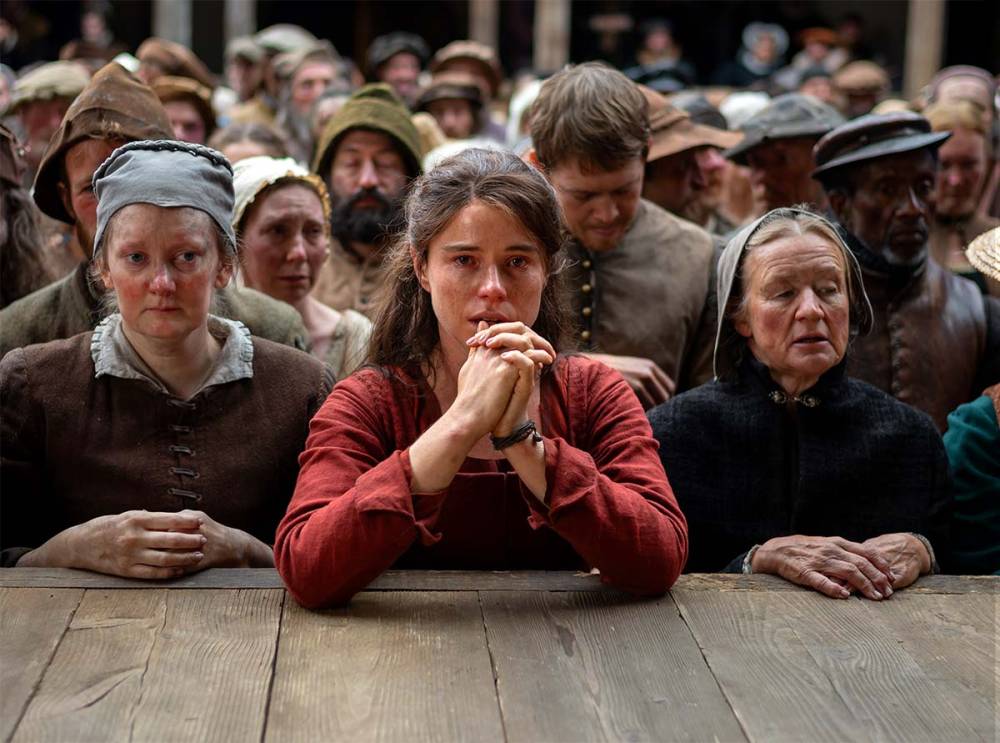
In 2020, Maggie O’Farrell’s historical fiction novel Hamnet became a surprise bestseller. It was a perfect blend: a sad story, a character study, and an exploration of the relationship between art and grief. Naturally, Hollywood came knocking, putting together a dream team of Academy Award-winning director Chloé Zhao and producers Steven Spielberg and Sam Mendes. The result is as good (although, perhaps, not better) than anyone could expect, as Zhao has broken from her own directorial style to craft yet another humanist fable about love, loss, and catharsis.
In Elizabethan England, a young Latin tutor (Paul Mescal) teaches a group of farm boys to pay off his abusive father’s debts. While teaching, he sees the eldest daughter, Agnes (Jessie Buckley). The whole town whispers about Agnes, whose deep empathy, lack of religion, and love of nature brand her a witch. Yet the Latin tutor, himself a sensitive soul, only sees her beauty, inside and out; and soon, the two are wed, with three children, Susanna (Bodhi Rae Breathnatch) and twins Judith (Olivia Lynes) and Hamnet (Jacobi Jupe). When unspeakable tragedy strikes the family, the parents’ relationship is torn asunder as they grasp for a way to cope with the grief. Agnes’ grief is more outwardly felt; her husband channels his into a play we now know as Hamlet.
Hamnet is perhaps the best demonstration of what Zhao thrives with as a filmmaker. While her early films utilized an improvisational, verité style, her latest demonstrates how far she’s come as a formalist, blending a newly developed visual style with her trademark deep-running empathy. Haunting cinematography captures lush woods, sterile households, and a physical passion that permeates the screen, emphasizing elaborate sets and costumes. Yet the film’s best moments come from the human touches: two humans connecting through storytelling and empathetic souls; a wife’s sacrifice to support her husband; a reluctant mother-in-law finding common ground and compassion for her spirited daughter-in-law; children playing and their parents’ doting love.
These are the moments that make Hamnet so haunting. Indeed, they are so emotionally overwhelming it perhaps, almost ironically, overshadows the story’s primary themes. While there’s a poignant sequence capturing the effects of the titular play on a mourning Agnes and the importance of catharsis, it is perhaps less successfully realized than the otherwise-ordinary moments that Zhao so perfectly captures. The creation of Shakespeare’s greatest work feels less realized than the story that essentially amounts to a medieval counterpoint to Ordinary People. This exploration of grief is the film’s greatest asset, and what truly makes the film soar.
Theoretically a two-hander, it is Buckley’s Agnes who dominates the film overall. Long one of the best actresses of a generation, Buckley gives Agnes her fierce edge. You feel in her performance a pain she’s carried her entire life, the deep empathy she feels for her other human beings despite it all, how Will’s love makes her feel seen, the power of her motherly devotion, her passion for nature, and, ultimately, a deeply felt grief. As her more famous husband, Mescal isn’t quite as strong when he has to play a grieving Shakespeare, it should come as no surprise that the rising star nails the yearning, paternal man looking to escape his broken home – not to mention he’s still the master of looking at women.
Much of the rest of the ensemble plays their roles about as well – or perhaps slightly better – than expectations. The great Emily Watson may be underutilized as Will’s pious mother, yet she delivers the strong performance we’ve come to expect, capturing a good woman hidden beneath a gruff, flawed exterior. Joe Alwyn continues to emerge as an underrated actor as Agnes’ protective younger brother, understated in his mannerisms and emotions. Yet perhaps the real breakout here is young Jupe, whose portrayal of Hamnet will crush you. He fills the role with an essential joy for life, and in his crucial scene, he will absolutely crush you.
Hamnet is about as strong a straightforward period piece as one could hope for. It is deeply felt, strongly acted, and lush to look at. Perhaps in its more cinematic moments, the action feels more staid than its more lyrical moments. Yet this is but a quibble in the film’s emotional tapestry. Hamnet is a lesson in using art to grieve, and in that goal it is accomplished. It’s the marriage of a relatable story, the best actors of the day, and a director who is clearly at the top of her game. And it makes Hamnet an emotional journey worth experiencing.
B+
Hamnet is now available on VOD


Add Comment