
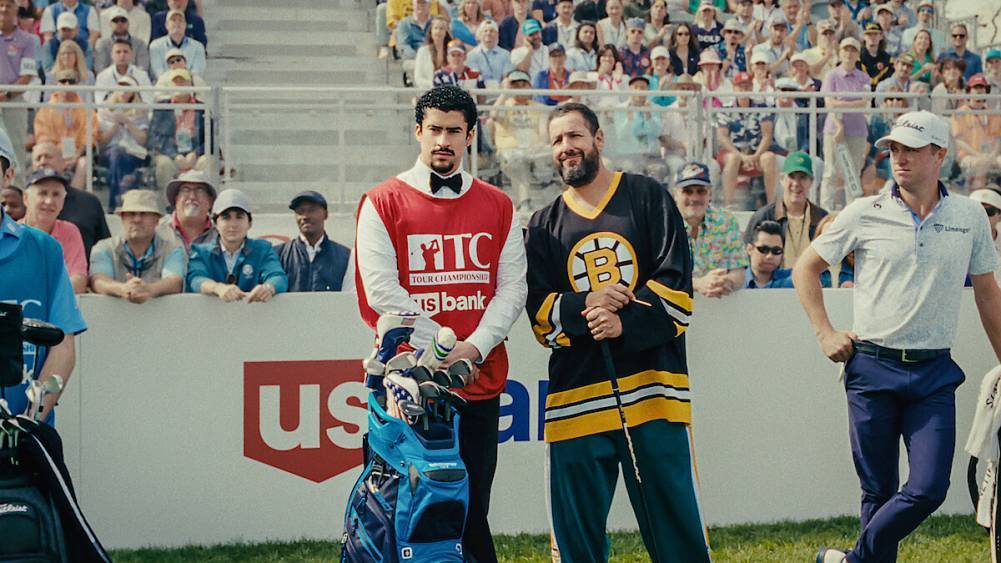
For as beloved as Adam Sandler and his comedies have become, only two characters have really had an impact on the “iconic” scale. Sure, people may like Zohan or Grown Ups or Hubie Halloween, but the only two that really have had staying power have been Happy Gilmore and Billy Madison. With Netflix firmly in the camp of churning out nostalgia sequels for views, and having paid Sandler an obscene amount of money for the rest of his life, a sequel to one of these films was inevitable. And thus we have Happy Gilmore 2, a film perhaps many years past its shelf life, and a sign of everything wrong with modern comedy, yet enough heart to carry its two hour runtime.
In the aftermath of his triumphant win, Happy Gilmore (Sandler) has lived the perfect life. He wins multiple tournaments and has five children with his beloved wife, Virginia (Julie Bowen). However, after accidentally slicing a drive and inadvertently killing Virginia, Happy gives up golf, takes up drinking, and loses everything. Having been out of the game for almost a decade, Happy is faced with a dilemma: his only daughter, Vienna (Sadie Sandler), has a chance at a prestigious dance school, but only if they can scrounge up $300,000. Reluctantly, Happy reenters the game he once loved – and not a moment too soon, as tech bro Frank Manatee (Benny Safdie) is looking to destroy the game of golf forever.
Let’s address the elephant in the room: both as a legacy sequel and as a stand-alone comedy, Happy Gilmore 2 is a misfire in simple execution. For what is essentially a slapstick comedy, it is surprisingly bleak. Beloved characters are brutally killed off in the first five minutes, the hero turns into a raging alcoholic and loses everything from the first film (including the house that served as the crux of the original. And while it does result in an admittedly-funny recurring bit where Happy turns ordinary household objects into flasks, one can’t help but feel uncomfortable with the tonal shift from lovable comedy to bleak existentialism.
Furthermore, Happy Gilmore 2 feels enslaved to the recent demeaning trend of modern studio comedies. While the original followed the tropes of the average 90s template, there were still, you know, jokes. In modern comedy, there aren’t so much as jokes as there are lazy comedy setups that don’t go anywhere. Egregious cameos where the point is “I know him” as opposed to the subversion of expectations (imagine if the joke of the first film was just Bob Barker’s presence as opposed to the fact the nicest guy around got in a fistfight). Butts and bros as the punchline as opposed to the conduit for a punchline. And let’s not forget an absurd level of escalation – this time, it’s not just grandma’s house; Happy now must save the entire sport of golf.
Yet despite it’s glaring shortcomings and disappointments, it’s hard to write off Gilmore completely. Its heart is still in the right place, making the characters likable. It’s still fun to watch a grown man gallup around a golf course on his driver. And there are even a few jokes that work fairly well. There’s a montage where Happy tries to get back in shape, Rocky style, but for a sport that involves no running or overt exertion. There’s a terrific joke where a graveyard seems to consist of exclusively people from the first film (while it starts out nostalgic and kinda bleak, the longer it goes, the funnier it gets). And while most of the cameos feel egregious, the use of John Daly as an insane hermit version of himself is spectacular – he steals the film.
As for the performances, they’re the kind of hit-and-miss works one would expect from a Sandler comedy. Sandler’s Happy is essentially just an angrier version of himself, but while I hated the alcoholic subplot, at least he brought in some of the dramatic chops he’s honed over the years. Christopher McDonald, meanwhile, seems to have a blast playing an insane version of Shooter McGavin (a treat after years as the straight man).
Ben Stiller shines in his return as Hal L; Safdie, despite the only actor in this cast to star in an Oscar-winning film, does not (not his style of comedy, although I applaud him trying). And I’m still not convinced that Sandler’s daughters (two appear in the film) are really actresses. The only performance that truly surprises is Bad Bunny as Happy’s new caddy – the rapper has a surprising screen presence and sharp delivery; he’s absolutely terrific, and damn near steals the movie.
It’s hard to truly quantify Happy Gilmore 2’s comedy. If you’re a fan of the original, you’ll probably be pleasantly surprised. But it ultimately feels the most like a cash grab of any of Sandler’s oeuvre. Despite his clear affinity for the character, it feels like the film he was expected to make, as opposed to a film he wanted to make. That doesn’t make it unwatchable, nor does it make it unbearable. But it does make one want to question their standards, both for nostalgia and for comedy in general. Even in his dumbest comedies, Sandler is capable of more. And as excited as we may be to see Happy again, the result should feel, well, happier.
C
Happy Gilmore 2 is now streaming on Netflix


Add Comment