
Few directors have had as strange a journey as Robert Zemeckis. Initially tapped as the next Spielberg with broad high-concept family hits before evolving to middlebrow Oscar contenders, the last twenty years of Zemeckis’ career have been spent on odd technological experiments that almost always failed. From his dabblings with motion capture and the uncanny valley to a dalliance with 3D technology, Zemeckis’ big swings always felt like the wrong fit. His newest film, Here, finds the middle of the Venn diagram of his passions: a middlebrow film about the passage of time mixed with weird experimental filmmaking (specifically camerawork, editing, and de-aging). The result is as messy as it sounds, yet I can’t pretend that despite at times featuring some of the sloppiest work I’ve ever seen, there’s an oddly winsome spirit to Here that won me over.
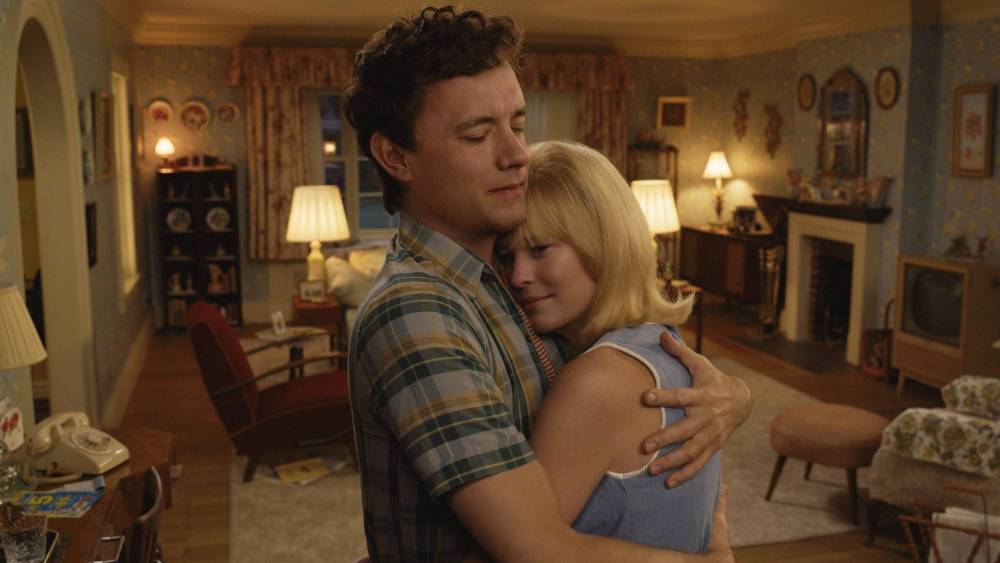
Here follows the story of one specific spot over the course of hundreds of millions of years, jumping back and forth through time. From the days of the dinosaurs through the Ice Age, from the home of the Lenni-Lenape people to the American Revolution, eventually a small colonial home is built on the property. While several families live in this house over the century (with the action all taking place in the living room), much of the film follows the Young family, Al (Paul Bettany) and Rose (Kelly Reilly), as well as their young son, Richard (Tom Hanks), who grows from a young boy to a man alongside his wife Margaret (Robin Wright).
There’s an inherent earnestness to Here that surprisingly works; a winsomeness that wears you down. Its victory is in its simplicity, despite the complex nature of the premise: the passage of time, the inevitability of aging, and the life we live along the way. From our spot in the corner, we watch millions of years play out before our eyes, yet it is the cyclical nature of life that makes the story worthwhile. We watch countless births, countless deaths, and all the little moments in between – the sex, the fights, the love, the hate, and the holidays celebrated along the way.
There’s an easier route a story like this could take, where the major events in history take focus, or are explored in their mirror imagery. After all, we witness the asteroid that wiped out the dinosaurs, a revolution, Pearl Harbor, the Beatles, and beyond. Hell, the house begins and ends with two different pandemics (the Spanish Flu and Covid-19). Yet as laughable as it might be that all these events play out in one house, Zemeckis wisely focuses on the human aspect. The way families grow, and fall apart, and come back together. The importance of memories, the wisdom of time, wasted potential, and a desire to make our lives meaningful.
These ideas are elevated by Zemeckis and editor Jesse Goldsmith, who keep things moving with a light touch that helps to elevate the themes. Images are layered upon each other, evoking the original comic by showing lyrically symmetrical events occurring in their own space and time. Characters enter in and out of the room through fade-outs and hard cuts and intercut images, juxtaposing happiness with sadness, the sweet with the bitter, birth with death. Occasionally, these edits are used to established time and mood – the evolution of music, The Beatles on Ed Sullivan as Richard and Margaret fall in love, etc. It is smart filmmaking, and helps drive home the film’s themes.
Sadly, Zemeckis just can’t help himself in his experimentation, and it ultimately hinders what could have been a surprisingly soulful film. There are three key elements Here is built upon that ultimately threaten a complete tonal collapse. The first, and most egregious, sin is the script by Zemeckis and Forrest Gump scribe Eric Roth. Every line feels forced, every emotion feels fake, characters launch into more obviously-scripted monologues than a bad Off-Broadway show. It certainly doesn’t help that many of these lines are delivered directly into camera, as characters walk downstage to stare into the camera to deliver monologues as if this were a Mister Rogers episode (the second sin).
However, the film’s most fatal flaw is in its casting. It’s not that Hanks or Wright or any of the other litany of the ensemble are miscast, per se. I mean, they are, but they do bring a certain nuance to the more aged scenes. It’s that Zemeckis has decided that they should play these roles from birth to death, through digital de-aging. That’s right, Tom Hanks plays Richie, who is born in this house and lives there until damn well near death, starts playing his character at the age of 18. This is “accomplished” through uncanny valley levels of CGI and the worst wigs you’ll ever see. At its best, it’s laughable. At its worst, it’s terrifying.
The performances beneath this godless façade are mostly decent, at least in their best moments. For example, Hanks and Wright are effective when they play characters their own age in their quieter moments, although less so when in their 20s. Bettany has some incredible moments as a PTSD-riddled World War II vet, but cannot deliver on his big monologues. Few other characters (not even big names, like Michelle Dockery) make any sort of impact, although I will say Ophelia Lovibond and David Fynn are memorable as an artsy couple who owned the house before the Youngs. Still, everyone’s at least effective in their roles.
Here is a conundrum of a film, emotionally resonant and technically broken. I suspect if I were to think about any single detail in a meaningful way beyond the empathetic, this film would fall apart. The CGI is bad, the script godawful, and the actors over-the-top. Yet there is a beauty at the core of this film, an undeniable heart that feels winsome and honest. I understand why this film is bombing at the box office. I’m not even sure it has an audience in the future beyond film school. But if I’m being honest as a critic, there are far worse films out there with less heart than Here, and worse ways to spend an hour forty on a rainy afternoon.
B-
Here is now playing in theaters nationwide


Add Comment