
I grew up in a small Midwestern town (and still live there, at the moment). I went to college in an even smaller town not far from the Ohio-Pennsylvania border. Why do I tell you these things? Because in recent days online and media discourse has begun dissecting and discussing the portrayal of the Midwest – in the news, in pop culture, and beyond. Part of this is because of the election, where several states became hotly contested battlegrounds between two candidates with vast “working joe” appeal. Another reason is the release of Hillbilly Elegy, Ron Howard’s adaptation of the best-selling memoir of the same name. Somehow the film has become a cultural hot-button as critics undergo criticism for condescendingly writing off the film’s merit – a story about achieving dreams and escaping the cycle of poverty that still haunts the Midwest. Well, what both sides of this debate lack is an insight into the actual Midwest experience. So with my own personal history and understanding of filmmaking as a whole, I’m here to tell you that Hillbilly Elegy is not a bad film for portraying the struggles of the average American. It’s a bad film because it condescends to its characters and its audience with a misleading, overwrought story and features a murderer’s row of great actors giving some of the most overacted performances of their careers.
J.D. Vance (Gabriel Basso, played by a child by Owen Asztalos) is on the verge of achieving his every dream. Despite a broken childhood with his abusive mother Bev (Amy Adams), her string of failed relationships, and the constant infighting between Bev and her feisty mother Mamaw (Glenn Close), Vance has managed to work his way out of poverty in the dying town of Middletown, Ohio, into the Marines and eventually all the way to Yale Law School. However, despite his efforts to put his “hillbilly” past behind him, he still sticks out like a sore thumb at parties, unable to relate to the fancy Ivy Leaguers he associates with. And what’s more, on the eve of his big interview to get an internship that will allow him to stay in school, he receives a call from home: Bev’s started using again, and this time it’s heroin. And so J.D. must return to the home he’s so desperately clawed his way out of, and confront the past that made him the man he is today.
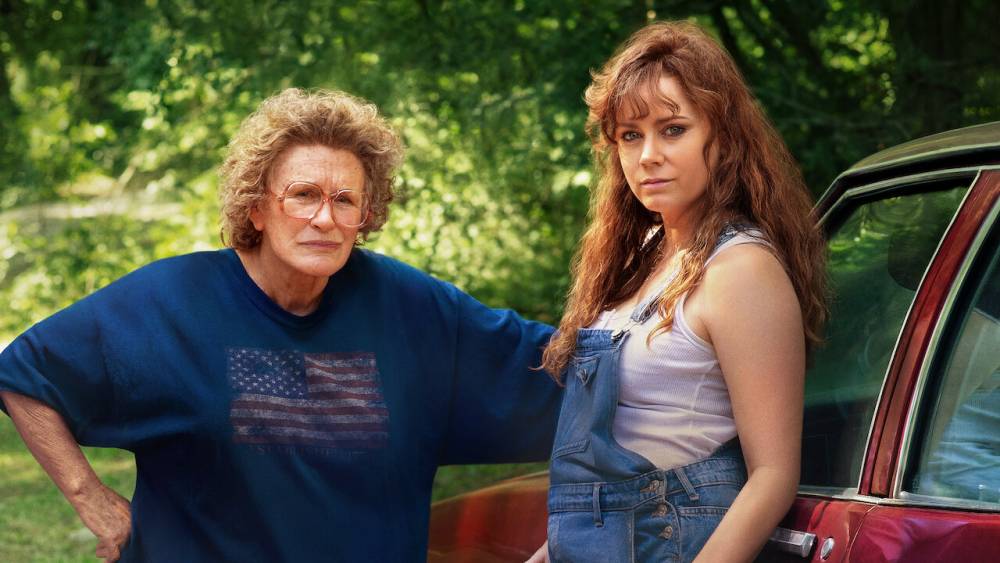
The discourse around this book and film has already become increasingly tedious. Either the message of understanding the struggles of poverty in the Midwest is completely scoffed at, or condescending intellectuals (presumably in bow ties and dopey, confused looks on their faces) claim that this sort of nonsense is completely accurate. As per usual with Hollywood’s attempts to understand the lower-class Midwest, they are all wrong. None of this is necessarily Howard’s fault, or Adams, or Close for that matter – in Howard and Adams’ cases, they actually lived this lifestyle for much of their childhood, and have more understanding than anyone in how to tell it (in theory). It’s just that in all of Hollywood’s hundreds of thousands of attempts to pander to Middle America, and to capture their triumphs and struggles, the only two properties to ever find true success are Roseanne and The Middle. Whereas those shows found a beating heart of trying to get through life one paycheck at a time in a small town where everyone is generally nice on a surface level, the average Hollywood production prides itself on an incredibly attractive actor or actress putting on a ratty pair of overalls or an ill-fitting dress and going without makeup to show how The Other Half Lives.
Hillbilly Elegy is exactly that type of condescending claptrap – and not just because Amy Adams and Glenn Close both wear those exact outfits I just mentioned. From the very opening, the film paints its characters with a wide brush, with an on-the-nose sermon by a preacher declaring that the prosperous 90s never reached the Kentucky land. Now, this could have been an interesting enough topic, even in its haphazard state. Only…it’s the only time the film mentions it. In fact, nothing in the film even remotely explores the ideas present in this monologue. Instead, we get films that prove that the filmmakers clearly don’t know the subjects they’re portraying, or condescend to them completely. The film’s attempt to juxtapose “country bumpkin thrust into a hoi polloi world that doesn’t understand and mocks him” lacks the intellectual and philosophical backbone of the average Beverly Hillbillies episode. It is an actual point in this film that he doesn’t fit in because he went to a state school, doesn’t know the difference between Chardonnay and Sauvignon Blanc, and doesn’t know which silverware to use during a fancy dinner. They only know about his hometown because they “watched a miniseries on the Hatfields and McCoys” (side note: the miniseries in question wasn’t released until two years after this film takes place. This isn’t important, but shows the level of laziness on display here). Oh, and he flips out when they refer to Ohio as “redneck country” despite having just called it “hillbilly country” thirty seconds prior. While it’s certainly accurate that the Ivy League comes with a level of snobbery towards those without a silver spoon in their mouth, it is important that films learn to show, not tell, and this film is telling up a storm.
The sequences within the family’s inner life are even worse. You see, the Vance’s aren’t just poor, they’re Nobly poor. They’re the kind of poor that collects eggshells as “family heirlooms,” high schools resemble stills from Duck and Cover, and has to fish drugs out of the toilet when they hit rock bottom. You know, Movie Poor. There’s a laugh out loud moment where, during a funeral, the poor people of Kentucky line the streets to salute a fallen Vance. When J.D. asks Mamaw, “Why they salutin’?” she responds, with a forced conviction beneath Close’s status as an actress, “Because we hill people, honey. We respect our dead.” This is what I refer to as Noble Poverty: the stripping of all hardship and reality to paint the poor waifs as suffering with Dignity. And what’s most ridiculous is that it mostly seems exaggerated. Take, for instance, J.D.’s sister Lindsay (Haley Bennett). According to the film, after getting impregnated by her high school boyfriend and future husband, Lindsay’s family remains so poor they live in a broken-down shack and have to wash and reuse plastic silverware (not something I ever experienced, but it’s possible some people do do this). That’s all well and good, showing the alternative to J.D.’s journey to Yale and beyond. Except, during the closing credits, we see photos of Lindsay and her family during this time…and they’re comfortably middle class. Their house is relatively nice, they’ve got several photos from beach vacations, and the clothing they wear is hip and modern (for the time). They’re nowhere near the level of poverty that has to recycle disposable cutlery. Whether or not Vance’s book is this fictionalized is beside the point (I’ve heard compelling arguments both ways); the film itself is perpetuating an unrealistic and dishonest myth that undercuts its very message. In fact, the only scene that rings true about this kind of family in this particular area during this time period is when Adams’ Bev, upon seeing a photo of J.D’s Indian girlfriend Usha (Frieda Pinto), asks “What is she?” It’s the kind of unintentionally misguided question that would come from the remarkably white hills of Kentucky and Ohio.
What’s perhaps more insane about Hillbilly Elegy is its insistence on both teaching and learning the wrong message. I’m not someone who believes characters must always make the right choice, or cannot commit heinous acts. That’s what makes them interesting and human. But what I am concerned about is whether the characters emerge with the right takeaway. Take, for example, J.D.’s fondness for his original Kentucky home. This is a strangely ironic statement, considering the only moment we see in his Old Kentucky Home involves a group of redneck teens trying to murder him and his uncle punching a 12-year-old in the face – accompanied by the message “We Vances don’t start fights…but we sure as hell finish them.” Now, this isn’t an inaccurate portrayal of Midwestern mentality. But it does seem weird to advocate grown men going around beating up teenagers. At least in Roseanne, which portrayed the idea of fighting for one’s family, it came with complicated repercussions and an overall message of “violence can’t erase violence.” Then there’s the way the film portrays the characters’ casual racism, like the aforementioned scene with Beverly, or Mamaw’s various rants against the Polish and “those people on food stamps.” It’s one thing for the film to show the characters making such observations and comments. Hell, it’s even location accurate. But the film has to at least be aware that such condescension, belittlement, and bigotry isn’t ok, and I don’t think it reaches that conclusion. No, it’s too busy making blanket, inaccurate statements about how marijuana is a gateway drug while consistently ignoring Bev’s root causes of abuse and hospital misconduct to address its characters’ rougher edges. It is clear Hillbilly Elegy learns the wrong moral about itself, and that’s what’s so tragic.
It’s tragic because it could have been something great. If Howard and writer Vanessa Taylor had just understood what makes this story so interesting, this film really could have been something special. For Hillbilly Elegy isn’t some charming look about some upstart and his wacky family, as Elegy would have you believe. No, this is supposed to be a tragic story about a man who worked his ass off with three jobs who still only barely escaped the cycle of poverty (not to mention the aid of the 2009 GI Bill, a detail Vance mostly leaves out of his retellings of that period of his life). The film glosses over the glaring flaws in the American system – its ignoring of vast, inescapable poverty, a flawed health care system (Bev is mocked by the doctors, her former coworkers, for her addiction and dumped due to a lack of insurance, but the film paints all this as her fault), and the lasting ramifications of abuse – to instead make the story about the rascally antics of a kooky grandma and her boring-as-sh*t grandson. Which reminds me – J.D. has no character arc in this film. While he’s a fascinating character in real life, and could have been oh so complex here on film, the film’s J.D. changes motivations from scene to scene, with his only consistent trait being that he’s clumsy. And don’t get me started on Bev, a character Amy Adams clearly plays as bipolar without any indication from the film around her, leaving moments like her attempt to drive off the road when J.D. mentions her trouble with relationships, completely baffling and hilarious. Perhaps the character choice would make more sense if the film had actually explored the cycle of abuse, instead of simplifying it through sequences of Mamaw lighting her husband on fire – or worse, justifying it, like the moment where J.D. “heroically” lies to the cops who rescue him from his mother’s brutal assault. So many interesting moments that drive to the very soul of America’s dark, forgotten bottom, and yet that’s sadly not the film we are presented with. It’s like if Taxi Driver were a romantic comedy.
Now, despite all of these flaws, I do want to give the film some credit. Despite Taylor’s garbage screenplay, Howard manages to find some weighty flare to balance out the material. For example, an early scene shows a “family portrait” spark a montage of every generation who ever lived in their Kentucky house, going back to the 1800s. While most of the film’s flashbacks are horribly mishandled, occasionally that old Howard charm shines through, such as a sequence showing young Mamaw arriving in Middletown, Ohio for the first time juxtaposed with the city’s current decline. And there are several subtle moments that hint at the type of film Howard could have made with a better script. For example, while the film mostly shies away from the opioid epidemic that clearly ruined Bev Vance, there’s an incredibly subtle moment where every resident at a neighborhood barbecue recommends a rehab clinic because “I’ve got a [insert relative] who stayed there.” Moments like these show both a sense of community and allude to the way drug companies ravaged and destroyed Middle America over the last twenty years. Hell, I’d even take subtle moments that get gilded to death, like the moment where J.D. realizes for the first time that his grandmother is going without food to support him that naturally leads to a dramatic Hero’s montage. It’s a subtle moment nearly destroyed by clunky editing and a pretty-but-overbearing score by Hans Zimmer, but at least it’s an attempt. I am more than capable of recognizing the movie’s merits; I just wish it had more of them.
As for the acting, it’s…a rather mixed bag, all across the board. Amy Adams’ Big Character Choice seems to be wearing ill-fitting clothing, but there’s something to her performance that captures the eye. Yes, for the most part, she alternates scene to scene between underacting and overacting, but occasionally she finds the sweet spot between the two that emphasizes little, honest touches that elevate many (not all, but many) of her Dramatic Sequences. Of course, on the other end of the spectrum, there’s Glenn Close. From her first scene, Close is making CHOICES, hamming it up in a rather striking Irene Ryan impression. Close, like Daniel Day-Lewis, is a master of physical choices, and watching her transform into a cancer-ridden, cigarette-smoking, foul-mouthed Kentuckian is certainly impressive, but almost everything else about her performance, from her line delivery to her interactions with human beings, is over-the-top in a way I never thought I’d see from such an iconic performer. Gabriel Basso is something of a milquetoast non-entity as J.D. Vance, but I’d take milquetoast over the obnoxiously unwatchable performance from Owen Asztalos as young J.D. any day. Freida Pinto is amiable as Usha, and honestly may be too good for the rest of this cast. And Haley Bennett, an actress I otherwise enjoy, gives a performance I can only summarize as “not great.” I don’t fault any of the performers for this film – they did what they could with what they were given. But I do wonder, had they tried any harder, or sculpted their performances any sharper, if the film could have found itself a bit more, instead of the confused mess it remains.
Hillbilly Elegy is just a mess of a movie, one of those rushed adaptations meant to capitalize on fifteen minutes’ worth of fame and the Story of the Week. Ironically, the film made me yearn for The Blind Side – the 2009 Oscar-winner was equally dubious and poorly written, but it had the benefit of Michael Oher’s remarkable story and Sandra Bullock’s honed-in performance. And as the case may be, recent tweets by the real-life Vance seem to indicate that he tried to market his own story as “The Blind Side but without that pesky white guilt.” Ultimately, my big takeaway from Elegy is that this film had so much potential – if it had just found itself in the hands of a director who understands salt-of-the-Earth people, like Barry Jenkins, or Richard Linklater, this could have been a moving picture. But as it stands, it remains a caricature of what it means to live in the Midwest, to live in poverty, and to survive in a system stacked against you.
C-
Hillbilly Elegy is now streaming on Netflix


Add Comment