
Humanity loves an underdog story. We love watching people work hard against all the odds and somehow, come out on top – or if not come out on top, then at least find happiness. It’s why the most beloved American movie (if not, perhaps, the greatest – not that I’d argue that title) is Rocky. Not only a perfectly structured character study, Rocky captured hearts and minds because of the parallel story of its lead, Sylvester Stallone, who wrote the script while barely avoiding homelessness and turned down massive paychecks in order to act in his own film – which launched him to superstardom.
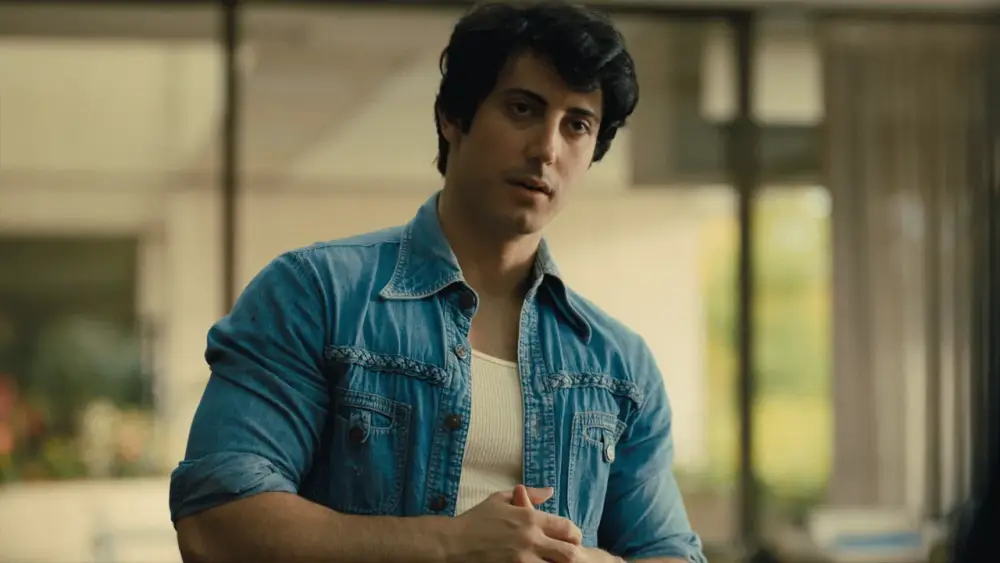
It’s a story good enough to be its own movie…and that is exactly what has now occurred with I Play Rocky, the annual by-the-books biopic. What makes I Play Rocky striking is twofold. Primarily, it features Anthony Ippolito’s soulful propulsion of an otherwise-ordinary story. On the other hand, there’s director Peter Farrelly’s attempts to sabotage him along the way through a failure to trust the audience. The struggle makes for a challenging watch at times, but ultimately, like Rocky itself, the spirit of the lead wins out.
In 1974, struggling actor Mike Stallone (birth name Sylvester, and played by Ippolito) found himself at the end of his rope. With limited roles due to his meaty build and speech impediment, at times he found himself living in the street and working in adult films as his only way of practicing his craft. At the behest of his girlfriend, later wife Sasha (AnnaSophia Robb), Stallone tries his hand at screenwriting, hoping to find the piece to get his foot in the door.
After multiple false starts, he eventually knocks out a screenplay titled Rocky over three days. The studio loves the story, but is not so keen on giving the lead role to an unknown performer. Soon Stallone’s will is challenged: how long can he hold out against studio execs throwing exorbitent fees his way, and can he deliver an under-budget, on-time independent film to prove his worth?
It’s easy to like I Play Rocky because it actually feels like a story, rather than a retelling of facts. So many biopcis fall into the habit of “event, event, event, look how accurate our lead’s impression is!” We’re expected to accept the narrative because “that’s what happened” – even though 80% of the events the film purports are made up. While this formula has had success before (see: Bohemian Rhapsody), it is an eternally lazy crutch that leaves films bare underneath the surface. At the very least, strive for A Complete Unknown’s level of insight!
I Play Rocky actually tells a story. It centers a charismatic lead character in Stallone, who is, like us, flawed and ambitious. It doesn’t gloss over his more painful moments as so many showbiz stories do – we get to see the infamous softcore film, and instead of writing a perfect script from the jump, Rocky emphasizes 18 terrible scripts that came before, eliminating any “prodigy” narrative. And by making him a human being, it makes his interactions with the hard-nosed corporate types in Hollywood mostly more entertaining. Sure, sequences like the hiring (and firing) of a fight choreographer are bad, but watching them figure out the budget, or realize the magic of the Stedicam feel miraculous.
Sadly, while the performances and story are strong, I Play Rocky inevitably and fairly frequently falls into the dangerous trap of Member Berries. So much of the film is built around references to Rocky, ranging from benign to egregious. It’s already irritating to see that Stallone’s daily workout is essentially the same as his iconic montage, or that when we meet Robb as Stallone’s future wife, she’s dressed identically to Adrian. But is there any more inherent lack of trust in an audience than showing execs listen to “Gonna Fly Now” and scoff “This will never catch on!”
My first instinct in these situations is to blame the writer, Peter Gamble. However, the script is far too smart in other scenes for Gamble to be that stupid (the filming of the Rocky-Mickey scene has a shocking amount of nuance compared to the rest of the film). No, the blame here seems to lie solely with Farrelly. Already a rather pedestrian filmmaker, Farrelly’s touch can be seen in several of the film’s more egregious shortcomings – ranging from ugly staging that fails to capture 70s grime to attempting to instill laughs (through very dumb jokes) in the middle of bitter, realistic fights within a marriage. Farrelly is a director who aims for the lowest common denominator, and it undermines what could otherwise be a very good film.
Thankfully, the film’s heart is carried by a tremendous performance by Ippolito. Not only does he capture the look and voice of the young Stallone, but he also emphasizes the bruised charm that endeared the superstar to so many. There are moments where he fully disappears into the role, to great effect. No performance is as strong as Ippolito, although Tracy Letts as a stuffy exec and Stephan James as a cocky Carl Weathers fully understand the assignment. Robb and an unrecognizable Toby Kebbel as producer Robert Chartoff are both serviceable, while Matt Dillon does too much in his supporting role as father Frank Stallone. And PJ Byrne as producer Irvin Winkler is…well, he’s PJ Byrne.
I Play Rocky isn’t a flashy film. It doesn’t reinvent the wheel or tell us anything we don’t already know. It’s not even an underdog, like the story it’s based on. But like Rocky, it makes audiences feel good. It’s a testament to the power of a good story and great actors, even when the screenplay and especially the director can’t muster the same energy. I Play Rocky is a fine film about a great film, but I’d be hard pressed to say you’d leave disappointed.
B
I Play Rocky will premiere nationwide next Friday, November 20th, and is currently playing in select theaters. It will be on Amazon Prime Video in the near future


Add Comment