
Despite the fact that Covid – and specifically the Delta Variant – continues to ravage the world around us, most people continue to embrace the fact that we are seemingly in the endgame. And part of the post-mortem on any major disaster like this is the seemingly vital question: who’s to blame? There’s a lot of that going around right now – hell, we’ve already seen a few mildly intriguing documentaries on the subject. But out of all the dreary, generic documentaries I’ve seen on the pandemic, none of been as utterly fascinating, or as adept at cutting through the bullsh*t, as Nanfu Wang’s In The Same Breath, a film that exposes the propaganda and cover-up going on in China with the skill of a grand conspiracy thriller – and then turns its lens towards the United States’ own shortcomings, be it the President, a supposedly trustworthy NIH figure, or Wang herself.
In late 2019, a handful of Chinese citizens began to complain of an inability to breathe, along with a handful of other symptoms. Coming just days before the big New Year’s celebration, Chinese President Xi Jinping had these individuals rounded up and imprisoned, ignoring any and all warning signs. As the individual cases transformed into a full-blown pandemic, Xi pivoted the cause into a propaganda tool, hoping to change the narrative. However, as director Naifu Wang sets out to untangle the web of lies surrounding the pandemic, she found herself embroiled in a similar string of lies – this time in her home country of the United States, who embraced a similar narrative and cover-up all while condemning the Chinese government for their own actions. And as Wang realizes she herself was misled by misinformation, she must ask herself, “How do we handle when the misinformation comes from those we are supposed to trust?”
One of my favorite styles of documentary is the “conspiracy thriller” – a film that stages its story, action, and research as if it’s a mystery movie, although what’s occurring is very, very real. Director Naifu Wang has made a career out of criticizing and deconstructing the Chinese government’s totalitarian policies, with her previously acclaimed film diving headfirst into the One Child Policy. Wang approaches Breath with the same level of care and detail that, say, Alan Pakula did making All The President’s Men. She lays out her case brilliantly and effectively – during an opening montage of happy, upbeat news footage, she casually dropped in brief footage about “8 agitators” being punished for lying about an unknown disease. Later, after backtracking to show the start of the pandemic (a full two months earlier than first reported), Wang utilizes found footage from 2019 of people coming into drugstores to complain about coughs, chills, difficulty breathing, and a fever, one right after the other. The sequence goes on for almost two uninterrupted minutes before revealing that these patient zeros would later become the very agitators arrested during the prologue. It’s the type of reveal Sidney Lumet or Alfred Hitchcock would envy, with government officials secretly writing speeches for the doctors and eliminating access to witnesses, and watching Wang thoroughly break down the efforts of the propaganda machine is an absolute thrill.
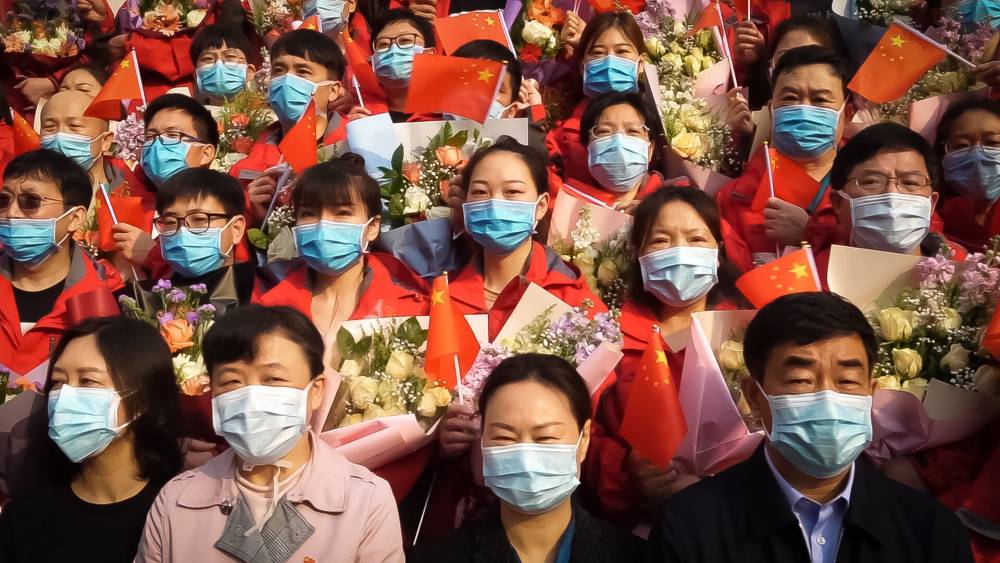
However, perhaps more insidious than the cover-up on display is the way China diverted attention through propaganda. As Wang notes as she begins dissecting the Chinese narrative, “when the government tells us where to look, they’re also telling us where not to look.” After realizing they had lost control of the pandemic, the Chinese government pivoted from “there is no disease” to “there is a disease, but we’re winning.” Stories of Covid were restaged as television dramas, with heroic doctors winning the fight. However, Wang breaks down exactly how these optimistic stories were simply distractions from the issues at large. While doctors and patients showed up on the local news to sing the country’s national anthem, ambulance drivers had to drag gurneys through the streets with the roads shut down. And what’s worse, when the propaganda pivots so quickly, it leaves those most easily susceptible to its power confused and disoriented. One of the film’s most heartbreaking examples comes when a man shows up at the hospital trying to see his son, unable to comprehend that the boy is dying because the government convinced him there was no disease. In a shockingly powerful callback, the same man shows up later in the film, crying over his loss while the news footage proclaims the Covid battle a “triumph.” And even when people may have an inkling that there’s something fishy going on, Wang finds that they are willing to overlook it, due to the U.S.’s threats of lawsuits and their overall rhetoric. It’s easy to understand – patriotism is such a strong force that some would rather blatantly ignore facts than risk tarnishing their country’s image. As Wang later notes, “Disasters become propaganda tools. They never inspire change.”
Of course, the meaning of the title’s “In The Same Breath” is not just a reference to the lies and doublespeak of the Chinese government. It also refers to the hypocrisy and similarities to the United States response too. Now obviously, if the failures of the U.S. response and ensuing cover-up are to be addressed, it must obviously start with President Trump. Even before reaching the previous administration’s tonal whiplash surrounding the pandemic, Wang takes a few opportunities to paint a humorous, and occasionally scathing, comparison between Xipeng and Trump – both of whom would hate the comparison. Hell, there’s even a speech on the former’s part that reads as something of a “Make China Great Again” moment. But Wang isn’t interested in drawing surface-level comparisons here. No, she’s more interested in the ways that the countries came to the same catastrophic conclusion despite completely contrasting political systems (authoritarianism vs republicanism). Both leaders refused to acknowledge the threat of the virus, using terminology like “No Clear Evidence” and “Preventable and Controllable” to abate fears and concerns, and resulting in tonal whiplash when forced to pivot into lockdown mode. Both were more concerned with preventing their counterpart from gaining the upper hand and exploiting weaknesses if errors were admitted. And both were so focused on keeping their economies healthy and strong, they overlooked the thousands likely to die in order to save face. By the time overall death numbers are revealed, it is impossible to avoid looking at either China’s or the U.S.’s numbers without a healthy dose of skepticism. The film isn’t as deep a dive into the Trump administration’s failures and cover-ups as, say, Totally Under Control, but by avoiding the finger-pointing and finger-wagging, the overall commentary ends up becoming all the more incisive.
Of course, it is such an easy out to just blame Trump and move on. Thankfully, Wang refuses to play the partisan game as she breaks down the churning of the propaganda machine on a global scale. Wang is interested in cutting through the bullsh*t of the last year. This extends beyond the former administration. It’s the patting on the back that occurred in the medical and journalistic communities for “holding truth to power” despite their own culpability in ignoring warning signs. It’s Ron DeSantis lowballing numbers and silencing doctors to avoid shutting down his state. It’s Anthony Fauci and Anthony Cuomo both going on TV to state that no shutdown was needed, and feeding the eventual anti-mask lunacy with their eventual about-faces. And it’s Biden triumphantly declaring success in vaccinations before rollout plans were even in place (but he never called it the flu, I guess?). Wang refuses to let any of these individuals or institutions off the hook, pointing out how Chinese whistleblowers warned of the pandemic in the United States for months to no avail, being ignored by MSNBC and CNN and mocked by Fox. Doctors are interviewed who were fired “for hysteria” after breaking from the hospitals’ pre-approved scripts for trying to reveal ineptitude. In the most shocking twist of the film, Wang points out that she could not condemn the anti-maskers after she herself was suckered by her faith in the United States and the institutions. And that’s the kicker – as ironic as it is, “no freedom” and “too much freedom” end up at the same conclusion when subjected to the whims of the propaganda machine.
And all the way, Wang keeps things moving with deft, dazzling skill, thanks to her abilities as a filmmaker. This is smart, bravura filmmaking from beginning to end. This extends to the editing by Wang and Michael Shade, which utilizes some creative techniques including bookended New Year’s celebrations with ominous-sounding bells and a haunting “what could have been” montage showing the alternative where Xi, Trump, and all the other governments of the world had responded appropriately. But it also extends to the film’s entire narrative aesthetic. The reason Breath works better than most Covid documentaries so far is that, more so than Totally Under Control or 76 Days, it keeps the focus squarely on the human cost of the pandemic. The underground photojournalists hired to investigate China talk to real people suffering real consequences of the decisions and propaganda. The interviewees, whether they’ve bought the propaganda or not, all express their honest opinions, giving the conversations an earnestness missing from boring “experts” or political pundits. And when the film ends with dedications to the dead, a list of the still-rising numbers, and a montage of “disappeared” activists, it reminds you of the hyper-real consequences of the entire ordeal in ways that lists of failures just won’t cut. If I had but one quibble, it would be that I wish Wang had a few more clips of the U.S. and China condemning each other’s mishandlings of the pandemic. The film insists that it was a common occurrence, and it may seem like common knowledge (we’ve certainly seen enough clips on our end), but if they really wanted to drive these comparisons home, showing is always better than telling.
In The Same Breath is an insightful, intelligent documentary. Hell, I’d go as far as to use that dreaded I word: Important. As the art and practice of journalism slowly die under the weight of mega-corporations picking stories to death and twisting narratives to their own means, documentary filmmakers must step up to cut through the mess and find new, engaging ways to get the truth to the people. Its importance cannot be overstated. After all, Wuhan rang in 2021 the exact same way as they rang in 2020. The U.S. seems reluctant – and in some places, aggressively against – the idea of reinstating mask mandates to slow the Delta Variant. The propaganda machines in both countries show no signs of slowing down. And that’s why films like In The Same Breath and directors like Wang are so important: to counteract the lies and make people question what they’ve perceived to be true.
A-
In The Same Breath is currently streaming on HBO Max, as well as in rotation on HBO


Add Comment