
Jon Stewart left his beloved show five years ago, and since then there’s been no one to cut through the bullsh*t. We’ve witnessed this country go farther divided than any point in the last fifty years, bolstered by a media that feeds off that division and secretly desires the chaos in Washington, and instead of any one voice speaking truth to power and dissecting the madness, we’ve watched comedians, pundits, and public speakers eschew common sense and logic to buy into the “Cheeto Man Bad” mentality of the #Resistence – or just wholeheartedly buy into the nonsense from Fox News every night. Even the few voices willing to hold a fire to the feet of Washington politicians on both sides of the aisle, like Chris Wallace and Jonathan Swan, are shackled by the agendas of greater media corporations. Where is the voice who commented and condemned on two different presidencies, and the asinine ways both were covered? Who had the freedom to go on CNN’s Crossfire and criticize the show, network, and Paul Begala and Tucker Carlson so badly he got the show cancelled and the hosts fired from the network? Thankfully, that voice has returned, and while it’s still peddling some rusty, middling jokes that would have felt dated 50 years ago, each and every punchline finds itself in service of one of the sharpest satires of Democrats, Republicans, and the broken election economy I’ve seen in decades.
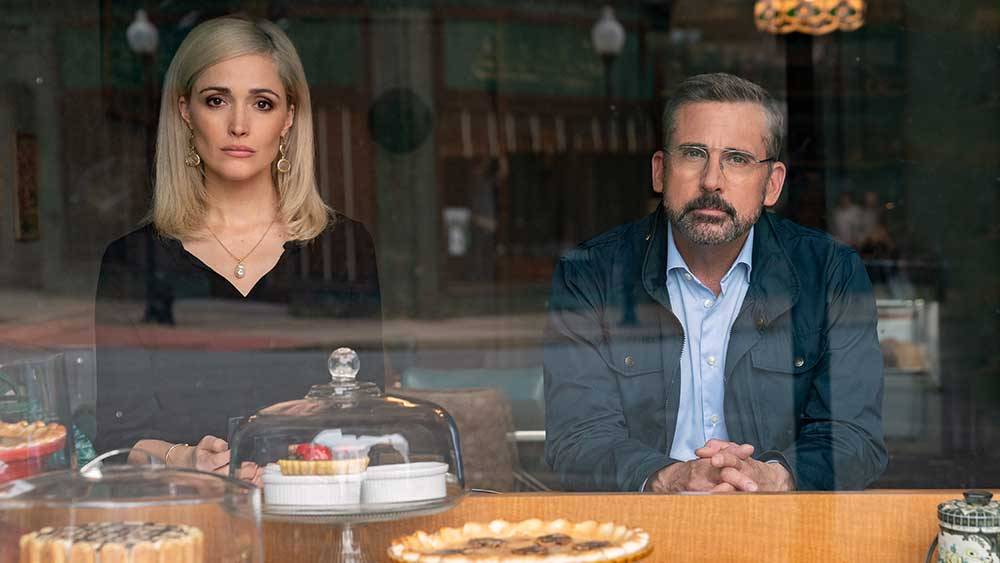
Gary Zimmer (Steve Carell) is slowly losing his mind. After overseeing the historic loss of Hillary Clinton to Donald Trump in the 2016 election, Zimmer’s massive ego has earned some nasty bruises. Understanding that the Democratic establishment needs to change if it wants to recover in the 2020 election, Gary seizes on a story from the small town of Deerlaken, Wisconsin. A local farmer, Colonel Jack Hastings (Chris Cooper), has gone viral thanks to a video of a rousing speech he delivered at a town council meeting. Determining that the Democrats need to appeal to small-town voters in swing states, Gary decides to run a little experiment: if he can help Colonel Hastings run for mayor and beat the long-serving Mayor Braun (Brent Sexton), then it would prove to the DNC that they can reach across the aisle and steal some of the precious swing state voters that were lost in 2016. Gary sets up camp and begins to traverse the alien world of small-town Midwestern life as he tries to make the case for his candidate. However, when the Republicans take note, and realize that they can demoralize their opponents even further if they put up an equal fight – enter Faith Brewster (Rose Byrne), brilliant Republican strategist and Gary’s archrival/sometimes lover. And soon begins a battle of wits of comedic proportions – one that leaves the fate of a town in the balance, and which will, by the end, reveal every broken facet of the American Electoral System.
A good portion of the negative reviews currently filed against Irresistible mention its tone, and on paper, I kind of understand this sentiment. Several plot points feel as though they’re drawn directly out of the Frank Capra playbook from the 1940s, but made by a far less interesting director – a light satire filled with lots of archetypal people who learn valuable lessons. Carell’s Gary is no Jimmy Stewart, but he does fill the role of the pompous city boy who goes to the country to learn about the simple life. He’s a Washington insider, with photographs with Bill and Hillary who can’t even figure out how to open a twist-off Budweiser. It seems, for the first two-thirds, as though the story is about learning to love Middle America again through the charm of a small town girl and the magic of the perfect donut. Hell, even the jokes about small town life seem directly out of a cheesy, 90s-esque send-up to the Capra era – the margin of error in town is three people, the townsfolk are all idiosyncratic and know each other by name, and their Internet is still dial-up. If you were to watch this setup without knowing Stewart’s name, you’d probably wonder to yourself, “Yeah, I guess it’s charming, but why is this Hallmark movie getting released in theaters?” And therein lies the brilliance of Jon Stewart’s storytelling – just like in real life, the Capra story is just a façade. Stewart brilliantly stages his film with cunning allusions to lure us into a false sense of security. By placing us with Carell’s Gary, and utilizing Carell’s Nice Guy image and inherent likability, he structures the film as a Capra-esque light satire – a Mr. Smith Goes To Washington, or Mr. Deeds Goes To Town. Thanks to the setup, you imagine the film is going to go one of two ways: it’s either going to build off of the “City Guy Goes To Small Town And Falls In Love,” like Miracle Town, or it’s going to be a toothless, jokey story about a flawed skeptic learning his lesson, like Mr. Smith. If it were to adhere to these tropes, it would be a far lesser movie. The material would feel hackneyed and unearned, no matter how funny the one-liners are. After all, Carell’s love interest (Davis) is significantly younger, and the two have no chemistry. However, Stewart uses this entire set-up as a joke, utilizing our audience expectations to subvert for something smarter, funnier, and, dare I say, better.
Without giving away the farm on what the film is trying to do, and the twists and turns the seemingly simple story ends up taking along the way, I can say that the real message here is that the Election Economy – that is to say, the money that is spent on pollsters, spin artists, and media consultants to turn elections into a sporting event as opposed to electing someone to actually help the people – is a broken, corrupt system that needs to be at best reformed and most likely dismantled. It’s why the film doesn’t go after any one particular party. The people of Deerlaken, Wisconsin are in no way actually Democrat or Republican. Neither party has helped them in over fifty years’ time. What they desperately need is someone who can address the issues that need addressing. Neither Trump nor Hillary was going to prevent their businesses from shuttering – as one character notes late in the film, “You only show up every four years because we’re a swing state. Then you leave, and we’re stuck with the same problems as before.” It’s why the film’s opening montage is the song “Still The Same” by Bob Seger, played over a montage of real-life politicians schmoozing and politicking voters in condescendingly unrealistic ways (eating hot dogs, posing at bowling alleys, etc.). The film condemns both political parties for setting themselves up in bubbles and focusing on made-up issues to distract from the very-real threats most Americans face every day – disappearing jobs, Covid, etc. In fact, I dare say the film’s harsher on Carell’s Gary than it is on Byrne’s Faith – Faith at least is self-aware in her actions. As she casually (and astutely) notes in her first major appearance, “$20 says I do better with fear than you do with shame” – an accusation he instantly shrugs off, despite its truth. Gary tries to take the self-righteous route while f*cking over constituents. His cluelessness can be found from his first appearance in town, when Colonel Hastings’ favorite song “Rhinestone Cowboy” comes on and he immediately changes it to Terry Gross. Hell, lest you think Stewart views one party’s culpability as lesser than the other, he literally has Faith and Gary engage in constant hookups – a satire of relationships like Carville/Matalin and the Conways and a sharp satire of how both parties are two sides of the same coin.
No, Stewart is well aware of the culpability of both parties, and he knows the true culprit behind the broken system: money. Stewart’s sharp, well-laid out thesis makes it clear that by allowing interest groups and lobbyists to throw money at every facet of the system and transforming our free elections into sports-esque farces, we lose sight of both the importance of our vote and the necessity to elect people who will actively fight for change. We see inside the fundraising rooms, where actual beliefs and platforms are lost inside the hoi polloi of New York only wanting to badmouth the opposition. These interest groups are portrayed as so inside their own bubbles that when they hear Hastings give a speech criticizing the role of money in politics (the only honest thing any character says in the entire film), it ironically earns him more funds because the elites can’t see it as a criticism of them. The message really starts to kick into gear as SuperPAC money seeps its way into the race and Gary starts to fire the earnest townspeople that want to make a difference to instead hire Washington bigwigs who lack any sense of understanding about the town and its issues. And in my favorite bit, we get a chance to see the billionaire donors who control the election, on both sides, in all their bizarre glory – the Republican donors are a group of older white men in wheelchairs, while the Democratic donor (who may be a Soros satire) is a decrepit robot man played by Bill Irwin whose robotic voice speaks in the Hava Nagila. It’s a brilliantly weird moment that comments on the weirdos that really run our country. The money even controls the media, as we can see the way that the desire to play the game has overridden any semblance of actual journalism. MSNBC is lazily left without any sense of self-awareness or investigation. CNN is so desperate for scoops they believe any lie they’re told and cut away from real journalism to talk to 48-head panels about who will run in 2028, and Fox and Friends is basically just itself, using giant overexaggerated headlines and pompous declarations of patriotism to win the hearts of its viewers. It’s all funny commentary until it starts to hurt people – the desire to focus on non-issues results in a suffering man’s struggles with OxyContin to become a national headline, simply as a means of discrediting the opposition. Near the end of the film, Gary quietly notes that “An election isn’t about politics. It’s just math.” And I don’t think any line could sum the film up any better.
Now, the thematic material did the bulk of the heavy lifting in terms of my appreciation of Stewart’s vision. But in terms of the execution, the film is a bit of a mixed bag. Basically, your mileage may vary depending on how much you can appreciate relevant, but routine jokes delivered in fairly entertaining ways. For the most part, I could look past the obviousness to relish in the deliveries, mostly by Carell and Byrne. They have a charming repartee throughout the film, and they can make the most basic jokes shine. Carell’s pomposity and lack of self-awareness (something shared with Michael Scott from The Office) make for some delicious line reads, including a scene where he tries to have cows pose for an announcement video and he declares “Don’t put all the black cows in the center – he’s running as a moderate!” Meanwhile, Byrne’s lines are mostly delivered with a sharp sense of sardonic wit – she so easily delivers banal lines like “This turd of a city…sorry, ‘Heart of America,’” and when asked if her slogan is “Deerlaken Uber Allez,” she perfectly responds “Well, we were going to go with ‘I’m With Him,’ until we remembered how f*cking stupid it sounded.” And a lot of the subtler political jokes earn some big laughs. There’s a series of terrible political ads that use hilariously bad slogans like “A Redder Kind Of Blue,” “Not Your Daddy’s Democrat,” and a hilariously over-the-top ad for Republican Mayor Braun. The SuperPACs are all given ridiculously long, entirely pandering names that get funnier and funnier with each revelation. There’s a high schooler who jumps ship from Gary’s campaign team because “the Republicans actually pay!” And in a hilarious bit near the end, different lobby groups show up on election day to recruit, starting with your basic special interests and growing more absurd until it’s the alt-right Neo Nazis and Antifa. I even enjoyed a dumb running joke where Carell constantly makes inappropriate comments whenever an old lady walks behind him. That’s Beginner Level Comedy, and it still earns chuckles! But while most of the dumb jokes worked for me, there were quite a few that didn’t quite land. In fact, it’s almost a 2:1 ratio of good jokes to bad. There’s an opening bit where the strategists look into the camera and declare that they are lying, and even the film seems unaware if this is a bit or actually a reality. A LOT of the jokes are heavy-handed, including an opening graphic that describes Deerlaken as “Rural America In Heartland USA,” which…ugh. Meanwhile, for every good joke about egotism and implicit corruption within both political parties, there’s a joke about how Steve Carell Is Too Old To Understand Alexa And Siri. And there are MANY poorly edited sequences where Stewart seems unaware which joke is the funniest, so he tries them all. Irresistible’s humor is far from perfect, and yet the jokes are still there, and land more often than not.
As for the performances, the film mostly rides on the coattails of its two leads. Carell is a terrific lead here, utilizing both his charismatic leading man charm and his antipathetic Michael Scott pomposity to create a character that will give us complex emotions. We want to like Gary, and we want to believe he’s trying to make a difference in the world. But Carell never lets us wholeheartedly embrace his assh*le of a character, always reminding us that money and power are his only two concerns. At least he gets some great zingers and deliveries out along the way. However, this film far and away belongs to Rose Byrne, who continues her winning streak of great performances here as Republican strategist Faith Brewster. Byrne is hilarious from her very first reveal, and she doesn’t let up from there. The film is at its best when Carell and Byrne face off, and I honestly wouldn’t mind a spinoff focused on her character. Plus, a sequence where she does a Kellyanne Conway parody is one of the best moments of the film, and still has me chuckling to myself at the way she channels that monotonous delivery style. Chris Cooper has a few great monologues, although this is far from his best performance in recent years, while Mackenzie Davis needed far more to do here, even if her character is mostly kept in the background for most of the film’s run. And Brent Sexton is a great character actor when it comes to embodying small-town characters – he may give the stealth best performance in the film. And finally, some commentary on bit parts and cameo appearances. Debra Messing appears playing a DNC chairperson, and I wholeheartedly believe she was not told she was playing herself. She so earnestly portrays the Guilty White Liberal that she has morphed into in recent years, declaring herself a Voice for the Black and Latin communities and chanting “Si se pueda” with so little self-awareness, it makes for one of the best in-jokes of the entire film. I’m certainly not mad that Topher Grace and Natasha Lyonne appear in the film, as both give great performances, but I’m shocked they agreed to sign on considering how thankless their roles and material truly are. And while she bears no significance on the plot, I’m shocked at how good Katilyn Carlson is as the film’s Rachel Maddow parody. It’s ridiculously spot-on.
Irresistible shines through its many flaws to tell a smart, scathing story that America, quite simply, needs to hear. It’s easy to see why so many critics condemned the film – it’s holding them accountable for their own complicity in the fracturing of America. I’m not going to pretend Irresistible is a great film. Many of the jokes don’t work. The central premise has some pretty nasty implications that are more mean-spirited than Stewart intended. And the fact that the title is a reference to the #Resistence is infuriating, whether its supporting them or mocking them. But this is still a film America needs – a funny, breezy smackdown of the way money and power have allowed elites to ignore the needs of the people and insert their will upon the weak, regardless of political party or background. Irresistible uses the Frank Capra model to tell a Hal Ashby/Warren Beatty satire. And while the powers that be may want you to think seeing it or not seeing it will be some sort of grand political cause, you should watch it, you should see Irresistible for the same reason you’d watch any other movie: to make you laugh, and to make you think.


Add Comment