
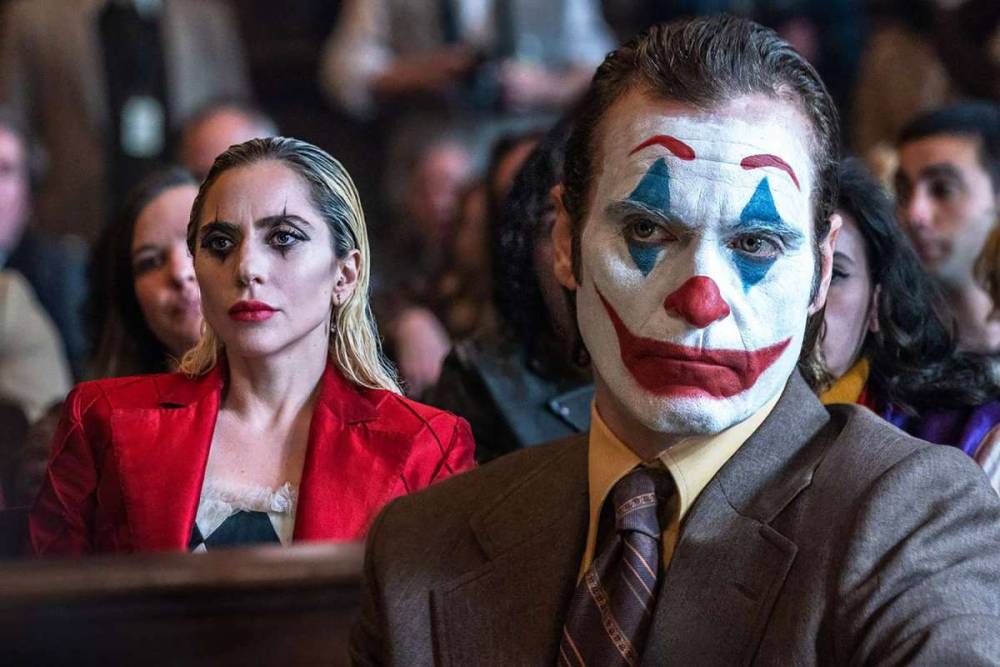
In 2019, Todd Phillips of The Hangover fame embarked on a mission to tell, quote, “a classic 70s crime story but through the lens of a comic book movie.” The result, Joker, was instantly controversial, with many critics praising its aesthetics and acting, while others voiced concerns it may start a riot or inspire copycat killings. Nevertheless, the film became a barnstormer, earning $1 billion at the box office before being nominated for a ceremony-leading 11 Oscars, winning two (including Best Actor for Joaquin Phoenix).
With David Zaslav taking over at Warner Bros. and cutting funds to smaller films in favor of tentpoles (he is currently burying Clint Eastwood’s Juror #2 because he spent all his money on notorious flops The Flash and The Idol), Phillips was given free reign for a sequel, including a $200 million budget and no producer oversight. The result is Joker: Folie à Deux, a massive boondoggle that has been reviled by most everyone. Critics hate it, audiences hate it, and it’s threatening to bankrupt Warner Bros. However, while fans ask the question, “What went wrong?” I choose to posit a different question: is it really any better or worse than the first film?
Two years after his breakdown that led to the murder of six people, including talk show host Murray Franklin, Arthur Fleck (Phoenix) remains locked in Arkham Asylum. Broken down and mocked by the guards, he has little joy in his life as he awaits a trial that could see him sentenced to death. However, after meeting fellow inmate Harleen “Lee” Quinzel (Lady Gaga), the duo discovers that they may share similar delusions (including a penchant for movie musicals). And at her encouragement, Arthur decides to embrace the Joker again, riling up a city that still idolizes what he did to the “haves” in a city of “have-nots” – albeit at the cost of the human at the heart of it all.
Incidentally, Folie à Deux does, in some ways, improve over the concepts raised in the first film. While a smarter film overall (barely), Joker’s biggest struggle was its inability to decide if it wants to celebrate the Joker or mock those who celebrate him. It explores what happens when society ignores its most vulnerable, and mocks the idea of idolatry when the figure at the center is just some loser. Yet Phillips films Phoenix with such passion and idolization, his ultimate reveal as Joker feels more like a “revelation” than it does a self-destruction.
For most of its run, Phillips struggles to strike that balance once again. He seems to idolize Arthur’s Joker personality while constantly beating up on the poor man abandoned by society. In fact, the divide feels more prevalent, as he finds himself abused by the guards behind prison walls, yet idolized in the courtroom by fervent followers. Yet somewhere along the way, Phillips takes the indecision and utilizes it, actually saying something profound. By emphasizing Arthur’s sadness, and juxtaposing it with Lee’s obsession, it actually explores the way society mythologizes Arthur, instead of ever treating him as a human being. I’m not sure if it’s accidental or intentional, but it at least says something.
Ironically, perhaps the film’s worst decision is the choice to make it a musical. It’s disastrous thematically and in execution. Now, I’m not saying you can’t use musical numbers as a means to explore either mental illness or the theatricality of crime. Hell, it’s not even the first to do so in a courtroom setting. Chicago adapted the stage show in this very manner, while Dancer In The Dark portrayed a poor, mentally ill immigrant on trial for her life. However, in both those films, the music is instrumental to the story. It’s how the characters see their lives, and the way in which they express themselves.
There’s no such necessity in either Arthur or Lee, as the songs feel less like their escape or a continuation of their mental problems, and more as a weird flex or misunderstanding on Phillips’ part. Truly, none of the Golden Era songs chosen for these characters fit, and while they’re occasionally sung adequately (there’s an excellently staged “If They Could See Me Now”), it mostly serves to baffle and bombard audiences by slowing the plot and losing sight of the characters. After all, there is nothing in either character indicating an actual reason to burst into song – not mentally, not emotionally, nothing. Each song slows down the plot and kills the film dead.
I suppose the performers are all decent enough. Phoenix is consistently good in the role, or at least as good as he was the last go-round, and while he can’t exactly sing or dance, he has enough stage presence to get by. Gaga, meanwhile, has a blast as Lee, physically and emotionally immersing herself in the role. The only complaint regarding her work is that Phillips makes her sing poorly whenever playing real-world Lee…and then only uses the real-world Lee takes. It is an almost hilariously evil decision on his part. Most of the rest of the cast shows up to dutifully perform their scenes and that’s it – I will credit Brendan Gleeson as an abusive guard and Catherine Keener as Arthur’s lawyer as lone standouts.
Joker: Folie à Deux is a mess of a film, there’s no denying. But ultimately, I’m not convinced it’s any better or worse than the last film. On the one hand, it tackles its central themes far better. On the other hand, the musical sequences and atrocious third act muddle any chance of a film that’s as technical sound as its predecessor – let alone as entertaining. Like Joker, it is neither good nor bad enough to elicit any sort of response. Perhaps the greatest trick the Joker ever pulled was convincing us he had anything interesting to say.
C
Joker: Folie à Deux is now available on VOD…not that anyone’s watching it anyway…


Add Comment