
When telling a story with massively weighty material, it becomes essential that one maintains that the pain doesn’t become the point. Art can capture the nature of suffering to make others feel less alone; excessive suffering becomes the definition of exploitation. This is precisely the line that writer-director Beth de Araújo wishes to explore in Josephine, one of the year’s hardest watches. It’s a film I have grappled with since I saw it at Sundance back in January, and I’m still not sure where I stand. It is a smartly crafted feature, and incredibly well acted by its leads. Yet it’s hard to say what, if anything, the film adds to the greater conversation – especially after its haunting opening.
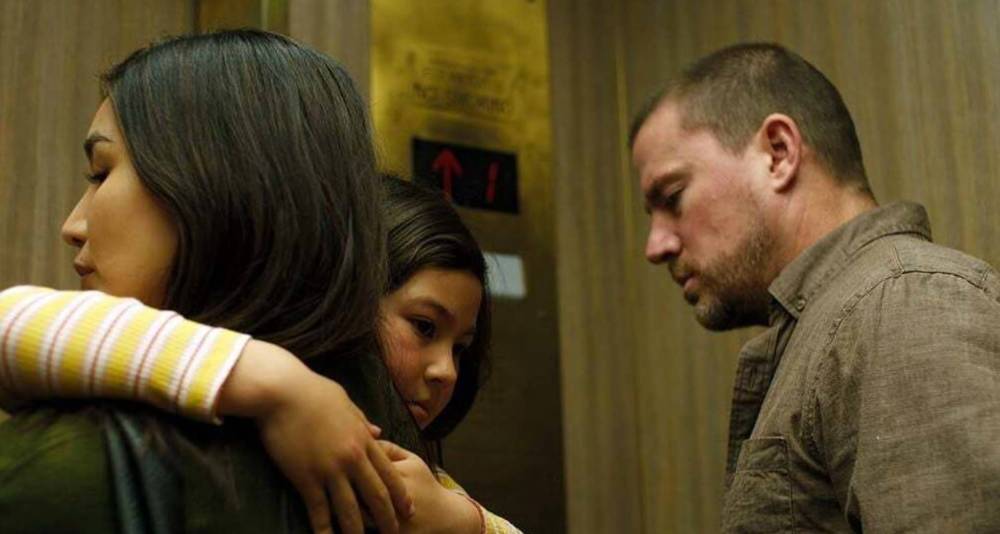
Josephine (Mason Reeves) is an eight-year-old girl living with her mother Claire (Gemma Chan) and father Damien (Channing Tatum) in San Francisco. One day, while out for a morning job with her dad, Josephine witnesses a horrific crime, one she’s not even old enough to begin to understand. With the victim too scared to testify, Josephine serves as the only witness, and is asked to testify. However, while Claire and Damien debate if she should be put through this ordeal, Josephine herself struggles with visions and images as her young brain tries to contemplate the evil she witnessed.
Where Josephine most explicitly shines is when de Araújo finds unique and imaginative ways to tell this story. Utilizing her camera and her screenplay, she finds exciting ways to place the viewer inside the mind of this 8-year-old girl and the trauma she’s undergoing. This is prevalent from the film’s opening, shot from Josephine’s POV until she finally emerges into the world. It continues as we often see through her eyes the way Greg (Phillip Ettinger), the perpetrator she identified, follows aroundin her mind, from the moment she goes to school until she tries to sleep at night. The film’s most impressive, disturbing sequence involves the spectre of Greg walking into the living room as Josephine speaks to police, staring her down as the officers conduct their interview.
This is an insight films of this subject don’t often explore – not only that of a witness, but that of a child. And because of this, we get to explore this story in a way that (usually) subverts expectations. We see police officers who don’t know how to interview kids correctly due to lack of training; details that look different to an eight-year-old who doesn’t know better; advice from a parent that sounds good until it doesn’t (“Being scared does you no good at all,” Damien notes, which sounds good on paper before confronted with things that really scare you). We even get to witness, from a child’s perspective, a realistic, hard debate between parents with different approaches to an impossible situation – Mom worries about the psyche, Dad worries about justice.
Yet as singular as the film’s approach feels, it oftentime feels as though it is embracing tragedy for tragedy’s sake. We are living with a young girl whose life has been ruined – not by what she’s experienced, but what she’s witnessed, and what she will be forced to relive in order for justice to be served. There’s no denying it’s an interesting perspective, but watching this unfold for a child makes it a hard watch, and it’s even harder to say it ever fully justifies its own intensity – or justify showing the horrifying act in the first twenty minutes.
While not de Araújo’s intention, the film almost feels borderline manipulative in its interactions, as the trauma we witness unfolds on a sweet, unsuspecting child. We have to witness Josephine not sleeping, throwing herself into self-defense classes her father insists on, unsure if the phantom monster she sees everywhere is friend or foe, and even hurting others because she can no longer tell the difference between a good touch and a bad touch. It all builds to a climax that doesn’t quite feel earned, doesn’t really give audiences what they need or deserve as viewers, and instead opts for an overdirected finale that doesn’t deliver on the talent the script and direction have indicated before.
At the very least, the cast is perpetually game in every scene. Much praise will be reserved for Reeves, who at a young age carries this film on her shoulders with relative ease. There are so many nuances to her work, so much she keeps behind her eyes, and it stands tall as one of the better child actor performances in cinematic history. Tatum, meanwhile, has possibly never been better as a good father who doesn’t know how to handle a situation like this. Little things he says, certain things he does, and little ways he emotes all convey a very real, lived-in performance. Chan is strong but tragically Claire is not given the space to breathe that Tatum is. I do, however, want to shout out Angela Vereau in a small role highly reminiscent of Erin Doherty’s Adolesence turn. It’s a bit part that feels big in its mastery.
Josephine is a strong demonstration of directorial prowess and acting powerhouses. Yet these neither dull nor impress the difficulty of the watch. I’m not entirely sure I’m convinced that it does justify that pain. It is one of those rare films whose talent you can appreciate for its talents, but a combination of missteps and subject matter make it difficult to recommend, or want to watch again. I’m doubtful that Josephine is a film I loved, or truly even liked. But it certainly makes me excited for Beth de Araújo as a director on the rise.
B-
Josephine will premiere in theaters this Friday, November 20th


Add Comment