
The other weekend, the box office world was shaken by surprising twist. Netflix, who never releases films in theaters, ended up taking its first-ever top box office spot. Not only that, the film in question wasn’t a new release, or directed by a renowned auteur. It was a theatrical release of a film that premiered two months ago – a film that is already the most watched film in Netflix’s history. I’m talking, of course, about KPop Demon Hunters, a children’s film that became the summer’s most talked-about film, as well as one of the most listened-to albums.
I missed the film when it came out, and was mostly stubborn about seeing it once I’d missed the zeitgeist and had friends sending me TikToks and Reels of admittedly catchy music. I did, however, opt to see one of the sing-along showings this past weekend, and found myself in a sold-out theater. This, it turns out, was the correct choice. KPop Demon Hunters is the type of light, fanciful children’s cinema the world has been lacking – gorgeously animated, simply told, and with an immense amount of care and craft put into every level of development.
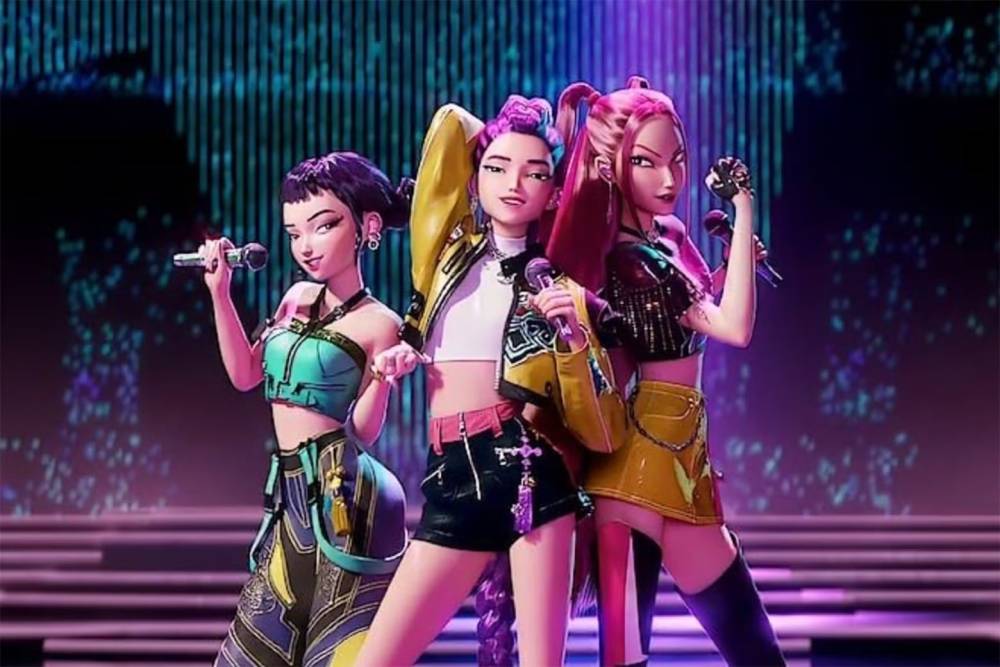
For centuries, a team of three women have been selected to protect the world from demons, monsters that steal the souls of ordinary humans to feed their master, Gwi-Ma (Lee Byung-hun). They do so with the power of their voices, which maintain the seal between the human world and demon world and provide the girls with magical weapons. The newest batch of heroines has taken the form of Huntr/X, a K-pop group consisting of lead singer Rumi (Arden Cho), cynical dancer Mira (May Hong), and peppy lyricist Zoey (Ji-young Yoo).
The trio are amongst the most successful hunters to ever serve as protectors, and their new song “Golden” is strong enough it may seal the portal forever. However, it turns out Rumi has a secret motivation, one that she can’t even tell her closest friends: she’s part demon, and hopes that sealing the barrier will cure her. And never one to lie down and accept defeat, Gwi-Ma has arranged a deal with servant Jinu (Ahn Hyo-Seop). Because there’s only one thing that can match a girl band…and that’s a boy band.
The beauty of KPop Demon Hunters is in its simplicity. While so many films check out the moment they register their logline, Hunters takes a surefire concept – KPop stars that fight monsters, print money – and just allows classical storytelling and filmmaking to take over. The simplicity allows the story to thrive. The central metaphor is actually deceivingly brilliant, and the sort of universal appeal Disney once thrived at: themes of insecurity, of being told to hide oneself away, of facing one’s own demons literally and metaphorically. Characters who start as stock figures explore their stereotypical archetypes through pain and personal growth, and learn because of it. It is masterful storytelling.
Yet where the story thrives in its simplicity, Demon Hunters thrives in its mastery of both animation and musicality. In terms of style, directors Maggie Kang and Chris Appelhans texture the film like those early-2000s American shows inspired by anime (your Last Airbenders and Teen Titans and such). Yet the animation moves far more fluidly than those shows ever dreamed. The action possesses a masterful fluidity, whether that’s an action sequence, a music video, or choreography. Hues of purple, blue, red, and green pop off the screen. This is a gorgeous, gorgeous film.
And beyond even the animation, there’s the songs. The soundtrack has already tied records held since Saturday Night Fever back in 1977, and listening to it, either on its own or in the context of the film, it feels hard to argue against this feat. The team behind the music constructs songs that carefully parody, yet exist within the world of K-pop; they functionally further the story as a musical yet work individually on their own. From the first line of “How It’s Done” to the bridge of “Golden” (the undeniable Song of the Summer”) to the infectiousnes of “Soda Pop,” this is the type of masterful musical songwriting most artists dream of.
As for the vocal work, the actors and singers each balance out to bring these characters to life. Cho, Hong, and Yoo provide more than enough emotion and originality for Rumi, Mira, and Zoey, while their vocalists, actual K-pop stars Ejae, Audrey Nuna, and Rei Ami, are sublime. They give the best animated musical performances since Idina Menzel sang “Let It Go.” Hell, maybe since Jodie Benson and Paige O’Hara gave Ariel and Belle a voice for Disney. Ahn Hyo-seop (and singer Andrew Choi) is appropriately haunted, yet sinister as Jinu. And a litany of Korean comedians bring the background characters to life, including Ken Jeong, Daniel Dae Kim, SungWon Cho, and Joel Kim Booster.
KPop Demon Hunters is a wondrously watchable piece of entertainment. It is a testament to what can happen when care, effort, and love permeate from an animated film. The result is a simple piece of storytelling made to feel intricate, where each frame bears the film’s soul, and where the music feels effortlessly catchy and joyous. It’s the best piece of pop animation since the Spider-Verse films; more accurately, its soul feels akin to the Disney Renaissance. It’s no wonder it has become the biggest hit of 2025; for once, the audiences got it right.
A-
KPop Demon Hunters is now streaming on Netflix


Add Comment