
Ed. Note: The following is my review of Greta Gerwig’s Little Women, a film I never had a chance to review, but desperately wanted to. After all, every film on my Top Ten list deserves a review, as far as I’m concerned. And Little Women is no exception
In 2017, Greta Gerwig emerged on the scene as one of the most impressive new directors around. Her Lady Bird remains a high point of the 2010s, and an impressive show of writing, directing, and acting for generations to come. Because of this, her follow-up film, the fourth adaptation of Little Women, seemed deceptively simple. After all, both Women and Lady Bird tackle similar themes of feisty, talented young women finding their way in the world as they come of age. The only disappointment was the nagging question: “What can Gerwig bring to this film that hasn’t been done in the past – and already so well?” As it turns out, a great deal. By adding layers and finding new ways to make classic dialogue sound new and lively, Gerwig has elevated what could have been a stodgy period comedy-drama into one of the best films of 2019.
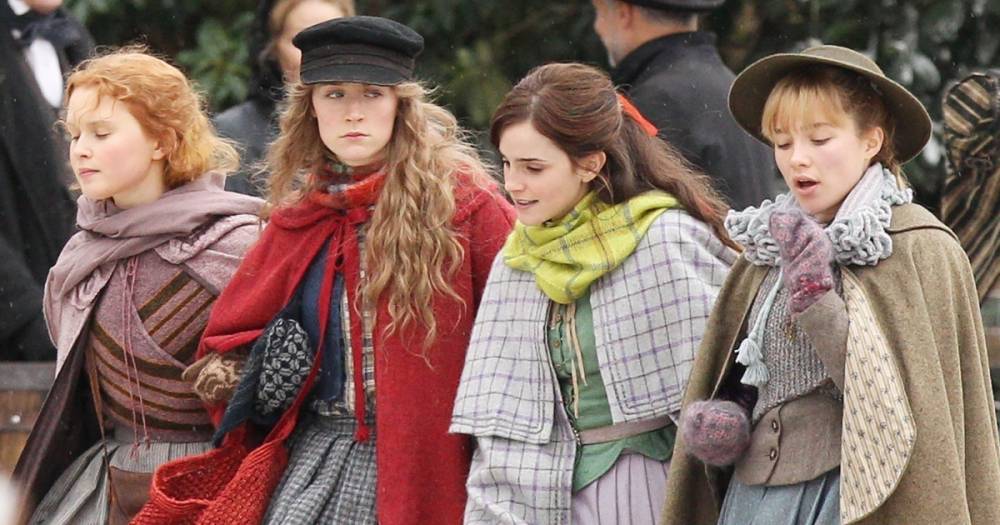
Based on the iconic Louisa May Alcott book of the same name, Little Women follows the four March sisters during two key moments in their lives. The first takes place in their childhood during the Civil War, where the girls use their talents to brighten up the small Massachusetts town where they grew up. There’s goodhearted eldest Meg (Emma Watson), who dreams of a simple, quiet life. There’s writer Jo (Saoirse Ronan), who dreams of the opposite – traveling to New York to become a famous author. Empathetic Beth (Eliza Scanlen) plays peacekeeper between her feisty sisters. And the flighty, lovestruck youngest girl Amy (Florence Pugh) just wants to be noticed. The film contrasts their idyllic childhoods with the harsh realities of their grown-up lifestyles, where money troubles, disease, and loneliness challenge their ways of life. But no matter what the world throws at them, be it good, bad, or beyond, the young March women have each other to fall back on, no matter what.
The strength of any adaptation of Little Women lies not with the power of the actress playing Jo (although that is essential), but through the relationship shared between the four sisters. After all, the story is a love letter to sisterhood, and if you don’t believe their relationship and the affect they had on each other throughout their lives, every other detail on display falls apart. There have been many great adaptations of this novel throughout history, but I’d go as far as to say that Gerwig’s film is the first to truly capture the spirit of togetherness and love that exists not only between sisters, but siblings in general. The best moments in Little Women are the ones where all four sisters are together laughing, playing, helping each other, and occasionally fighting. There’s silly outings on the beach, neighborhood plays staged for the members of the community, and many a party and ball attended (much to the chagrin of tomboy Jo). Hell, my favorite moment in the film is a scene where the sisters host their own parody of an Old Men’s Club, complete with beards and pipes. It’s such a specific moment shared among siblings, and acted so honestly by Watson, Ronan, Scanlen, and Pugh that I felt I was watching something honest and real, and not a group of twenty-something actresses pretending to be American tweenagers. Furthermore, Gerwig finds ways to bring Alcott’s iconic dialogue to life, without resorting to anachronistic dialogue or speech patterns. She does this by overlapping the dialogue and revising its delivery, transferring from a stodgy, set-driven period feel to a lively, honest performance. It’s a truly remarkable piece of modernizing over anachronizing, and it helps establish the universality of the sibling relationship. And yes, it is quite obvious that Gerwig is commenting on the idolization of our formative years – it is hard to look at the cinematography in the flashback sequences and not read into the golden hues she uses to illustrate the past. But even that doesn’t read as a negative slant – the nostalgia on display has less to do with proving that our childhoods were truly all terrible, and more a demonstration of our human tendency to only remember the great moments we shared with those we love.
However, Little Women is not just a story of sisterhood, and Gerwig understands this deeply. The novel is, first and foremost, a proto-feminist text about the balance between women’s drives for careers in a time when such ambitions were frowned upon (but not impossible – most 19th century writers were women or women writing under pseudonyms) as well as their quest to find and feel love. From beginning to end, Little Women challenges the ideals of the era (a period many members of society still look back upon fondly) by demonstrating the strength and intellect of women in every facet of society, be they housekeepers, housewives, writers, or social climbers. Heroine Jo is constantly battling the societal notions (often voiced by Meryl Streep’s Aunt March) such as “Women must marry well if they want to be rich,” or “The sole purpose of a woman is to marry and give up on the childish dreams of careers and passions.” Jo’s goal is to prove herself a successful, famous author – “No one will forget Jo March!” she boastfully declares. However, it is not solely Jo who embraces her personal destiny. Each female character pursues their dreams and their desires in their own personal, often subtle way. Matriarch Marmee (Laura Dern) personally oversees the daily goings-on of the entire town, from feeding the poor to caring for injured soldiers returning home from the war. Social-climbing Amy may seem content with her role marrying rich, but in a brilliantly delivered monologue, she explains how every romantic decision she makes is politically motivated, as she will have no power over her estate once choosing a spouse. And in a moment seemingly designed to dismantle the criticism that feminism wishes to dismantle the family unit or drive women away from her houses, the conservative, engaged Meg explains to an irritated Jo that “Just because my dreams are different than yours doesn’t make them unimportant.” But Gerwig’s not only interested in showing women confronting the patriarchal norms of the time – her Little Women is also a treatise on the desire to find and feel love while balancing one’s passions. Obviously this can be found in Amy and Meg’s arcs, the sisters most passionate about falling in love and finding a mate, but it’s also prevalent in Jo’s arc too. Despite Jo’s adamant stance against marriage, her loneliness is tantamount to understanding both her character and the film’s moral. After all, the now-famous monologue she provides on her views of women doesn’t end with her quest to end gender roles. Her exact message is “I’m so sick of people saying love is all a woman is fit for…But I’m so lonely!” Gerwig is weaving the tenets and complexities of love, feminism, family, and beyond into a simple, kindhearted fable, and it works in spades.
I think my favorite thing about Little Women is that it’s just so pleasant. I’m not saying the characters are perfect, or without flaws, or miniature saints. I mean that the characters are, without fail, all well-meaning and kind at their core. There are no villains, no evil forces trying to harm anyone, or vicious bullies. These are human characters, who may feel jealousy, egotism, and anger, and may occasionally fight with one another, but ultimately feel love for others, be they family, friend, or stranger. I’ve already talked about the warm, complex relationships between the March sisters, but it extends beyond their internal relationships. It can be seen with their interactions with every character they encounter throughout. The normally-curmudgeoned Mr. Laurence (Chris Cooper) is quietly revealed to be a quiet, loving man who is suffering from the sins of his past (the scene where he watches Beth play piano is a highlight of the film). And Teddy’s (Timothée Chalamet) profession of love to Jo has been rewritten from its previously manipulative, ostentatious nature to become an honest, well-meaning, and heartbreaking moment both ways. These positive moments manifest in joyous cinematic presentations – when the March girls donate their Christmas dinner to a poor family in need, the house literally brightens through kindness and camaraderie. And even when the characters do screw up or make poor decisions, they actively learn from them. For the first time in Little Women’s history, Marmee is allowed to deliver her iconic monologue where she reveals that even she feels angry at the state of the world, but she chooses to channel that anger into something healthy. Not only is this an incredible message to teach audiences (and especially the young girls watching at home), but it adds to the homespun sage advice the film presents throughout its run. This is a film about good people interacting, facing hardships, and thriving together, and while not every film can make all-good characters interesting, Gerwig once again proves herself an unparalleled author capable of breaking storytelling tropes and conventions.
As for the filmmaking, Gerwig has proven that Lady Bird was no fluke. Sure, she has some tricks she likes falling back on – just like her directorial debut, she opens the film with a quote pertaining to the source material. I’ll get to how great she is overseeing actors in a second, but make no mistake: this is a director who has complete control over her production. She interweaves her storytelling with homages to different, classic eras of filmmaking. Her production design comes straight from the 80s-era Merchant-Ivory school of filmmaking. The score by Alexandre Desplat possesses the respectability and jauntiness of 50s-era period pieces. Gerwig’s camera angles maintain the elegance of the period while utilizing some modern tricks – close-ups on Jo’s ink-soaked hands are terrific tools for establishing character, and a sequence near the end where Jo puts on an old coat she used to wear while writing has more gravitas than any superhero film it’s emulating. And the editing and storytelling come straight from the 1930s’ techniques of setting the camera firmly in place and letting the actors run the scene – with one glaring exception. Now comes the time where I have to break down the film’s story structure, which jumps between the childhood and adulthood timelines sporadically. I will be the first to admit the narrative jumps aren’t perfectly executed, but they’re still damn effective regardless. Not only does it add a sense of ironic nostalgia to the childhood sequences and make the adult timelines land with an added pain of reality, but it actively creates three new narrative beats that keep the material fresh and alive. The first involves Amy, a character long-hated by fans due to her childhood brattiness. By introducing audiences to Amy as an adult with agency and a loving disposition, it allows us to connect to her character far more than we would during her petulant youthfulness (although no self-respecting author could ever forgive the book thing). The second involves Beth’s storyline, which has reached a point of infamy amongst the literary community. Everyone knows the twist by now (although I won’t spoil it here), but through careful restructuring of the material, Gerwig has revitalized the arc in clever, evil ways. A juxtaposition of two similarly-framed scenes late in the film is one of the most heartbreaking moments of 2019. And the third new piece of commentary involves the ending, which involves a romantic, brilliant wink at the camera while simultaneously commenting on Louisa May Alcott’s real-life realities. These choices not only demonstrate Gerwig’s brilliance as a writer and filmmaker – they firmly establish her as an auteur on the rise.
As for the performances, it should be noted that this is one of the finest ensembles put together in all of 2019 cinema. As expected, Saoirse Ronan has continued her hot streak of remarkable performances, bringing the spunk, charismatic, and whip-smart Jo to life with a passion worthy of Katherine Hepburn and Winona Ryder’s prior entries in the canon. Of course, the real revelation of the film is 2019’s superstar Florence Pugh, who not only sells grown up Amy’s awkwardness and unrequited love, but also is incredible as Young Amy. I’m not sure there’s anything funnier than Florence Pugh, who looks far older than her 23 years, trying to emulate a rambunctious 12-year-old through quirky mannerisms and over-the-top proclamations. It is not accurate in the slightest, and looks so weird, but is such a distinct, well-acted cinematic choice that I love it as opposed to loathing it. As eldest stick-in-the-mud Meg, Emma Watson takes some time finding her own, but through a series of key moments, both in character development and loving play with her sisters, she eventually grew on me. And Eliza Scanlen is more than capable as Beth, the sister who is designed to be a perfect martyr and therefore boring. Meanwhile, two of the film’s secret weapons come in the form of the girls’ female role models: Laura Dern’s Marmee and Jayne Houdyshell’s Hannah. Houdyshell doesn’t have a whole lot to do in the film’s 135 minute runtime, but every moment she’s onscreen is a revelation. She makes her presence known without ever overwhelming the scene, and I loved her repartee with the rest of the cast. Meanwhile, Dern turns in one of her best performances yet as the March mother. Not only does she command every scene she’s in like a real mother, but she adds small subtleties to the performance that just leave you in awe. There’s a moment where she has to put on a brave face for the girls to hide them from the truth, and she does so much without saying a word. Furthermore, her delivery of the aforementioned anger monologue is as great as we always hoped it would be.
And while she’s really only in the film to be sassy and rude, Meryl Streep is of course top form as Aunt March, even if it is essentially a rehash of Devil Wears Prada. I suppose I must talk about the men, let’s talk about the best of the best. Timothée Chalamet plays Teddy “Laurie” Laurence as the Manic Pixie Dream Boy, and I’m honestly here for it. He has great chemistry with Ronan, and I love the way he silently conveys his love (obsession?) with her from the jump. It’s a quiet, loving performance and I’m happy the rising actor has another hit under his belt. As Chalamet’s grandfather, Cooper could have played Mr. Laurence as yet another curmudgeon, a real forte for the actor. But instead, Cooper crafts his portrayal as something quieter and softer, and it actually makes for a better performance. The scene where he cries listening to Beth play his dead daughter’s piano features one of his best performances yet. James Norton is sweet, if unmemorable, as John Brooke, while Louis Garrel not only plays Professor Friedrich Bhaer as charming and loving – he also makes him HOT (sorry, had to make that digression). Tracy Letts is his usual stodgy self as a disgruntled publisher Jo interacts with, and it’s not worth the extra words to describe how great Letts is at playing stodgy, stuffy characters – it’s his bread and butter. Oh, and I can’t get over the fact that Bob Odenkirk shows up for thirty seconds to declare “My Little Women!” It’s such a wonderfully silly bit of casting in an ensemble with no weak links.
Little Women is a lively, warmhearted film the likes of which they just don’t make anymore. It’s the kind of film that has you leave the theater or turn off the TV smiling, as if you’d just left a family gathering where no one fought, no one argued, and the banter and booze was just to your liking. I loved this film. I loved the acting, I loved the writing, I loved the filmmaking. Hell, I loved it so much it managed to end with my greatest cinematic pet peeve – in which a character gets their book published and it ends up being the name of the movie/show/etc. (think Gilmore Girls, The Great Gatsby, Game of Thrones) – and I still liked it. This is one of the best films of the year, and I hope it is remembered as a high-water mark for adaptations in the years to come.


Add Comment