
It’s easy to forget, in the wake of his four Oscars for Parasite, that Bong Joon Ho is ultimately just a Lovably Weird Guy. His playpen involves sci-fi parables that touch on important issues in the world, yet ultimately involve silly ideas played out by delightfully over-the-top performers. A sea monster that kidnaps a young girl, a rebellion onboard a super train, a genetically engineered giant pig, etc. His first follow-up post Oscar, Mickey 17, is something of a reminder of what he enjoys and does best…albeit a pale reminder when it comes to the themes and story.
In the year 2050, with the world in shambles, an exploratory crew is sent into space to colonize the icy planet of Nifilheim, led by failed politician, yet local celebrity Kenneth Marshall (Mark Ruffalo). On the run from a loan shark, Mickey Barnes (Robert Pattinson) signs up for the mission as an “Expendable” – a person tasked with oftentimes lethal grunt work who can be cloned and reprinted after each death. Along the way, Mickey falls in love with Nasha (Naomie Ackie), a security officer on the ship.
Four years and seventeen iterations into their journey, the crew lands on Nifilheim, and finds it inhabited by creatures known as Creepers – seemingly murderous creatures that resemble giant worms. After being trapped in their cave, Mickey is stunned to realize they didn’t try to eat him. He’s even more shocked to discover he’s already been cloned, leading to Mickey 18, a far more violent version of himself…and an automatic death sentence for any Expendable. Can Mickey save his own life, reconcile with himself, and share his experiences with the Creepers before Marshall exterminates the lot?
There are few directors as gifted at worldbuilding as Bong, and it shows in Mickey 17’s best moments. The film visually looks gorgeous, from the ship to the planet to the very design of the Creepers – weird, yet truly adorable. Each new twist on this future feels delightfully bizarre, and plays out well. There’s an intriguing (if underdeveloped) subplot involving Marshall and his wife (played by Toni Collette) obsessing over calories, both for efficient space travel and because of the strange pseudo-religion funding them. One sequence intercuts banning sex as a waste of calories and Mickey and Nasha’s first trysts.
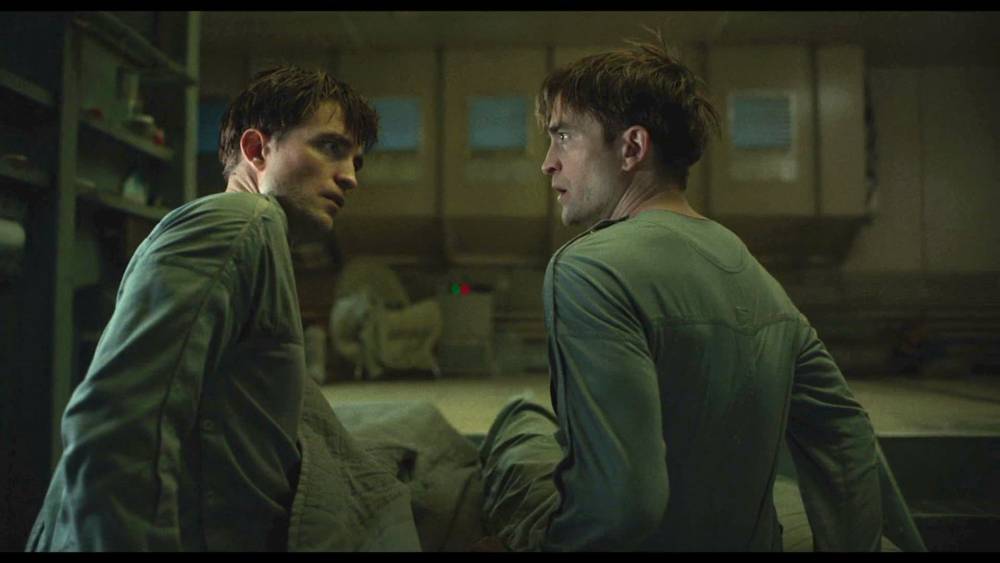
The film also offers a unique, and often humorous, take on cloning. We get to witness serial killing clones and women haggling over which version of Mickey they get to f*ck. There’s a delightful running gag involving the cloning staff getting distracted during reprinting as Mickey’s naked body topples onto the floor. And in the film’s funniest visual gag, the dual Mickeys offer conflicting moral advice to Nasha, framed on each shoulder, a play on the “angel and devil” motif. Bong is at his best when he embraces the silly and lets the world speak for itself.
Unfortunately, the film’s humor and ideas are let down by the thematic material at the film’s core. In all his work, no matter how messy and imperfect, the one glowing benefit has been Bong’s originality. His films tackle subjects in new, exciting ways, and always feel like something you’ve never seen before. Here, everything feels like a copy of things we’ve seen before. Obviously this means other sci-fi classics (Starship Troopers’ jingoistic parable is prevalent), but perhaps more striking is the way he steals from himself. Messages of authoritarianism, wealth inequality, and environmentalism have been previously covered in The Host, Parasite, and Okja – films that also fleshed out their metaphors in more precise detail.
There’s also the matter of simplified, toothless messaging. Perhaps due to pesky studio notes, Mickey feels relatively toothless in a way Bong has never been before. He has gifted us some real assh*les over the years – Tilda Swinton in Snowpiercer, Jake Gyllenhaal in Okja, and so on. However, what has made his films so brilliant is the moral grey area that exists in human beings – even the nastiest SOBs and the most endearing protagonists. The Snowpiercer rebels were also collaborators, the animal rights activists in Okja were naive and inept, and so on.
Here, everything is just so…oversimplified. Marshall is a buffoonish dictator and Mickey and Nasha are almost flawless. There’s no nuance to the portrayals that make the film’s satire biting, or evocative, or introspective. And without that nuance, the film ends up feeling more toothless. I’m not saying that Ruffalo’s Marshall should have been a good guy – he’s a wonderful sh*theel, and a smart satire of the buffoonish nature of most authoritarians. I’m just saying the moral shades of gray are what makes Bong’s films stand out.
Still, at least the actors are committed to the story they’re telling. Pattinson is absolutely delightful as the various Mickeys – his milquetoast 17 is winsome, while his psychotic counterpart 18 is delightfully aggressive and unhinged. Ruffalo and Collette are fine as the villainous Marshalls, but in their aim for camp, they’ve landed in a pseudo over-the-topness that doesn’t feel as sharp as it could have been. And while roles for performers Naomie Ackie, Steven Yeun, and Anamaria Vartolemei feel underwritten, the performances themselves help carry some of the film’s weight.
Mickey 17 is an entertaining enough film, with enough jokes, plots, and confident construction to sustain momentum. But after decades of brilliant films and an Oscar-winning masterpiece, we just expect more from Bong. He’s made less a five-course meal and more of a hodgepodge gumbo of leftovers – Avatar without the structure, Starship Troopers without the sex appeal, and Bong without the wonder. And like the metaphorical stew, it tastes fine. But we can’t help but remember and lament the grand courses those leftovers came from.
B-
Mickey 17 is now available on Blu-Ray, DVD, and VOD


Add Comment