
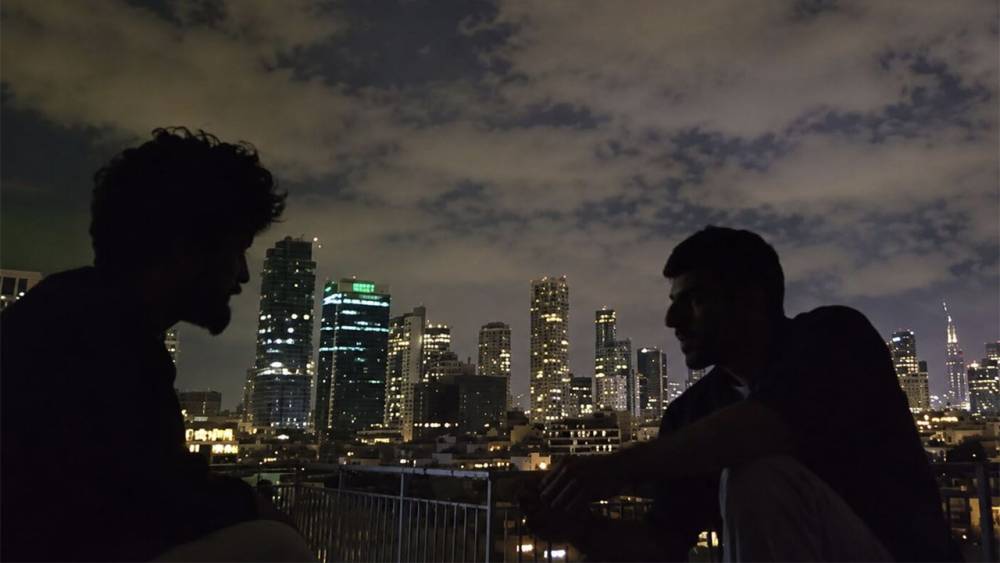
In 1985, Claude Lanzmann released Shoah, a nine-hour documentary covering the entirety of the atrocities of the Holocaust. Perhaps most infamous from the film are the interviews with former Nazi soldiers who participated in the genocide and Polish bystanders who were aware of the ongoings, but did nothing. A retrospective on Shoah is shown from the rooftops in NAZA, the newest documentary from Israeli filmmakers Yuval Abraham and Rachel Szor.
A continuation of the duo’s work on the Oscar-winning No Other Land, the comparison here strikes the stark irony: what Lanzmann once did to the bystanders and perpetrators, Abraham and Szor now do to the IDF, as 24 military operatives go on the record to reveal the lengths that the Israeli military is going to for the current genocide in Gaza. And like Shoah, NAZA emerges as an essential, stunning feat of documentary filmmaking that will be talked about for years to come.
The term NAZA is derived from the Israeli military as the title for “collateral damage” – that is to say, the number of civilians that will be killed in a strike on a military target. This isn’t a concept out of the norm – most militaries have similar terms and programs. Yet over the course of the 77-minute film, Abraham and Szor’s sources explore every facet of how this term is applied. Not only is the term used to create distance from admitting their own actions (there is no factoring the NAZA score for children or infants, for example, so saying “1 Naza” eases the guilt of “1 child killed”), but it is also used less as a guideline and more of a challenge – how high can one get their NAZA score?
NAZA is provocative filmmaking, to say the least. This is clear in its very design, shaped to mirror All the Presdient’s Men through shadowy rooftops and darkly lit interviews. It is smart cinematography, yet striking due to the reality of its real-world implications. Abraham and Szor edit their interviews to reveal a straight through-line to examine exactly how an ordinary citizen feeling legitimate nager over October 7th could then participate in government orders to dehumanize the enemy; from justifying the killing of innocence until soldiers are fully complicit in razing communities and executing children on sight.
Each reveal is rolled out slowly, methodically, and precisely, so it can sit with the viewer, unfold in all of its lurid details. An A.I. program that is not only inaccurate, but cannot differentiate between a butcher who once served a Hamas agent and an actual Hamas agent. Training programs to spy on cell phones and listen for children’s voices welcoming parents home (knowing full well that children would be killed in the process). Celebratory parties for every house burned and crippled Palestinian left in the rubble. By the time they reveal that one in every four targeted individuals is completely innocent with upwards of 5,000 civilian casualties considered “tolerable,” it already feels damning – and that’s the first twenty minutes. It’s no wonder one interviewee admits that the goal is “to destroy as much as possible before we lose international legitimacy.”
These interviews work thanks to the complexities present in the whistleblowers. While all have reached some sort of breaking point to provide these interviews, their guilt and level of realization varies from interviewee to interviewee. One of the creators of the aforementioned A.I. system Lavender almost sounds proud as he describes its ability to decimate and spy on teenage girls (“If I hadn’t created it, someone else would have,” he notes). Others grapple with the harsh reality while still trying to avoid full culpability – when asked how they can proceed bombing after hearing crying infants through spy software, the interviewee simply notes “Because we are taught to hate.” And some have reached a full rubicon moment, including one commenter who admits he now understands how the Germans were fully swept up.
As primary interviewer and filmmaker, Abraham never cheapens his film by asking pointed questions, or drawing attention to the debunking of talking points. He lets the subjects admit the lies about Palestinians, the claims that most of the targeted individuals are Hamas personnel, or that Hamas uses “human shields” – these are merely concocted after the fact to justify Israel on the international stage to give their actions “legitimacy.” Abraham is precise when he chimes in, only doing so to encourage his interviewee to share more details, or to chastise them for trying to shift or avoid their culpability in the atrocities. It is smart journalism, and electric filmmaking.
And on the subject of filmmaking, as simple rooftops with blurred figures would make for a boring visual, Abraham and Szor wisely splice in footage they take of the looming cityscape, showing footage of average Israelis going about their days, unimpeded, while watching news footage our interviews have shown to be fictional, or intercut with footage of Benjamin Netanyahu’s efforts to silence and quash Palestinian journalists (it is explicitly stated he is directly involved in these discussion). The metaphor of Israel being misled into genocide seems clear enough, yet when juxtaposed in the finale with footage of one of the attacks described in the interview, and showing the mass scale of the dead children (shown onscreen for maximum effect), it becomes clear what silence, complicity, and media cover-up can create.
NAZA is simply one of the greatest documentaries of the modern era. Its only flaw is the question, “Will this actually lead to any sort of change?” It is unlikely to move the needle in Yuval and Rachel’s home country – the response thus far has seen the filmmakers threatened with exile by Netanyahu’s regime while their parents have faced down lynch mobs. But perhaps the combination of on-the-record testimony and indisputable evidence can force more direct action from the international community at large. Regardless of what real-life action can be accomplished, NAZA is a bravura act of filmmaking, capturing history and serving as a breathing document of our shameful present.
A+
NAZA is now playing in theaters nationwide. It will premiere on The Guardian’s website in early December


Add Comment