
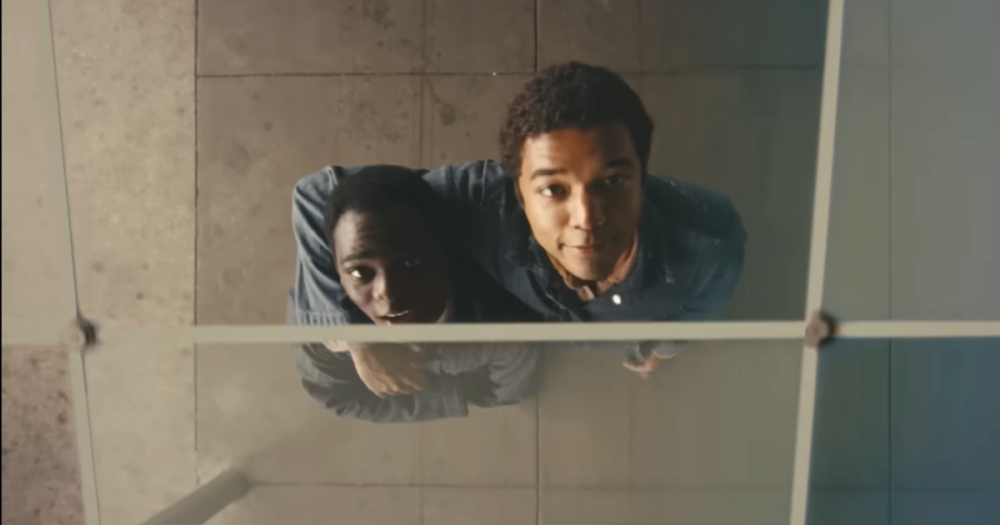
Roger Ebert famously called cinema the “great empathy machine.” They are a way of expanding our horizons, of drawing people together and exposing viewpoints as a way of opening our hearts and minds. Perhaps no director more wholeheartedly believes this than RaMell Ross. His 2018 documentary Hale County This Morning, This Evening was hailed as a grand experiment in the format. He has now turned his empathetic lens to Nickel Boys, adapted from the 2019 Pulitzer Prize-winner of the same name. And in doubling down on this vision, he has shot the film in first-person POV. It is a bold decision, and makes for a very good film, but may keep it from becoming a truly great one.
Elwood (Ethan Herisse) is a hardworking, highly intelligent boy from Tallahassee during the Jim Crow era. He dreams of one day joining Martin Luther King Jr. in protesting segregation throughout the South. After being accepted into a local college early, the fifteen-year-old finds his world turned upside down when the car he hitchhiked to the university in was, in fact, stolen. Despite having nothing to do with the crime, Elwood is sentenced to Nickel Academy, an infamous institution for wayward young boys.
In the coming decades, Nickel would be uncovered as a home of physical, mental, and sexual abuse on its patrons, with many young Black men “disappearing” at the hands of the staff. Nightly beatings, withholding of food, and secret graveyards permeate the grounds. Alone and frightened, Elwood befriends an affable orphan named Turner (Brandon Wilson), who takes him under his wing and tries to help the young idealist traverse Hell on Earth. Their friendship will have repercussions that will span almost half a century.
Nickel Boys is, without a doubt, a dazzling, dizzying film to behold, thanks to the tag-team efforts of Ross and cinematographer Jomo Fray. While first person has been used in mild doses in the sporadic action or horror film, few films have ever so decisively put the audience in the characters’ perspective. Fray’s camera is truly magical here, capturing the world and the perspective of the characters in ways both subtle and haunting as well as vivacious and magical.
When Elwood is free, we see sumptuous images of life, and love, and freedom, beautiful and childlike. Yet his eyes are not blind – the camera captures the Jim Crow South, and you feel its impact. The film explores the way racism both overt and inherent can slowly break down the soul, from the horror-adjacent first drive into Nickel. By the time Elwood and Turner are beaten down by the white men in charge, the camera drops to the floor, our eyes hidden in fear and subjugation.
Ross also expertly jumps between the three perspectives with relative ease, using each jump to allow us to explore the characters we are inhabiting as well as their philosophies (Elwood an idealist, Turner a realist, and an adult we eventually identify as Elwood jaded and broken). The edits between these perspectives are clear and precise, and allow us to understand memory, beliefs, interpretation, and the scars of the past in a new light. It forces us to live out a perspective that is not our own, and does so masterfully.
However, for as brilliant as the POV filmmaking may be, or as innovative as Fray’s camerawork may appear, it unfortunately also hinders Colson Whitehead’s story. By placing us directly in the characters’ POV, we are prevented a full vision of the horrors on display. A boxing match that, in the novel, is a major event (and one of the best chapters in modern literature) here feels lethargic and out of context with the rest of the film. And most strikingly, the POV often prevents us from connecting to the characters, as opposed to feeling their emotions.
Take, for instance, a pivotal moment in the film’s first half, shortly after the POV has switched to Turner, and he meets Elwood’s grandmother Hattie (Aunjanue Ellis-Taylor) for the first time. During their conversation (with Wilson’s voice offscreen as Ellis-Taylor stares into the camera), she realizes that Turner is a kind soul, and that no one has ever hugged him or shown compassion. She offers him a hug, and offers him likely the first act of kindness he’s ever received.
It’s a touching, striking moment…except we never get the catharsis of Turner’s emotional state. There’s nothing in his voice to confirm how he feels, no face to express this emotion. You can’t even feel it from Ellis-Taylor, who must act out the scene and hug with a camera, talking directly to the audience. The film is in no way empty of emotions, but in its most daring swing, its artistry undermines that heart, rather than amplifying its humanity.
For what it’s worth, the acting is consistently good, sometimes even great. While the nature of the film prevents Herisse, Wilson, and Daveed Diggs (the adult Elwood) from giving full-throated performances, they at least relish their few opportunities to act for the camera. I do want to commend Ellis-Taylor, who has arguably the most “screentime,” and she makes the most of it. She delivers great monologue after great monologue, and her two most impactful scenes land the punch they need.
There is no denying the artistry of Nickel Boys. It is a heart wrenching film with a powerful story, a rare experience that physically embodies empathy and experience. Audiences have not seen anything like this before; I’m not sure they will again. However, it often feels to be nothing more than a grand experiment, something to be studied as opposed to felt. It’s a film that I like, and appreciate all it stands for as a work of art; it’s just one I wish I could love.
B+
Nickel Boys is now playing in theaters nationwide


Add Comment