
Every once in a while, you find a film you can only describe as “special.” It may be once in a lifetime, it may be once a decade. But it will always be the work of a master, grappling with the big questions of the universe in a way that will shake you, body, mind, and soul. It’s Charlie Kaufman’s Eternal Sunshine, or Ingmar Bergman’s The Seventh Seal, or Agnès Varda’s Cléo From Five To Seven. This sounds like an elaborate buildup that no film could live up to; how could anything from the jump live in the same company as these classics? But I am not exaggerating when I say that Edson Oda’s striking debut Nine Days is worthy of that praise. It is one of the most original, moving films I’ve seen in years.
Will (Winston Duke) is an arbiter of souls. Essentially functioning as a Guardian Angel of sorts, arbiters monitor 27 individuals each on a series of television screens, recording moments they deem important on VHS tapes and taking copious notes. Will’s existence is thrown into chaos when Amanda (Lisa Starrett), Will’s favorite on Earth, dies under mysterious circumstances, leaving Will wondering what it is he’d missed. Unfortunately, he doesn’t have time to properly analyze his potential mistakes; for there is now an opening for a soul on Earth, and he must meet with a series of new souls, each determined to make the argument that they deserve to live. One name will be chosen, the rest will fade from existence, never to live. So alongside his dear friend Kyo (Benedict Wong), Will must choose between a variety of individuals, including the laid-back Alexander (Tony Hale), sensitive poet Mike (David Rysdahl), the loving Maria (Arianna Ortiz), the cynical Kane (Bill Skarsgård), and Emma (Zazie Beetz), a mysterious free spirit who makes Will question everything he knows about life, beauty, and existence.
What makes Nine Days so effortlessly brilliant is the way it uses its central premise to explore the major questions about the meaning of life. In this way, it bears similarities to such masterworks as A Matter of Life and Death, Defending Your Life, and especially Wim Wenders’ Wings of Desire. This is a film about finding the beauty in the world despite the trauma and pain that goes with it; the yin and yang of existence. These questions are primarily explored by the testing of the new souls, as Will quizzes them with a series of deeply ethical and spiritual questions, which force them to grapple with the full scope of life; its beauties as well as its disappointments.
The souls are subjected to the live feeds from Earth, where they must endure everything from weddings to paralysis, beaches to bullying, parenthood to paralysis. This juxtaposition is further explored in the two clear frontrunners for life, Emma and Kane. Emma loves the little things, filling volumes of journals with the things from Earth she loved. Kane, meanwhile, only sees the pain and violence, and fixates on crime and murder as opposed to love and joy. And these questions don’t just pertain to the tested; Will himself also finds himself grappling with these questions as he decides who to pick. After all, as he asks Kyo, “Why should I try? I send them flowers, and everyone else sends pigs to eat them!”
But the film is so much more than that. While Oda’s fabulous screenplay uses these themes as a doorway in, it also manages to branch outward to touch almost every aspect of human existence. I mean, look no further than the stunning opening, a first-person home video series following Amanda through her life, from birth to early childhood to school to the discovery of her talents on the violin. It introduces the world to us in this way to make us consider our own existence – the things we love, what makes for a good life, and whether it’s all worth it? That last question is particularly pertinent, as all of the characters, whether just created or having lived for hundreds of years, have to deal with intense empathy, suffering, and what they feel is an inherent brokenness. Mortality and suicide hang over the film at every turn – and how can they not?
Most of these souls will be erased from existence within nine days’ time. But this is not some bleak reflection on the pointlessness of existence. No, Oda keeps this film firmly uplifting throughout, finding the joy despite the pain and despite the desire to escape it. Each character has their own way of coping, some healthy, some unhealthy, and yet none are judged – whether it’s through sarcasm, escapism, violent justice, or simply the beauty of art. That’s right, art as a form of giving life and evoking emotion is brought up as a tangent. Oda’s film is so packed with ideas that there are themes most films would kill to explore as beautifully thrown out as brief, beautiful asides. This is a film about the importance of empathy, the little beauties that make life worth living, and the joys that keep us living, in spite of all the pain that surrounds us.
But it’s not just the questions and answers that make Nine Days so unique. It’s the way it asks those questions. Oda’s world-building here is absolutely unparalleled – the most unsurprising detail in the entire film is the reveal that Spike Jonze helped produce it, given his work on Her and Being John Malkovich. This is a complicated, original world from top to bottom, and yet not one iota of it rings false. Whenever a film utilizes a sci-fi or fantastical premise, each detail must be airtight enough to withstand scrutiny, but whimsical enough that you also don’t care and enjoy the ride. Oda’s vision of Purgatory is just that. His simple premise is so intricately detailed, from the rooms of closed-circuit TVs and VHS players to the way they record notes, and beyond.
It makes sense as a job that requires deep empathy, as you must watch everything on Earth without ever being able to intercede or partake. Therefore, the arbiters find little ways to enjoy their time together, including gathering together dressed in suits to watch a wedding. And in a joke so grim that you are more shocked than amused (a brilliant touch), we learn that when someone on Earth dies, their screen transitions into that multi-colored Please Stand By screen. Each new detail that we learn – that Will can perform the tests because he was alive at one time, that Amanda was special because she had the ability to, on some level, remember Will, and that the souls not picked, before they fade from existence, get the chance to live out what they feel is the perfect Earth memory – fleshes out the world uniquely and beautifully. It takes a special kind of artist to accomplish that.
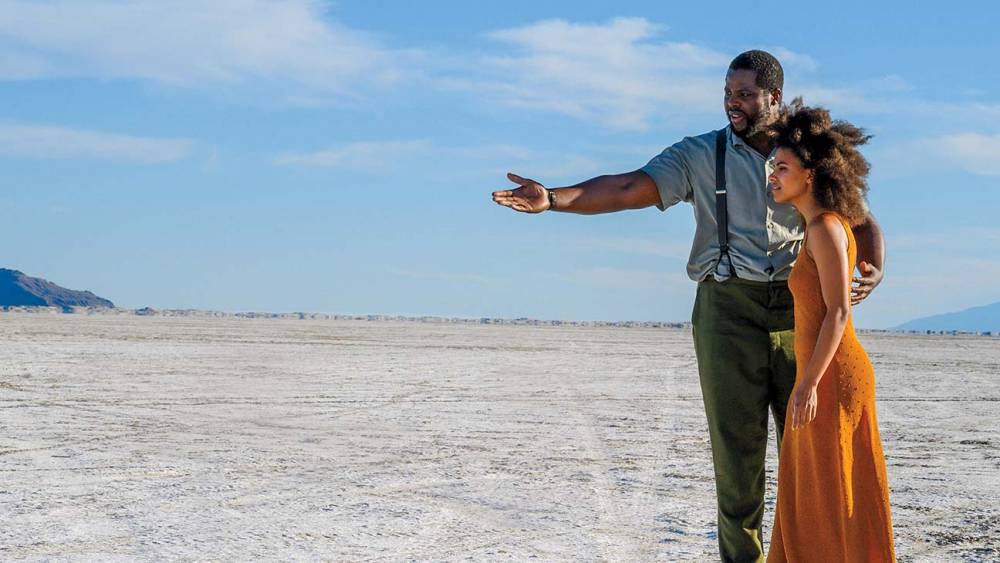
And all of this is made more extraordinary by the fact that Oda is a first-time director. I can’t remember the last time a film by a first-time director felt this unique and special. Maybe Jordan Peele? Oda maintains a top-notch production from every aspect of the craft. The stark desert creates a haunting, ethereal world, perfectly filmed by cinematographer Wyatt Garfield. The film is tight and sharp, thanks to the editing by Michael Taylor and Jeff Betancourt. And I’d be remiss if I failed to mention the score by Antonio Pinto, one of the best of the year, and the most iconic I’ve heard in a long time. Pinto manages to utilize a string ensemble (reminiscent of Amanda and Will’s beloved violin) to create a world of melancholy and pain, yes, but also of whimsy and beauty. It’s a transporting score that perfectly reflects the world that Oda and his team have created.
But the real capper on the whole production is the acting. Every performer is bringing their A-game, and while it isn’t intended as a dig at superhero movies, it’s nice that Oda has allowed so many performers, like Duke, Wong, and Beetz, to spread their wings in such new and interesting directions. Duke in particular is stunning in this role. He has to play Will as attentive, emotive, broken, withdrawn, empathetic, and cold, sometimes all at the same time. Duke has a pure sensitivity in the role, present in touching asides with some of the characters, as well as the way he quietly sings along with Amanda while she sings “You Are My Sunshine.” And when he finally expresses emotion via a scream, it is a primal scream unlike anything I’ve heard onscreen in a long time.
Duke is perfectly contrasted by Wong’s cool, sarcastic Kyo, who shows up quoting The Beatles and offering helpful insight on Will’s journey. Wong has a commanding presence through his empathy, whether he’s lightening a mood as needed or trying to comfort his broken, inwardly-retreating best friend. And Beetz rounds out the core three with her best performance to date. Beetz plays the role loose and reflective without ever resorting to the cliches of the genre. She’s not flighty like, say, Phoebe from Friends. She simply possesses a deep empathy and intelligence that shines through in each and every scene.
The other finalists each bring something special to the pot – Hale has a comedic timing that he smartly underlines with a surprising emotional depth as Alexander, Arianna Ortiz has an expressive face that will absolutely crush you as Maria, and I was particularly stunned by Rysdahl’s touching, beautiful performance as the sensitive Mike. But if there’s one other actor I want to shout out, it’s Skarsgård. Skarsgård is perhaps best known for his iconic portrayal of Pennywise in the It series, and he brings that same intensity to the role of Kane. But it’s a different intensity; Skarsgård brings a cool intelligence to the role, portraying Kane as someone who possesses empathy, but sees Earth as so helpless and depressing that he needs to shelter and hide that empathy away. It’s an interesting performance, and would be far less commanding in a lesser actor’s hands.
Nine Days is a monumental cinematic achievement; a stunning, bravura breakthrough from what will hopefully one day be a legendary director. I’m doing my best to avoid overpraising this film – much less avoiding the M word or the P word – but I can’t help it. This film moved me on a core level. It is a masterful fable that makes us question our very existence, why we do the things we do, and love the things we love. It is a textbook example of writing, directing, staging, acting, and beyond. I love this movie; and more importantly, Oda has reminded me why I love movies in the first place.
A+
Nine Days is currently playing exclusively in theaters


Add Comment