
One Night in Miami… is classic Hollywood filmmaking. Directed by first-timer Regina King, the Emmy and Oscar-winning actress from Watchmen, Jerry Maguire, and If Beale Street Could Talk, it delivers the same kind of historical storytelling that made Green Book a commercial and award-winning hit. And indeed, on the surface, the two films actually share some striking resemblances in overarching themes and period backdrop. But while the aforementioned Best Picture winner mainly focused on telling a simple story with straightforward themes (racism is bad), One Night in Miami… takes a slightly more difficult approach. It dares to take some of history’s most famous and influential Black figures (Malcolm X, Muhammad Ali, Sam Cooke, and Jim Brown) and use them as a source of intellectual debate over the Black experience, navigating fame as a Person of Color, and how to effectively use your voice to inspire change. And while it experiences some dips and lulls over the course of its 110-minute journey, it still crafts an effective, entertaining story and positions King as a directorial force to be reckoned with.
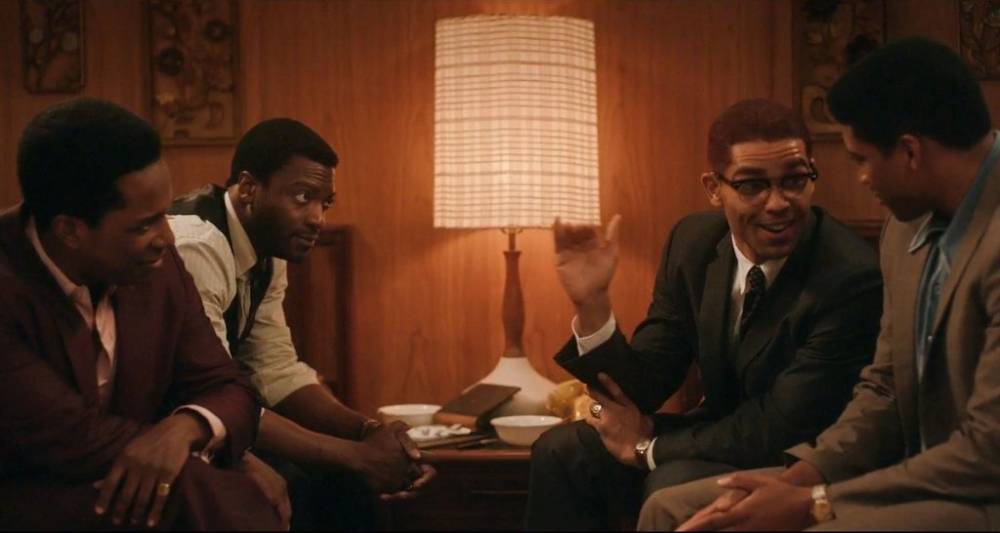
In February of 1964, Cassius Clay (Eli Goree), the man who would become Muhammad Ali, shocks the world by defeating Sonny Liston to become the Heavyweight Champion of the World. He celebrates his win in the company of his three closest friends: famous crooner Sam Cooke (Leslie Odom Jr.) who is trying to come to terms with his newfound fame, football legend Jim Brown (Aldis Hodge), who is contemplating retiring and going into acting, and the infamous minister and activist Malcolm X (Kinglsey Ben-Adir), who is contemplating breaking from the Nation of Islam due to disagreements over corruption at the top level. When it soon becomes clear that Malcolm is there to persuade the others to openly convert with him as a power play, the group soon launches into a serious of intellectual discussions surrounding the bigotry they faced on their climb to the top, and how to best use their voices to protest oppression now that they have a platform with which to do so.
One Night in Miami… follows in the footsteps of the great adult dramas of yore – the films that once would have been directed by Fred Zinnemann, William Wyler, or early Sidney Lumet. While the big-budget format is certainly enticing and exhilarating, there’s no easier way to ensure success than to set up four likable protagonists and have them debate weighty themes. 12 Angry Men (sort of) followed this model, A Man For All Seasons followed this model, and beyond. Kemp Powers uses his screenplay (adapted from his play of the same name) to let these legendary figures weigh in on a variety of weighty topics, perhaps none as overwhelmingly important as navigating fame while Black. In its most straightforward form, Miami… tells the story of Black heroes trying to come to terms with their sudden fame while still not having equal rights like their contemporaries. It’s easy to whitewash history now and assume that these figures (even X, to an extent), were revered in their own time. After all, Ali is undeniably the greatest athlete of all time, Cooke is often cited as the greatest singer, and Brown is regarded as one of the greatest football players. And yet, the film wants us to understand the psychological impact that this has upon the four young men suddenly thrust into the spotlight. After all, it was rare – downright impossible – for a Black man to become a celebrity in those times, and suddenly these four were thrust upon a stage without any script or training.
Things were made increasingly difficult with the necessity of crafting a public persona, and the effect this had on their own lives. I’ll discuss Cooke’s decision to generally not rock the boat in a minute, but it’s clear that the weight of publicity weighs heavily on Cassius and Malcolm the most. Goree captures the pomposity of Clay’s ego perfectly, and you can see the energy of a young man who would soon shock the world with both his conversion and his status as a conscientious objector in the Vietnam War, but it’s Ben-Adir’s Malcolm that’s the most fascinating. As opposed to the expected imagery of the fiery preacher who once declared “We didn’t land on Plymouth Rock! Plymouth Rock landed on us!” Miami… finds Malcolm near the end of his life, when he is forced to come to terms with the decisions he’s made. While his leadership and vision were revolutionary and deserve to be revered, this Malcolm finds himself realizing the pressures of living up to not only the fiery nature of his public persona (a persona that doesn’t quite mesh with the private, quiet family man he truly was), but also his choices, from his wording of famous speeches to his faith in the corrupt Elijah Muhammed – whom Malcolm seems preternaturally aware will likely bring about his ultimate demise (depending on which theory you subscribe to).
What’s perhaps most interesting about the film’s look at their fame, however, is how little it actually changes their general experiences with white America – and how aware they are of this difference. While the opening sequences struggle a bit in execution (more on that in a bit), what they do expertly set up is how little they were respected in their own fields. Clay is viewed as an untalented fluke by announcers and sportscasters, despite his clear athletic prowess in each and every fight. Cooke is booed offstage at the Copa because he’s “no Perry Como” – the most accurate dog whistle I think I’ve ever seen on film. Malcolm faces derision not only from a white America that views him as too extreme, but within his own church as well, which views him as a pawn and not the leader he so clearly is.
And in the most egregious and well-staged of the sequences, Brown meets with the manager of the Cleveland Browns, played to perfection by Beau Bridges, who praises him as one of the greatest athletes in history before casually explaining that he can’t help him with errands because “We don’t allow [redacted] in the house.” Miami… perfectly captures the double-standards afforded to Black celebrities, who must be perfect at all times to achieve overwhelming success and are still looked at as generally inferior. And this doesn’t just apply to the racists – the conversations the main quartet hold also comment on the irony of the White liberal who wants credit for supporting them when others won’t (“Some white folks cannot wait to pat themselves on the back for not being cruel to us”), as well as the racism they experience within their own community. One of the best moments comes after Malcolm gives an impassioned speech, only to be reminded by Brown that he’s had the opportunities he has because of his nature as a light-skinned Person of Color.
But if One Night in Miami… is about anything specific in particular, I would have to say it’s the story of learning to use your platform as a celebrity. In an era where celebrities speaking out over politics (and I mean actually speaking out, not white liberal back-patting like the average Patricia Arquette speech)is at best derided with a snide “Shut up and dribble,” and at worst means blacklisting from your entire career, this subject hits home as succinctly timely and intricately precise. Miami… is not just about four historical figures coming to understand the importance of Black Power – it’s about their efforts to find ways to use their fame to make a difference. Some of these methods are relatively small in scale but significant in scope – Jim’s at the beginning of his future acting career, a massive career shift he’s willing to make to provide young Black children with their first onscreen heroes (as opposed to servants and slaves, a model we’ve mostly backslid into).
But mostly, this conversation revolves around an extended, heated debate between Malcolm and Sam, who find themselves decidedly on opposite ends of the spectrum. Malcolm views Sam as a sellout, who started as an artist for Black people before coddling to the white folks who commodified his voice. Meanwhile, Sam would rather stay silent so as to win over the White Moderate who is slowly coming around on the Civil Rights issue. Both men bring up excellent points, perfectly shot by King as well as acted by Odom and Ben-Adir. Sam gets a smart, witty monologue revealing how he may be undercutting Black artists with his record label, but he’s making them rich by selling their songs to the British invasion. Meanwhile, Malcolm counters by playing a Bob Dylan record to prove that taking a stand can be accepted by the general public – as he succinctly puts it, “Why is this white boy singing about our struggle, and finding success while doing it, in ways you haven’t even touched?” Neither of them is entirely right or wrong (although the film’s conclusion implies that one of them was closer to the right track), and ultimately makes Miami… both a timely and timeless spectacle of acting, writing, and directing.
Now, the bulk of this film’s successes and failures falls at the feet of its structure. In many ways, the film Miami… most reminds me of is the aforementioned Green Book, based in large part to their structures. Both films center on lengthy conversations about race in the 1960s, feature the most straightforward (almost to a fault) of narratives, and both generally constitute the playbook for safe, but well-executed storytelling. However, what’s interesting about Miami… is that it plays almost as a critique of Green Book without feeling like an outright condemnation. Whereas the 2018 Oscar winner mostly desired to gloss over some of the harsher elements of the time to craft something of a feel-good story, Miami… keeps a similar sense of mood without ever undercutting the severity of its protagonists’ realities. It uses those clichéd moments to dig for something deeper than surface-level analysis – for example, as obviously pandering as a character like the security guard Jamaal (Christian Magby) may be, hearing him explain the influence the four men have had on him to set his life in the right direction is tear-inducingly beautiful. And whereas other films about race feature heavy-handed analysis or “emotional” releases, Powers crafts his film to keep the narratively solely focused on eloquent, intellectual debate.
Of course, such descriptions make this film sound like a dud or a snoozefest. Luckily, there’s a lot of middlebrow humor to go around, with the men enjoying their celebration in humorous, realistic ways. One of the funniest aspects of the film, both thanks to its historical realities and the reversal of expectations, is how dorky Malcolm is when compared to his friends. While Cassius, Jim, and Sam want to have a night on the town, where alcohol and women await them, Malcolm takes on the role of lovably lame dad, inviting them to pray with him, banning all booze and indulgences outside of ice cream (vanilla ice cream, to be exact), and insisting on taking pictures of his friends with his newly purchased camera. It’s such a funny and pure dynamic inside the group, and it’s a demonstration of what Powers can do while playing with expectations. And while it’s true that the narratives are mostly straightforward to the point of predictability, that doesn’t necessarily dampen the experience. After all, the minute you figure out the film’s main narrative arc is Sam’s struggle with speaking out, you know the film’s going to climax with the creation of “A Change Is Gonna Come.” It’s so obvious this doesn’t even constitute a spoiler. What this realization doesn’t account for is the reality that this means we will see the smooth-voiced, Tony-winning Leslie Odom Jr. sing the hell out of “A Change Is Gonna Come.” And that alone is worth the price of admission.
As for the filmmaking, I will say that King enters this film with a lot of confidence – and for the most part, she backs it up with aplomb. Sure, the opening scenes are a little clunky (there’s a lot of information hastily rushed out, in the same way Green Book is fairly rough until the main duo end up onscreen – last reference, I promise), but King counters the clunkier sequences with breathtaking boxing matches most directors would be jealous of. King continues to alternate between well-staged Acting sequences and impressively edited feats of filmmaking. For example, she allows cinematographer Tami Reiker (who shoots this film beautifully, for the record) to recreate the famous underwater photo shoot with Clay, she takes an interesting (and well-utilized) risk in introducing the title a full 16 minutes into the film, and she has not one, but two perfectly cut sequences (aided by Oscar-nominee Tariq Anwar) that would make a career auteur jealous. I won’t spoil any particulars, but the first features cuts between an energized storytelling Malcolm and one of Sam’s first major shows, while the second comes during the aforementioned “Change” performance as we see three members of the quartet finding their voice while Malcolm (always seen on the outside of the group, as his time is nearing its end) realizes that his days of fame are numbered. It’s a stunning, emotional sequence, and a sure sign that King is a director to watch for going forward.
If we are being honest with ourselves, Miami… has to be one hell of an actors’ piece, despite the juiciness of the material. After all, not only are these four iconic figures of recent history, but they’ve all been played before, in already iconic roles. For example, Kingsley Ben-Adir has the unenviable task of portraying not only Malcolm X, but Malcolm X in a post-Denzel world. Comparisons between the two are unfortunately going to come up. I won’t say that he necessarily makes the role as memorable as Washington once did (but then again, who could?), but I do applaud the rising star for making this role so uniquely his own. It’s hard to think of Malcolm as a restrained square, and it is a credit to Ben-Adir as an actor for not only making this work, but for creating a stark contrast from Washington’s performance while still feeling like the same man. I will say, however, I found myself much more impressed by the equally-unknown Goree. While Clay was also iconically portrayed by Will Smith back in 2001, I will go as far as to say that Goree’s performance here is far and away my favorite take on the legendary boxer. Goree captures Clay’s charisma, ego, and energy perfectly, and he manages the delicate balance between impression and characterization with great skill and precision.
Leslie Odom Jr.’s performance as Sam Cooke is certainly less flashy than his co-stars, but it is no surprise that he plays the role effectively and wisely. He manages his monologues with emotional strength and passion. And let’s be real here, he sings the hell out of “You Send Me” and “Change,” which are admittedly the most likely reasons he was cast in the part. And while he’s likely the most forgotten member of the group, Hodge is solid as Jim Brown, the sarcastic member of the group who mostly just wants to escape the tension to hit the town. And while that type of role gets overlooked during awards season, it’s integral to holding the story together. Outside of the main quartet, probably the best performance comes from Lance Reddick, who humorously portrays a no-nonsense Nation of Islam member hired to guard the protagonists’ hotel room. There’s a perfect Michael Imperioli cameo, and Beau Bridges is really remarkable in his aforementioned sequence. Joaquina Kalukango has some excellent, if relatively short, scenes as Betty Shabaz. And I don’t want to spoil it, but there’s a great cameo by Jeremy Pope, for any Broadway aficionados out there (or for all five fans of Ryan Murphy’s Hollywood miniseries).
One Night in Miami… is classic simple Hollywood filmmaking. I’d be remiss if I said it had legitimate staying power, but it’s that kind of film you can sit the entire family down for and have everyone enjoy it. This film is a snapshot of a moment in history, of men who changed their prospective fields and made an impact on American culture, both artistically and politically. It tells their stories and gives us a glimpse inside their minds, all while delivering an entertaining, simple story that builds on a foundation of good writing, good directing, and good acting. It’s all we can hope for in a film, and it’s one that’s worthy of the men it portrays.
B+
One Night in Miami… will be released in theaters on December 25th before arriving on Amazon Prime on January 15th, 2021


Add Comment