
As American culture began to accept the premise that modestly successful 90s rom-com Groundhog Day was, in fact, a modern cinematic classic, culture began finding ways to recycle the novel concept of the “time loop” in new and exciting ways. From 2013’s great action-thriller Edge of Tomorrow to last year’s TV underdog Russian Doll, characters have been finding themselves trapped inside closed loops almost as often as Phil Connors once repeated February 2nd. Each entry has had something new and unique to add to the subgenre, and has provided the proper balance of humor and heart to sell the unique and challenging story structure. However, I don’t think any of these projects (each of which I love so dearly) has come close to Palm Springs, a “Lonely Island Classic” (the underground comedy troupe’s parody of “Sony Pictures Classics,” right down to stealing the logo) that not only provides more laughs than any comedy in recent memory, but also tackles weighty philosophical concepts without batting an eye.
Sarah Wilder (Cristin Milioti) is a screw-up. She knows it, her family knows it, everyone knows it. She’s such a mess that on the day of her sister Tala’s (Camila Mendes) wedding, she isn’t even prepared to give her Maid Of Honor speech. Thankfully, she’s bailed out by Nyles (Andy Samberg), the nihilistic, laid-back boyfriend of another bridesmaid, Misty (Meredith Hagner). Sarah is drawn to Nyles’ casual attitude, and after he reveals his girlfriend’s infidelity, the two head into the nearby desert to hook up. Unfortunately for Sarah, a series of events reveals to her exactly why Nyles is so casual about everything: he’s been trapped in a time loop, forced to live out the same events over and over again. And what’s worse, she’s been sucked into the same predicament. So now, Nyles and Sarah are forced to live out the miserable wedding over and over again, for all eternity, and perhaps find some meaning in life’s chaotic randomness along the way. Or until they get killed by Roy (J.K. Simmons), a psychopathic wedding guest who’s also become trapped in the time loop.
The driving force of the Time Loop subgenre is its underlying theme. A modern-day Aesop’s Fable, the story always has some sort of moral that the characters must learn through their never-ending journeys. Groundhog Day is about a pessimistic assh*le learning about karma and living a pure, Buddhist life. The Happy Death Day series is about learning not to let your past define you and embitter you to the present. And last year’s Russian Doll (which is about so many different, exciting themes) is about mental illness and trauma. Palm Springs is no different, and yet it uses its moral to embrace the story in a refreshingly new way – and almost specifically catered to me, it seems. It approaches life not from a place of Buddhistic purity or hopefulness, but from finding light in the darkness. Palm Springs operates under three essential principles, and builds its metaphors around them: that Existence Is Pain, that love is what gives us strength to cut through the mundanity, and that through that strength and hope, we can find the ability to better ourselves. In terms of the hopelessness of existence, the film makes its point quite clear from the jump, which begins in medias res with Samberg’s Nyles already in the loop. By starting in the loop, not only does the film pay homage to Groundhog Day’s original opening (which was supposed to have Bill Murray inside the loop from the jump), it helps define exactly what the film’s core message is. The film establishes Nyles as miserable, depressed, and nihilistic (perhaps where the name Nyles comes from?) from the get go, making such declarations like “Love is an illusion, we’re all alone” and “Nothing matters, which makes it ironic are only choice is to live.” Through Nyles’ views on life and the structure of the film, the final result comments on the emptiness and hopelessness that many humans share. Palm Springs is about finding love in the seeming futility of existence, and by having our characters starting in a metaphor for their own loneliness, it helps establish the themes economically and intelligently.
However, Palm Springs is far from some dirge of a watch. It possesses the soul of a romantic, and will warm your heart about finding love in a loveless world. At its core, Palm Springs is a funny, captivating parable about trying to find love while suffering a deep depression while trapped in a loop of your own worst decisions – a live-action, peppier BoJack Horseman, if you will. As Sarah and Nyles embrace the meaninglessness of their own existences together, it’s both a terrific moment of comedic filmmaking as well as a wonderful moment of finding that one person whom you can share the meaninglessness together with and provide hope through it. After all, we don’t see Nyles honestly smile for the first time until he and Sarah start pulling pranks together. They see through the bullsh*t of the world around them, and suffer through and dissect it together. After all, there’s nothing smarter that this film does than utilize a wedding as its primary setting, as it not only underlines the feeling of loneliness inside our protagonists, but also punctuates an underlying notion that weddings are a form of Hell as a literal concept. However, as their time together goes on, their codependency in debauchery begins to transform into something deeper – a commentary on coupledom. They debate the importance of their pasts in a world with no past and no future. They discuss if it’s even worth leaving the loop if “all their bullsh*t” will affect their newfound freedom. And in perhaps the best scene of the film, they argue over their trapped codependence in an argument that mirrors that of an ordinary couple. “I never would have gotten involved with you if I’d known you were just a pretentious sad boy,” Sarah angrily declares. Yet despite their arguments, fears, and beliefs, the film openly and honestly explores both characters’ desires to find a love strong enough to help them grapple with the harsh realities of the world around them – closed loop or not. As one character declares late in the film, in a beautifully rendered monologue, “There’s nothing worse than going through this sh*t alone.”
And perhaps most beautifully of all, the film also provides commentary on how to better oneself for love without actively changing what makes someone utterly themselves. Both characters go through significant changes based on their lessons and experiences inside the loop, but the most interesting of these is far and away Sarah’s. When we first meet the maid of honor, she’s an incredible mess. She’s drunk, she’s unprepared, and her family looks at her as a failure. As the film so eloquently puts it:
“They think I f*ck around and drink too much.”
“Why would they think that?”
“Because I f*ck around and drink too much.”
Sarah’s journey is not just one of accepting life, but moving forward in life. Her mission is to learn that her actions have consequences, and that while actions may not matter in the grand scheme of things, living with the guilt should be enough to prevent oneself from becoming a “source of terror.” “Pain matters,” as Nyles so eloquently puts it. And there is nothing to make Sarah learn this lesson more effectively than the fact that the loop not only makes her relive the same day over and over, but it makes her relive her rock bottom every single morning. This is what makes the film so powerful – because while Sarah’s mission is to better herself to earn love (just like Bill Murray had to do in the 90s classic), she also sets out to better herself. Yes, this means spiritually, romantically, and personally, but the film is brilliant enough to take it one step further, and show her literally taking quantum physics courses to learn how to escape the loop. These efforts to improve help us connect to Sarah’s character, and when she gives her maid of honor speech a final time, it not only marks an improvement from her flustering opening, and expresses the wisdom she’s learned in her infinite time on Earth, but it allows for such a poignancy it’s hard not to get choked up. This is a rich film with much to say about human nature, and I’m impressed writer Andy Siara and Max Barbakow manage to flesh it out so fluidly.
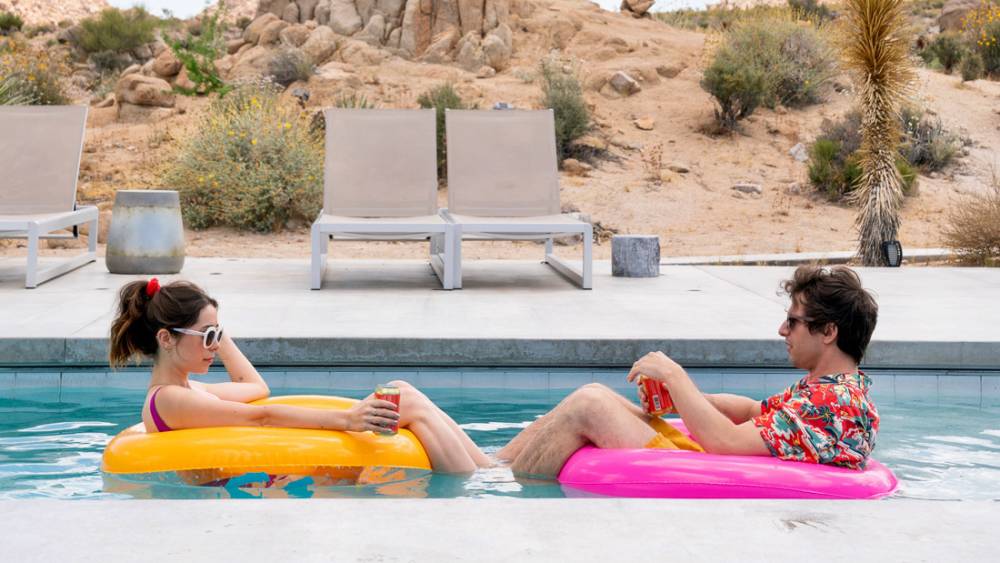
Now, all of this philosophical talk probably makes this film sound like a slog. I promise you nothing could be further from the truth. Not only is Palm Springs one of the best examples of the time loop subgenre, it’s one of the best comedies I’ve seen in years – no surprise, considering The Lonely Island’s hand in some of the funniest films, albums, and shows of the last decade. Part of the success of Palm Springs’ comedy is the introduction of multiple people inside the loop. While Groundhog Day and other popular films of the genre have demonstrated the insanity and humor inside an individual feeling they’re going crazy, Palm Springs takes a different approach by seeing what the shenanigans would look like if people were forced to share this experience together. Not only does this allow for witty repartee that a solo participant would sorely lack (one of the best comes when Nyles explains away the film’s concept with an off-hand “It’s one of those…infinite time loop situations you might have heard about” and they just roll with it), it allows for all jokes to be one-upped by a second presence. Andy Samberg morosely drinking in a pool is a funny image, but Samberg and Milioti getting wasted punctuates the joke. There’s an entire, wonderful montage showing the ways they pass the time together, which both elevates the concept of infinite time (learning an entire dance routine) and a lack of permanent consequences (stealing planes, drawing naughty tattoos on each other). And it comments on genre clichés in fun, undercutting ways – they discuss the possibility of the loop being a “karma thing” before instantly casting off the common moral, and Samberg plays out a pastiche of the classic “seduction” trope by making passes at everyone from the bride to Sarah and Tala’s father (Peter Gallagher). All the while, Siara gives us a master class in writing and structuring, as the jokes come quickly and effortlessly, the twists feel earned and poignant, and it knows exactly when to go against its own structure to repurpose the material. These are lessons in writing that take years to master, and the young television upstart has done it without breaking a sweat – or exceeding the 90 minute comedy nadir. It is comedy in its purest form.
In terms of the performances, the film is an incredible two-actor showcase. Cristin Milioti has been a star on the rise since the early 2010s, when she was a Tony-nominee and stealing shows like 30 Rock and How I Met Your Mother. And she’s no different here, where she’s a magnetic force from the moment she first appears. She’s a ball of chaotic, self-loathing energy, breaking your heart one minute and still delivering “your mom” jokes well into the film’s climax. Quite frankly, she could create chemistry with any fellow performer. Of course, it’s easy to have chemistry when your co-star gives you what Andy Samberg provides. Samberg here is a revelation, a shockingly solid, funny, and romantic lead. It’s impressive how gifted he is at delivering his one-liners without ever feeling like an imitation of Bill Murray. Hell, he even possesses the sex appeal of a leading man, Tom Hanks style – he even makes lounging lethargically while carrying a beer look attractive. The film lives and dies on the strength of these two and their performances, but I do want to take some time to praise the supporting cast, which is a veritable who’s who of character actors, each taking great pleasure in the silly material. Camila Mendes and Tyler Hoechlin are quite adequate as the bride and groom, even if they don’t get quite the same material as their co-stars. Two of my favorite performances come from rising young underground comic actors Conner O’Malley and Meredith Hagner as a douchey groomsman and Nyles’ girlfriend, respectively. Dale Dickey is hilarious as a local barfly, Peter Gallagher has the time of his life as the father of the bride, and June Squibb is here to provide grandmotherly warmth and advice. And of course, there’s J.K. Simmons as fellow loop-patron and Nyles’ archenemy Roy, who fully deserves a second Oscar for his performance here. He is capable of providing true belly laughs while doing drugs in a bathtub with Samberg or torturing his archrival in brutal, hilarious ways, as well as choking us up with powerful monologues on the meaning of life. The fact that an actor of his caliber is willing to show up for a few minutes is a testament to the talent of this ensemble and the quality of the script.
Palm Springs is a film seemingly tailor-made for me. It is a film about the futility of life, and about finding love to give that futility a little meaning. It’s a love story for those who see the world as meaningless, an optimistic tale that every true cynic secretly desires and desperately needs. I can’t get over how bowled over I am by the final product, from Barbakow’s direction to Siara’s screenplay to the performances by Samberg, Milioti, and the entire cast. I went into Palm Springs expecting a respectable, pleasant rom-com. I emerged with a deeply funny, emotionally sweet philosophical journey that had me laughing, crying, and cheering. Kudos to Lonely Island, kudos to the two AFI grads at this film’s core, and kudos to Palm Springs.
A
Palm Springs is now streaming on Hulu


Add Comment