
The news surrounding Bong Joon Ho’s Parasite has sort of reached a fever pitch at this point. It won the Cannes Palme d’Or, became the most buzzed about title of the Toronto, Telluride, and New York Film Festivals with record-setting lines, and has been selling out most showings since its opening weekend. When a film reaches this level of fervor, it becomes understandable to ask, “Is it even worth it?” Well, if you’re aware of Bong’s works, which have ranged from the meditative Memories of Murder to the balls-out insanity of The Host, Snowpiercer, and Okja, you’ll know the answer is most likely “Yes.” And with that level of understanding heading into the production, Parasite feels like a twisty, turning take on a modern day Hitchcock film, tackling weighty subject matter in a fun, entertaining way.
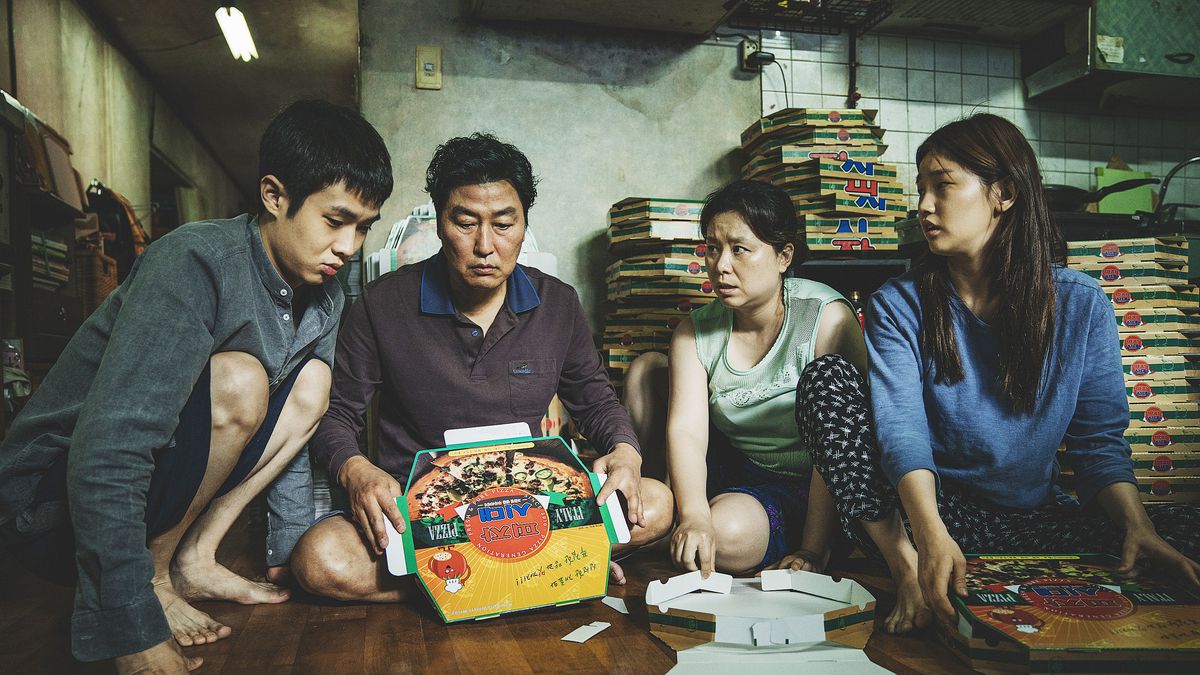
The Kim family lives in near-squalor. Consisting of easygoing dad Ki-taek (Song Kang-ho), former Olympic medalist Chung-sook (Jang Hye-jin), former soldier Ki-woo (Choi Woo-shik), and artistic daughter Ki-jeong (Park So-dam), the family gets by living in their basement apartment through a series of scams and side jobs, struggling to make ends meet. However, there luck begins to change when Ki-woo receives a major break. Thanks to a well-meaning bluff by a friend, Ki-woo is hired as an English tutor for the wealthy Park family: CEO Dong-ik (Lee Sun-kyun), simple-but-loving Choi Yeon-gyo (Cho Yeo-jeong), teenage daughter Da-hye (Jung Ji-so), and energetic son Da-song (Jung Hyun-joon). As time goes on, Ki-woo begins to invent and execute elaborate schemes to ensure employment with the Parks for the rest of his family. And so begins an insane, twisted journey that will shape both families’ lives forever.
It’s incredibly difficult to describe Parasite in terms of its plot, both because avoiding spoilers makes for an incredible viewing experience as well as the way the themes twist and turn in unexpected ways to keep viewers on their toes. It is almost impossible to classify Parasite to any specific theme, because Bong is constantly changing the film’s plot and genre on a moment’s notice. For most of the film’s first act, Parasite positions itself as a traditional satire in the classical 1930s model, pitting the “highly educated” book smart Parks vs. the poorer street smart Kims. Like most films of the genre, there is no animosity between the two groups. The Kims aren’t out to get the Parks by any means; they’re just desperate to make a living and are willing to use their skillful cons to take advantage of the Parks’ naiveté. Meanwhile, the Parks are far from a demonic, evil conclave determined to screw over the working class for their own benefit. They are but simple players in the Jeeves and Wooster model, with the mom falling asleep and panicking at random moments, the dad waxing philosophic about disgusting smells and sights in a quest for perfection, and the kids just rambunctuous little weirdos. The worst thing they do is flaunt their wealth and Americanization in humorous, satiric asides. When paying the families’ salary for the first time, Yeon-gyo comments “I added a little bit for inflation!” And almost immediately after meeting the Kim family, the Parks rename them with something that sounds more American. It’s a traditional comedy of manners, demonstrating the lower classes coming up with intelligent schemes to weasel their way into the lives of their wealthy contemporaries – schemes that, hilariously, involve carefully choreographed rehearsals, scripts and visual gags. It’s easy to walk out of this film imagining the first half as a comedy.
And yet, right as you begin to finger the film for a Noel Coward/Shakespearean comedy, it takes a hard right turn. I can’t go too far into the second act (although I will touch on it a little further into this review), but the best way to describe it is a Hitchcockian thriller. This is not exactly a surprise if you know Bong, whose films often go off the rails in absurd, extreme ways. But what is surprising is that it takes over an hour to reach these insane levels. Bong is known for adding the insanity in from the jump, whether in the form of an insane Jake Gyllenhaal zoologist, an off-the-rails train, or a giant monster terrifyingly – and hilariously – ravaging a waterside fair. By withholding the shock from his audience for so long, Bong is building a false sense of security that makes the fall from grace and change in tone all the more shocking when it shifts. As mentioned above, I’ll be careful about describing exactly what happens, but it is worth noting that the film’s genre undergoes a series of rapid, almost comical changes in the following acts – thriller to horror to drama and beyond. Yet all the while, it never loses that sense of comedy that undercut the first act’s narrative – there is a closing door comedy thrown into the middle of the tension-laced second act, even having characters trapped in a room watching others become intimate. This is a bizarre, funny, brilliant film, and Bong has accomplished something that so few directors have ever achieved: a tonal whiplash that succeeds in enrapturing its audience, as opposed to alienating them.
Of course, it is clear from the jump that Bong has more on his mind than just silly commentary, when it comes to class relations and economic anxiety. After all, it is a pretty clear metaphor to set up that “the rich people live in a big house on a mountain and the poor people live in a basement apartment.” Bong is a master of balancing subtlety with gonzo filmmaking, leaning into the obvious metaphors as opposed to dressing them up as sophisticated (in the case of, say, Darren Aronofsky’s mother!). He understands that by embracing the silliness of broad metaphors, it grants you the freedom of focusing on themes, performances, and visual jokes as opposed to grandiosity. You see, Parasite takes place in a South Korea experiencing vast increases of wealth, yet simultaneously undergoing rampant unemployment and class malaise – and Bong rightly assumes that this is a universal concern. “What a miracle it is that in an age like ours, where an opening for a security guard attracts 500 university grads, all four of us are employed!” Ki-taek declares, in a dark piece of brilliant writing. For while it’s entertaining to see the lower class Kim family scheme and plan to earn their jobs, there’s an underlying commentary on a system that would force them to resort to such means in the first place. Despite the comedic presenting of the material, it is still disturbing to see the stink bug-ridden, sock-covered apartment in which the Kims are forced to live. It is made worse when, in a passing line, we learn that despite Ki-woo’s knack for languages and education, and despite serving in the South Korean army, he was still unable to put himself through college.
The film makes it clear through clever doublings and well-crafted editing that the only reason the Parks are better off than the Kims is because the system has allowed them to thrive. “They aren’t rich because they’re nice; they’re nice because they’re rich,” Chung-sook declares at one point. And while the film doesn’t fault the Parks for that – after all, they didn’t design the system, they just benefit from it – it certainly makes it clear that their naiveté and ennui translates to how they perceive those below them. In one of the most striking sequences of the year, we see a hard cut from Yeon-gyo trying on clothes in her massive closet with refugees and homeless people digging for clothes in a rummage bin. And the Kims are presented as no better – when opportunity presents itself, they are shown to be just as cunning and ruthless as their employers to benefit themselves. The schemes that make the first act of the film such a riot are, with hindsight, brutal and unfair to the predecessors they force into unemployment. Just like in real life, the film sets up a conflict where tensions and animosities boil and simmer until they explode into violence and rage, setting up a finale that pushes likable people to primal attitudes in the worst possible ways. Parasite makes it clear that when the system fails on such a colossal scale – where it pits class against class, neighbor against neighbor, and worker against worker – then humans will turn to their animalistic tendencies, and we will forever be trapped in a circle of disparity, where everything that has happened before will happen again. And without both personal and widespread change, there’s nothing we can do to stop it.
These last few paragraphs make it sound as if Parasite is some sort of slog, a preachy, intellectual piece of drivel that you’d have to watch in a college lecture. And yet, that’s why Bong’s sense of comedic timing is so brilliant – Parasite is so lighthearted and funny, you could almost miss the subtlety and nuance of the material it’s covering. Much of the humor Bong devises comes straight from the characters and how they interact with each other. It is clear from the get-go that Ki-woo views himself as an intellectual ready to mingle with high society, and Bong milks this characterization in hysterical ways. Ki-woo’s catchphrase is the oft-repeated declaration that something is “so metaphorical,” and he comments on Da-song’s self-portrait as “a clear metaphor for a chimpanzee!” Meanwhile, Ki-jeong is a hilarious little sociopath, letting cigarettes dangle from her lips as she casually comes up with detailed lies on the spot. She criticizes her brother for reading his teenage pupil’s diary while immediately popping it open herself. And in one of the film’s funniest moments, she improvises an entire monologue about art therapy that makes Mrs. Park burst into tears. And don’t get me started on Mrs. Park, whose kind ditziness is timed to the second, and the way she reacts to each and every one of the Kims’ schemes makes for high comedy. Bong’s jokes beyond this point range from the silly to the profound (the desperate Kims pray to whichever cause grants them employment each day, be it the Wi-Fi to Mr. Park himself). And when his dialogue isn’t enough to get a laugh, he crafts a visual joke so creative, you can’t help but cackle. The entire second act is a straight-up slamming doors comedy, and in one of my favorite visuals of the year, a group of characters are held at gunpoint – although instead of a gun, the perpetrator uses a cell phone video. Sometimes the jokes are poignant, sometimes they’re silly, but they never cease to provide entertainment.
As for the acting, this is one of the greatest ensembles I’ve seen in years. Parasite is the type of film where your favorite character will change on every viewing. On first viewing, my favorite character was far and away Park So-dam, who knows exactly how to deliver the dialogue of the charismatic sociopath known as Ki-jeong, aka “Jessica, Only Child, Illinois, Chicago.” The second time I saw the film, my favorite became Cho Yeo-jeong, who is a comedic marvel as Yeon-gyo. Every line out of her mouth is pure gold, and the way she carries herself should be studied in acting classes for years to come. And the more I sit with the film, the more I am mesmerized by Song Kang-ho’s performance. Song’s performance is easy to overlook on first viewing – it is a broken, introverted performance until the very end of the film. And yet, the little ways in which Song brings Ki-taek out of his shell as the film goes along, allowing him to find himself, remain some of the best acting you’ll see all year. Jung Ziso and Jung Hyeon-jun are both stellar as the Park children, as is Lee Sun-kyun as Park Dong-ik, the respect-commanding patriarch of the Park family. The same can be said for Choi Woo-shik and Chang Hyae-jin as Ki-woo and Chung-sook of the Kim family. However, if there are two members of the Parasite ensemble who deserve a shout out, it is Lee Jung-eun and Park Myung-hoon. Jung-eun plays Gook Moon-gwang, the original housekeeper to the Park family, and she remains one of the funniest characters you’ll see onscreen all year. She has a gift for physical comedy, and her deliveries are top-notch. I can’t say much about Park Myung-hoon’s performance, but I will say he has fantastic eyes and a gift for both physical prowess and comedic timing. They are two key members of an ensemble I could watch forever and ever.
Like a real insect, Parasite burrows its way into your mind and infests your soul, in all the right ways. I have already seen this film twice, and I can’t wait to see it a third. It’s the type of film that will wow you its first time out, and consistently reward you on each repeat viewing. Bong Joon Ho has crafted a genre-challenging, style-bending work of comedic prowess, thrilling tension, and insightful commentary. It’s the type of film audiences love, and the type of film they deserve.


Add Comment