
Does Rosamund Pike need to fire her agent? I pose this question as a hypothetical, but there is a good deal of evidence that she should rethink her current situation. After taking the world by storm with her groundbreaking turn in Gone Girl, Pike has found herself participating in an endless string of stuffy, boring period pieces, each one diminishing her talents further and futher. Sure, A United Kingdom was fairly charming, but A Private War was a bit of a snooze that wasted her solid performance. And in her newest film, Radioactive, Pike finds herself ultimately betrayed by director Marjane Satrapi and especially writer Jack Thorne, who force her to carry an unconscionably bad film alone on her shoulders.
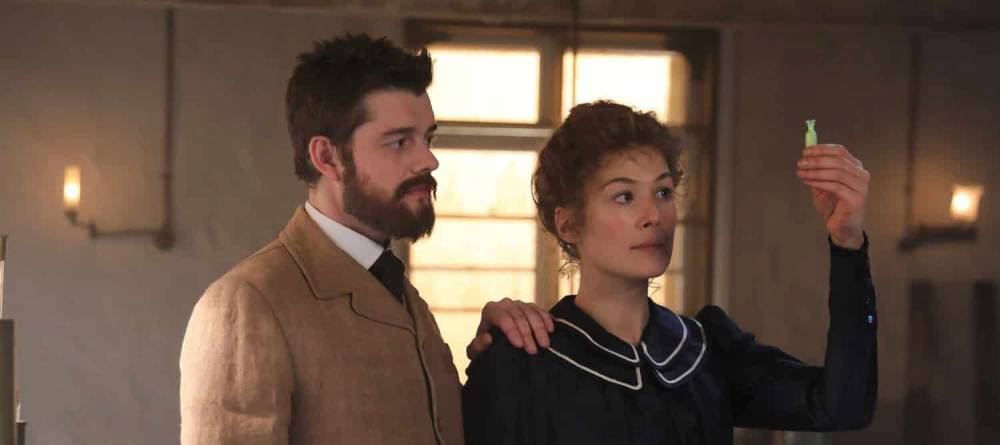
The film traces the life and legacy of Marie Skłodowska Curie (Pike) throughout her legendary career. Not only did she, along with her husband Pierre Curie (Sam Riley) discover two new elements in polonium and radium, but she managed to trace its uses in curing cancer and creating x-rays, and became the first person to win two Nobel Prizes. The film also tackles the death of her husband, her affair with Paul Langevin (Aneurin Barnard), her vilification in the press, and her strained, but loving relationship with daughter Irene (Anya Taylor-Joy). Or at least, the film claims it does these things. Mostly it just lists a bunch of facts while people look mopey.
It’s fairly apparent what kind of film you can expect from the very first minutes of Radioactive, when the film opens in Paris 1934 as an aged Marie falls to the ground and people start gathering around her screaming “It’s Madame Curie!” The “flashback on life while dying trope” has been the hallmark of the stereotypical biopic (in both good ways and bad) since Lawrence of Arabia in 1963. Writer Jack Thorne (who famously wrote the fanbase-panned Harry Potter and the Cursed Child) steals bits and pieces from far better biopics, like the aforementioned Arabia, The Imitation Game, the 1943 film about Madame Curie, and Hidden Figures, all as a means of providing a book report-quality take on Curie’s life. Why is Marie obsessed with science? Well, because she has Asperger’s and her mom died of cancer! How do they show that she’s a scientist first and wife/mother second? Well, they intercut between her scientific work and the most dispassionate sex scene ever put on film. Even the affair is shown in a rote, haphazard way. In a better film, this could have offered commentary on women’s sex lives, the judgment they receive, or the complex nature of Marie’s shattering psyche. But the film simply presents it as yet another fact in a long line of biographical bullet points. Hell, it’s not even clear that Langevin is married for another ten minutes of screentime due to the script’s inability to establish character or context. The film moves at such a fast pace to hit all the bullet points, it ends up glossing over the most interesting, complex plot points. Xenophobia and her vilification in the press are presented as side notes, and the film tacks on the creation of x-rays as a final, disconnected coda. This is a film that doesn’t know what to say, nor how to tell it.
Some of these setups for plot points are so lazy, it seems like they were forced at gunpoint. For example, exactly twelve minutes into the film, Marie Curie announces, unprompted, “I think I found a new element!” And later, after some stock footage of Pike and Riley looking dispassionately at test tubes, they then begin a speech that possesses the line, “We thought we had found a new element. We were wrong…Instead, we found two new elements!” Other moments are completely unearned – there is a stereotypical scene where the Marie Curie wins the Nobel Prize and all the women in the audience stand up to applaud, which is already a cliché, but is both ironic and disturbing for reasons I’ll get into later. And some of these moments are incredibly insulting – the opening scene after the flashback, the one that defines Curie as a creator and as a woman, is a horribly staged meet-cute with her future husband Pierre. In fact, the film approaches their relationship in the weirdest way possible – it desperately wants to tell the story about sexy scientists changing modern chemistry. After all, the book it’s based on was literally titled Radioactive: Marie & Pierre Curie: A Tale of Love And Fallout. But despite the efforts to put the relationship front and center, the film balks whenever it attempts to explore this angle – whether because Thorne can’t write romance or because the filmmakers wanted to avoid reducing Curie to her relationships, I couldn’t say. I’m not saying a film can’t succeed by playing it safe and resorting to clichés. For the most part, 2016’s Hidden Figures is a stereotypical, cliched biopic about famous scientific figures. However, whereas Hidden Figures focused on character development and narrative arcs to bring Katherine Johnson’s story to life, Radioactive thinks that bullet points and a stuffy, uptight retelling will get the job done. Radioactive is the cinematic equivalent of a book report based on the Wikipedia entry, nothing more.
Of course, to call Radioactive a stereotypical, cliched biopic is a bit of a misnomer. Sure, that’s what it seems like for the first half hour, but that is before Satrapi takes one of the greatest cinematic leaps – and missteps – I’ve seen in a long time. Now, I’ll admit, I was dazzled when the film first takes a narrative detour, thanks to the deft hand and clever cinematography that went into the sequence. While Marie explains her theory on uranium and radioactivity, the film breaks down the science with a fascinating look through the process of mining, testing, and creating the uranium necessary. It’s a fascinating sequence. But shortly after this sequence, Radioactive plays its hand. After Pierre off-handedly mentions that radioactivity could potentially “cure cancer,” the film takes a fifteen-minute detour to 1957 Cleveland, where a young boy is about to receive the first chemotherapy test as his father rants about “my son being used as a guinea pig.” Who is this child? Why does he matter to the plot? Why should I care? The film never answers these questions, and instead drags on for an endless eternity before returning to Marie Curie. And this is but the first detour the film takes – we later take trips to the Nevada Test Site and Chernobyl, with the intention of proving Pierre’s off-handed fear that “maybe humanity wasn’t ready for our discovery.” The most egregious digression is the one which cuts between Pierre’s Nobel Prize speech and the bombing of Hiroshima, which features a group of young Japanese children playing in slow motion before realizing there’s a bomb dropping directly on top of them. It would be a horrific sequence if it weren’t so poorly shot that you have to laugh. Each digression is poorly acted and staged, and oftentimes appears solely to break up the more stimulating central arc. One of Pike’s best-acted scenes in the film is quite literally interrupted by the anachronistic fire truck headed to Chernobyl. I mean, I guess I have to give Satrapi props for trying to avoid making a traditional biopic in some manner, but I can’t help but feel that these narrative digressions were done before, and better, by films as varied as American Splendor and Rocketman. Here, it just feels like the overplayed hand of an indecisive filmmaker.
In fact, you could argue that this indecisiveness is what creates the film’s poor decision making. Satrapi just doesn’t know what she wants this film to be. Is it a traditional, stuffy biopic or an avant-garde look at world history? Was Marie Curie a saint who saved lives through her discoveries, or is she directly responsible for Hiroshima and Chernobyl? The film wants to have its feet in every single playground imaginable, and instead just stretches itself too thin and too ridiculous. You can’t even claim that they were trying to show the complexity of the situations, as any chance to explore the nuances are bypassed for yet another string of bullet point presentations. It can’t make up its mind in terms of the core relationship – it always hints at an interesting dynamic, including Pierre’s obsessions with spiritualism and mediums and Marie’s devout atheism, but it never actually explores these ramifications. It can’t make up its mind in terms of Marie’s influence on history as either a hero or villain – despite praising her scientific mind throughout the film’s runtime, the final scene is a dying Marie walking through those previously mentioned digressions and realizing that her greatest discovery would decimate humanity for generations to come.
And perhaps most offensively of all, it can’t make up its mind on what it has to say. Madame Curie’s story is one ripe with major issues plaguing us to this day. As a female Polish immigrant, she faced sexism, classism, xenophobia, antisemitism (despite not being Jewish), and beyond. And despite all this glorious, bountiful material, the film explores none of it. Oh, it’s there. The film reminds you of all these topics in the final act, when Marie is suddenly forced to face these issues. But there’s no exploration of her struggles, these developments in France, or how she felt about their effect on her life and work. In fact, they’re only mentioned in the final act at all as a way of earning brownie points from politically-inclined audience members. That Nobel-Prize clapping scene I mentioned earlier? Not only is that the first time Marie’s gender is referenced as important to the story, not fifteen minutes later she tells her daughter, who is shocked at her accomplishments as a woman, that “I suffered far more from lack of funds than I ever did for being a woman.” If the issue was so unimportant to Curie’s life, work, and outlook, why even bring it up as a theme in the first place? And why have the anachronistic, unnecessary applause scene in the first place? Radioactive wants credit for raising Important Issues – including xenophobia, sexism, and humanity’s tendency to use life-saving science for evil – but it lacks the rational thought necessary to dissect these subjects, resorting to laziness time and time again.
Perhaps Radioactive would have been less offensive to its viewers if it had just had halfway decent technical aspects. After all, many a biopic has survived thanks to the attention to detail on its camera work and costume design. But sadly, the film couldn’t even manage to get that right. I mean, you’ll notice how cheap the filmmakers were with the budget from the jump, as soon as you realize how cheap the old age makeup looks on Pike’s face. And it’s all downhill from there. The editing is slapdash and inconsistent, be it from scene to scene or jumping between the avant-garde framing devices. The production design looks flat, gray and uninteresting, presenting neither romanticism nor commentary on the time frame (say what you will about 2014’s terrible The Theory of Everything, at least it was pretty to look at). There really should be no need for CGI in a film like this, and yet not only do the filmmakers find a way to shoehorn it in, but it appears in some of the most haphazard ways I’ve ever seen. Whether its glimpses of 1890s Paris or the aforementioned shot of a nuclear bomb dropping onto a group of schoolchildren, the CGI looks as if it were created by a middle schooler on Windows 95. Hell, it’s so egregiously bad the tragic death of Pierre – which is presented through the horse’s POV as it tramples him to death – transforms from a moment of anguish into a laugh line before our very eyes. In fact, the only compliment I can pay this film’s technical filmmaking is the cinematography by Anthony Dod Mantle, which is at least competent and occasionally brilliant in service of a non-starter plot. This is a lazy, lazy film, from beginning to end.
It’s hard to talk about the acting, as it can split into three camps: the Rosamund Pike, the barely there, or the Chewing Through Scenery. You really don’t need me to tell you Rosamund Pike is fairly exceptional as Marie Curie. Oftentimes, she’s the only thing keeping this film afloat. Now, I won’t say she’s perfect in the role – after all, she has been instructed to play Curie as an Aspergian “supergenius,” a cross between Benedict Cumberbatch’s Alan Turing and The Big Bang Theory’s Sheldon Cooper. But even when she goes a bit over-the-top, she manages to bring it back to a grounded, touching level. There’s a scene late in the film where she breaks down while talking to the spiritualist her husband may have had an affair with that almost touched on greatness, all thanks to her acting. And it’s worth noting that Sam Riley is solid as Pierre, even if that’s most likely due to Pike’s ability to forge chemistry with anyone and anything. Of course, it was an interesting choice to portray Nobel Prize Winner Pierre Curie as a bumbling idiot – we know he’s smart because Marie and the film tell us he is, but his most memorable scenes are him being awed by fake psychics and looking at his decaying hand and going “Whoa, cool!” Most of the other performances range from the interchangeable Stuffy Performance (lover Barnard barely registers outside of appearing in a nightshirt in Pike’s bedroom in one scene) or the hilariously inept actors in the flash forwards, but there is one performance I want to single out. This film breathes new life the minute Irene Curie ages into Anya Taylor-Joy. One of the fastest rising stars in the business right now, Taylor-Joy steals the film as her mother’s first equal, not only sparring with the talented Pike, but delivering the best scene in the film as the smart-but-loving Irene is forced to introduce her fiancée to her strict mother and pre-teen sister. It’s a loving, slapstick moment that feels pulled from a different, better film, but it shows how Taylor-Joy brings the first moments of, well, Joy to an otherwise-joyless film.
Radioactive is one of the worst biopics that can possibly exist. It’s a film that pretends it has something to say, and in the end offers nothing – not even insight on the famous figure it’s portraying. You can’t even compare it to something like Bohemian Rhapsody, because as cliché as it was, it at least had an angle. Radioactive doesn’t even have that. It’s the most boring book report you will ever witness, and the only highlight is the trainwreck-esque curiosity of seeing exactly how much weight Rosamund Pike can support as she single-handedly carries this film. Perhaps there’s an interesting film buried deep within this one. Perhaps the definitive Marie Curie film is yet to come. But no matter how many Marie Curie films have come before, or how many will come after, I can tell you this: I know which one will be the worst.
D+
Radioactive is streaming on Amazon Prime starting today, July 24th


Add Comment