
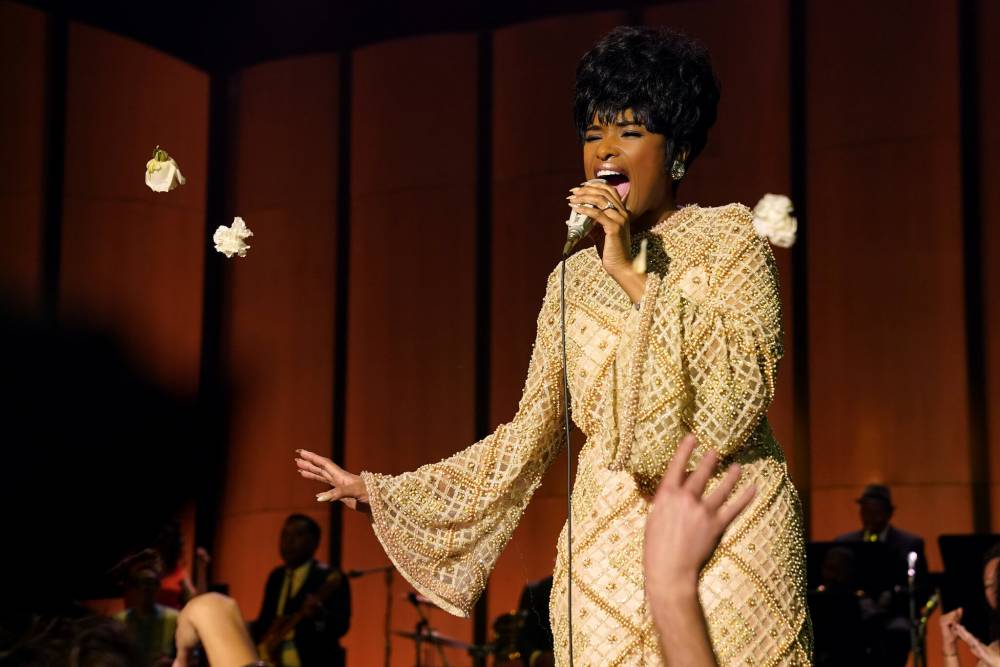
At this point, there is no such thing as a “great” musical biopic. Oh, sure, they can be good if they have the right star, like Rocketman, or as some would argue, Bohemian Rhapsody (I would not). But if the genre is going to insist on following a list of cliches, it will never rise above a level of mild entertainment meant to appeal to the most base level purveyor of historical facts and figures. Respect, the biography of the Queen of Soul herself Aretha Franklin, is yet another entry in the Walk Hard school of filmmaking, following each cliché and story beat note for note as if the satirical masterpiece hadn’t come out fifteen years ago. Yet as irritated as you’re likely to be by the overbloated paint-by-numbers version of Aretha’s life and legacy, there are a few saving graces: Jennifer Hudson’s performance, the decision to utilize exclusively live singing onset, and an interesting theme dropped here or there.
Respect follows Aretha Franklin (Hudson) on her journey to becoming an international musical superstar. Born to the popular traveling preacher at the forefront of the Civil Rights movement C.L. Franklin (Forrest Whitaker) and popular singer-songwriter Barbara Franklin (Audra McDonald), young Ree made a name for herself amongst her parents’ groups of friends thanks to her supernatural voice – a voice that can only be assumed to be a gift from God. The film follows her throughout the years as she struggles to escape her father’s tyrannical grip, finding herself in an abusive marriage to Ted White (Marlon Wayans), and ultimately working with Jerry Wexler (Marc Maron) and the Muscle Shoals band to craft some of the most iconic songs of all time, including “Natural Woman,” “Think,” “Chain of Fools,” and the now-iconic remix of “Respect.” However, through it all, Aretha struggles with her relationship to faith and her battles with the so-called “Demon,” her father’s misunderstanding of depression stemming from the death of her mother and a sexual assault that resulted in pregnancy at the age of 12.
It’s truly astonishing how closely Respect adheres to the Walk Hard biopic method. Hell, there are several moments where you could not convince me these aren’t the same films. It hits all the beats. The opening party scene where young Aretha performs for her parents’ friends. The CONSTANT Easter Eggs to lines and catchphrases that Franklin would later make iconic – shouting “Sock it to me, baby” while dancing, or “I just want a little respect, that’s all” during a romantic conversation, or telling her philandering, abusive husband “You better think.” And when we transition from young Aretha to Jennifer Hudson Aretha, we get the classic spinning reveal – you know, to show that time had passed. By the time the third act suddenly devolves into the trope-riddled addict’s tale, complete with the hazy alcohol filter, you’ll want to stand up and shout “WE’VE SEEN THIS BEFORE!”
What is unique for a biopic like this is the way the timing is condensed, occasionally to absurd degrees. For example, the year 1968. After 90 minutes of nothing happening, suddenly the film kicks into gear, with Aretha Franklin performing a “legendary” performance at Madison Square Garden, traversing the globe on a 19-week world tour, AND leaving her abusive husband. All this is well and good, but after all this happens, we then see Aretha receiving an award for her work in the African American community from her childhood friend Martin Luther King (Gilbert Glenn Brown). Which is odd, because anyone with an understanding of history knows that Dr. King was killed in April of 1968. This means that everything we’ve just watched – the concert, the three month tour, the divorce, the award, and beyond all has to occur in a little over three months. I’m aware that the film takes some significant liberties – after all, it intentionally mislabels Franklin’s performance of “Precious Lord, Take My Hand” as a part of Dr. King’s funeral, when in reality she performed at a different memorial so Mahalia Jackson could sing. But still, these are significant, unfathomable time lapses – hell, at least the changes to Bohemian Rhapsody made sense.
This lack of pacing is considerably stranger when you realize the film is already bloated beyond belief. This is a two-hour and twenty five minute film where we don’t see the main (adult) character until the 25 minute mark, and we don’t hear a single hit for an hour and a half. That bloat is further complicated by the fact that, despite the film’s action-packed runtime, it still feels disjointed. Writers Tracey Scott Wilson and Callie Khouri constantly drop bits of inferences and foreshadowing that inevitably lead nowhere. For example, there’s a sequence where Ted – who we know has anger issues – is getting huffy after Aretha criticizes him. In the very next scene, Aretha shows up at a meeting in giant sunglasses. Filmmaking 101 would allow the audience to infer that she now has a black eye that she’s covering up. Except…she doesn’t. But just as you begin to believe the film is playing with idea of subverting tropes and cliches, the film flashes back to show that he did beat her up. In an incredibly public place. While she is famous. And people still act surprised when it comes out that Ted is abusive.
This is far from the only example of the film’s complete disregard for follow-through. A similar issue arises after witnessing one of the film’s several lip-service treatments of Aretha’s activism. After watching Aretha express interest in more radical forms of protest, and giving a press conference in support of Angela Davis, we learn that Aretha’s concerts are suddenly being cancelled. Logic would dictate that this is due to her public stances and racism within the industry, but instead, we learn it’s because of her drinking issues – issues that have, up to this point, never been established. It’s actually astonishing how poorly the film follows through on its inferences before changing lanes on a dime. Ted, for example, goes from the perfect romantic lead to an abusive monster at the drop of a hat, without any warning or foreshadowing. I get that abusive men are capable of hiding their problems and red flags from their spouses until well into the relationship, but come on. This heel-turn wouldn’t even make sense if the film was told subjectively from Aretha’s point of view.
All these cliches and missteps are a real shame, because there are a lot of moments with real promise here. The messages and morals are laid on pretty thick, but the central story – about how a combination of music and faith managed to save the Queen of Soul’s life after decades of physical, mental, and sexual abuse – is actually pretty respectfully handled. Much of this is owed to director Liesl Tommy, who has a real knack for choosing to show, not tell, despite the film’s worst tendencies. Whereas most of the film’s missteps come from the screenplay’s ridiculous convolutions, but Tommy keeps several moments as subtle as possible. There’s interesting subtext surrounding Forrest Whitaker toxic father figure, and how he preaches the importance of civil rights to his followers while simultaneously (and metaphorically) pimping out his daughter to white record producers.
Meanwhile, there’s a moment where the ghost of Barbara Franklin comes to comfort her daughter during a time of crisis that could have been incredibly ham-fisted, but instead feels truly magical in context. And an early scene where Aretha works with the legendary (and all-white) Muscle Shoals band, distrustful of them after driving through gorgeous white fields hiding their shameful sharecropping secrets, to craft “I Never Loved A Man,” it feels like the type of scene that wins films like this awards all the time. Oh, and speaking of music, Liesl Tommy deserves an award for choosing to cast actual singers who could hit these notes and sing these songs live, as opposed to the lipsyncing Uncanny Valley this genre often resides in. It makes each song feel more electric, more impressive, and more respectable. My only complaint is that, for all the film’s bloat and extended sequences, we somehow only hear two songs performed in their entirety: the eponymous “Respect” (featured 90 minutes in) and “Amazing Grace,” which is unsurprisingly the final scene.
Before discussing any of the other actors, we obviously must discuss Jennifer Hudson. I had my qualms about the Oscar-winner playing this role. She was incredible in Dreamgirls all those years ago, but hasn’t done much since (outside, of course, of Cats). And when I realized that this film was going to be another bloated biopic, my expectations were at an all-time low. So let me make this clear from the jump: Hudson is outright astounding with an unbelievably bad script. Obviously, she can sing all these songs in her sleep, and even if she doesn’t sound exactly like Aretha, her voice will still leave you in awe, whether it’s a Gospel hymn, a soul classic like “Natural Woman” or “Think,” and when she sings “Amazing Grace” at the end, it will actually take your breath away.
But I’m also left firmly impressed by her performance, as even in the film’s more cliched moments, Hudson finds humanity and panache. One of the biggest pratfalls of the biopic genre is the way its stars are treated with fawning kid gloves who deliver quippy lines and fantastic musical moments, like the N.W.A. actors in Straight Outta Compton who have no flaws and are always Cool and Impressive. If you’re lucky, maybe you’ll have a two-minute sequence of humanity or emotion, like the bedroom phone call in Rhapsody. Throughout Respect, Hudson is actively making Franklin feel like a real person with real emotions, whether she’s sauntering sexily to flirt with Ted at a party, suffering serious bouts of depression, or standing up to a bullying figure in her personal life. This is a real, honest performance, and without it, the film doesn’t work.
As for the rest of the cast, everyone mostly shows up to play their roles dutifully, often aided by their vocal gifts – after all, a good chunk of the cast happen to be legendary Broadway stars. There’s icon Audra McDonald, who’s fantastic in a too-brief role, but at least we’re blessed with a few standout performances. Tony Award nominees Saycon Sengbloh and Hailey Kilgore play Aretha’s sisters/backup singers, and honestly, some of the film’s best moments come when the trio are onscreen singing together. And in one of the film’s most surprising turns, Tituss Burgess shows up as a deep-voiced, straight-laced (and straight) preacher that befriends Aretha in childhood, and it’s one of the film’s best performances. Perhaps my two favorite turns come from comedians Marlon Wayans and Marc Maron. Maron’s mostly here to do his normal shtick as the put-upon producer, and it works because, well, Maron’s really good at it.
But Wayans is the real surprise. He’s excellent in every scene, he’s surprisingly sexy when he has to be and sleazy when the role calls for it, and while never explicitly named, he gives a fascinating turn as a man with undiagnosed bipolar disorder. And I can’t forget to name Kimberly Scott as Mama Franklin (playing exactly the type of role you’d expect), Skye Dakota Turner as Young Aretha, with a voice of an angel and some acting range to boot, and David Simpson as Muscle Shoals organ player Spooner Oldham. Simpson probably has two lines, tops, but his mere presence just screams hip musician in the 60s, and I love it. But there are two performers I want to single out for more…complex reasons.
When it comes to Whitaker’s turn as Reverend Franklin, it’s a bit of an up-and-down performance. He has some terrific moments of both pathos and fury that hint at a complex man, but they’re buried under the actor’s odd accent choice and over-the-top sequences, like pulling a gun on a man for no damn reason. Oh, and Mary J. Blige shows up in a scene as the legendary performer Dinah Washington, and not only is it as campy as Walk Hard’s “It’s me, George Harrison of the Beatles,” but the performance and writing is so campy and offensive, it crosses the territory into slander. I’m honestly amazed I didn’t walk out of the theater after her scene.
Listen, Respect is going to be exactly what you expect it to be. If you hate biopics and groan loudly as each cliché and overtly checklisted moment rolls by, you may want to skip it. If you love watching celebrities give real good performances of other celebrities, you’ll likely love it. And if you’re like me, and want to see history unfold onscreen but are hesitant of the obviousness of the whole ordeal, you’ll likely walk away with mixed feelings. All I can say is this: did I groan a lot? Yes. Could I guess plots and lines before they happened? Yes. Is Jennifer Hudson great in this? Yes? And did I cry at the end as Aretha finds peace in her dead mother’s arms and sings the hell out of “Amazing Grace?” Also yes. Make of this information what you will.
C+
Respect will premiere exclusively in theaters on Friday, August 13th. Please practice proper precautions should you choose to see this film in theaters


Add Comment