
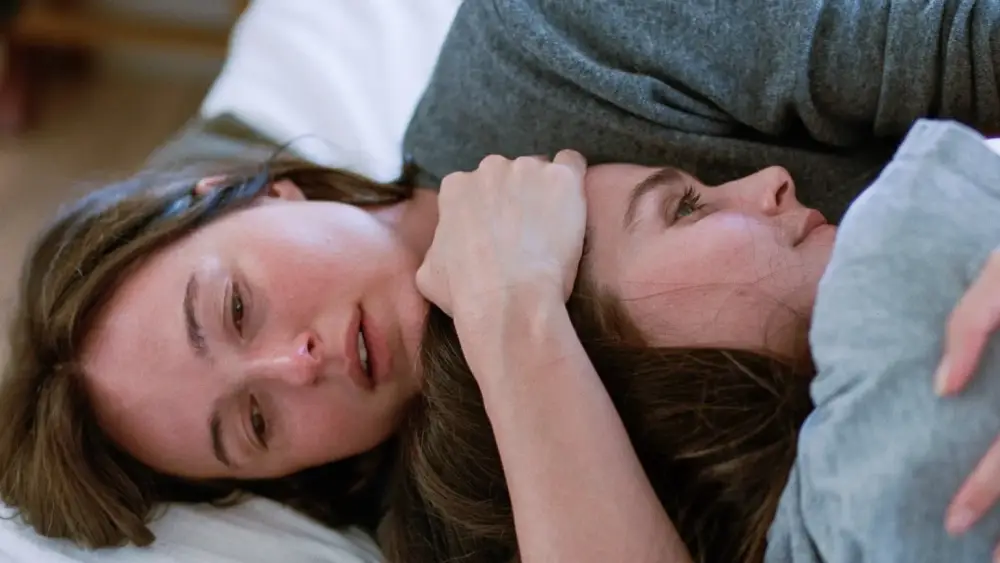
The point of art is to allow you to tap into your deeply felt emotions. Literature, music, art, film, it all is designed to tell a story that allows the individual to unleash the emotions they themselves cannot entirely fathom. Few directors are as gifted at this as Joachim Trier, the masterful Norwegian director fresh off his Oslo Trilogy. His newest film, Sentimental Value, is something of a metatextual exploration of this phenomenon: a work of art about a work of art allowing its characters to process their own emotions. And while Sentimental Value is not quite the masterpiece of his 2021 film The Worst Person in the World, it is still one of the year’s best structured, best acted films seen this year.
When Nora (Renate Reinsve) and Agnes Borg (Inga Ibsdotter Lilleaas) were little girls, their acclaimed director father Gustav (Stellan Skarsgård) divorced their mother and abandoned the family to pursue fame and success. Since then, Nora has become a popular stage and television actress juggling a messy personal life, while Agnes is relatively well-adjusted with her husband (Andreas Stoltenberg Granerud) and son (Øyvind Hesjedal Loven). After their mother’s death, Gustav returns to their childhood home, of course with an ulterior motive.
Gustav wants to film his swan song in the house, the story of his freedom fighter mother who committed suicide when he was a child. And in Gustav’s mind, there is no one more fit for the part than Nora…who wants nothing to do with her father. Ever determined to make the film (and perhaps to taunt her daughter with the role), Gustav instead hires Hollywood movie star Rachel Kemp (Elle Fanning) for the role. All together for the first time in years, the Borg family and their celebrity counterpart confront generational trauma, deeply held grudges, and messy personal lives.
Trier is a master of realistic characters who act like human beings. They are capable of great acts of love as well as those capable of harming both themselves and others. The Borg family is no different, and the script and filmmaking thrive in the moments that see them act as real people: real sisters, real flawed fathers, real aunts, real lovers, and so on. This is a script that finds its love, its humor, its pain, and its catharsis in these little moments between family, and thrives in these moments.
Yet this is no typical drama about a fractured family; Trier’s film firmly lives in the realm that bridges grief and art. Art and cinema is both the cause of, and seemingly solution to, the unspoken emotions between the Borg family. To the girls, Gustav’s love seems conditional. In his mind, he’s expressing his love the only way he can through his own trauma and selfishness: casting them in films to spend time with them and support them. Yet to Nora and Agnes, it is a symbol of the only way they could spend time with him. “If we’re the best thing that ever happened to you,” Nora asks, “then why weren’t you there?”
This tension and conflict of emotions serves as the film’s back and forth, egged on by Gustav’s newest screenplay. The new film, of course, is a MacGuffin. It is a metaphor for generational trauma, a pain repeated throughout history both intentionally and unintentionally. It is the scars of the past, inadvertently passed from a mother to a son, whose in turn passed his trauma on to his two daughters – one perhaps more similar than she’d ever care to admit. It makes the Gustav’s new film an answer, an apology, and an olive branch all rolled into one plot device, one that dissects the very nature of art as a means of healing – both the artist and the audience.
As is often the case with Trier’s films, the ensemble is top notch, particularly the four leads. Trier’s frequent muse Reinsve is, as usual, astonishing as Nora. Every aspect of the performance is controlled – her face, her body language, hurled insults and silent prayers. Reinsve shows us Nora’s entire life story before the film ever reveals it. Her trauma and loneliness are so earnest; it is a raw performance, and arguably one of the finest of the year. Skarsgård, meanwhile, is every bit her equal as depressed, alcoholic, and yet still utterly charismatic Gustav. He finds a raw center to a man running out of time, as an artist and as a father, and whose every action is a flail against the passage of time.
While theoretically the easiest role in the film, Elle Fanning is truly excellent as Rachel, something of a blockbuster actress trying to establish herself as a serious actress. It often makes her the comic relief, yet the complexity of the role shines through when she captures giving a great performance that is still utterly wrong for the part. And then there’s Lilleaas as younger sister Agnes, who carries two of the film’s most heartfelt moments squarely on her shoulders: one a beautiful monologue near the film’s end, the other a quieter moment simply looking at her young son. All four performers are at the top of their game, and elevate the film to transcendent heights.
Sentimental Value is one of the year’s truest and most human cinematic achievements. Trier has, honestly and earnestly captured the pain of realizing the pain you’ve passed to your children, of seeing the worst parts of you inherited by those you love, and of forgiveness and empathy, through art or through oneself, in healing that brokenness we all feel on some level. It is an open-hearted film, led by four bravura performances of pain and growth. Sentimental Value is the year’s most heartfelt picture, the clear work of an artist at the top of his game, and easily one of the best of the year.
A
Sentimental Value is now available on VOD, as well as in theaters nationwide


Add Comment