
Ed. Note: As a special Sacred Walloween treat, all five films running this week will be themed to reflect upon the most “trendy” pop culture costumes of the year, just in case you don’t have a costume yet
I’m at the point where I have to start wondering if Marvel Fatigue has ruined these movies for me. While I’ve never been fully invested in the franchise (albeit not as cynically as some of my contemporaries), I’ve at least been able to enjoy them. I’ve even given positive reviews to Endgame and the miniseries WandaVision. But these last few outings…I’m not sure. And when it comes to Shang-Chi and the Legend of the Ten Rings, I found myself constantly asking, “Why isn’t this working for me?” Whether it’s the predictable story beats, the Marvelization of the filmmaking, or the downright disappointing screenplay, Destin Daniel Cretton’s Shang-Chi finds itself struggling to click, despite some gorgeous visuals, smart casting, and a handful of cool fight sequences.
San Francisco valet attendant Shaun (Simu Liu) lives an ordinary life. He’s perfectly content living paycheck to paycheck alongside his childhood best friend, the extroverted fast-talker Katy (Awkwafina). However, Shaun’s idyllic life is uprooted when he finds himself attacked during his morning commute, and he is forced to reveal to Katy the truth. In reality, Shaun is Xu Shang-Chi, a skilled assassin raised by his immortal warlord father Wenwu (Tony Leung). Wenwu believes that his children, Shang-Chi and Xialing (Meng’er Zhang), hold the key to a hidden door, behind which lies the spirit of his late wife (and children’s mother) Ying Li (Fala Chan). However, Shang-Chi soon learns that the door also holds a dark secret capable of destroying the entire world. Can Shang-Chi finally defeat his father and take his place as the hero he was born to be?
The very first warning signs surrounding Shang-Chi’s ability to handle its lofty material can be found in the film’s opening moments, featuring a massive battle in ancient China, utilizing elements of wuxia and classical warfare. This is a massive scope, not unlike Red Cliff, or Crouching Tiger, or Drunken Master. And yet, the sequence lacks anything resembling any semblance of fun. It’s just…more of the same material Marvel’s already been feeding us. And therein lies the problem with the film: unlike, say, Black Panther, Shang-Chi is not allowed to lean into the magic and history that should make this story pop. It’s the same basic story filled with the same cheesy lines building up to the same lame conclusion.
In particular, the screenplay by Cretton, Dave Callaham, and Andrew Lanham screams of formulaic, even by Marvel’s standards. Characters constantly just state their thoughts out loud and comment on their surroundings. The ever-so-clever expression “Holy sh*t” is funny the first time it is uttered before becoming an oft-repeated crutch without any semblance of thought or usage. And the characters are constantly making decisions that work against their own best interests.
The Marvelization of these themes and genres – which are already cool in their own right – can be found in the much-hyped “bus fight” scene early in the film, where Shang-Chi takes on a series of assassins within the confines of a city bus. That’s an amazing set-up for a fight scene. And then…it cuts to slow-mo. Now, here’s the problem with slow-mo in a martial arts fight scene. The entire purpose of martial arts is that the action, and the speed at which it is performed, is the centerpiece. It is the punchline to the joke itself. We enjoy watching Jackie Chan and Jet Li and Crouching Tiger because what these people are doing with their bodies – in real time, with relatively minimal cuts – is almost unbelievable in and of itself, kinetic and exuberant in its sheer impressiveness.
Why drain this sequence of any semblance of joy and life for the sake of simplicity? It could have been impressive – there are swords, and martial arts, and a bus with no brakes and no driver. But in an effort to “Marvelize” something that needed no improvement (beyond the slow-mo, there’s also a random passenger who actually shouts out, after someone is kicked in the groin, “THAT’S gotta hurt!”), the final result isn’t just an example of pulled punches. It is soulless, in and of itself.
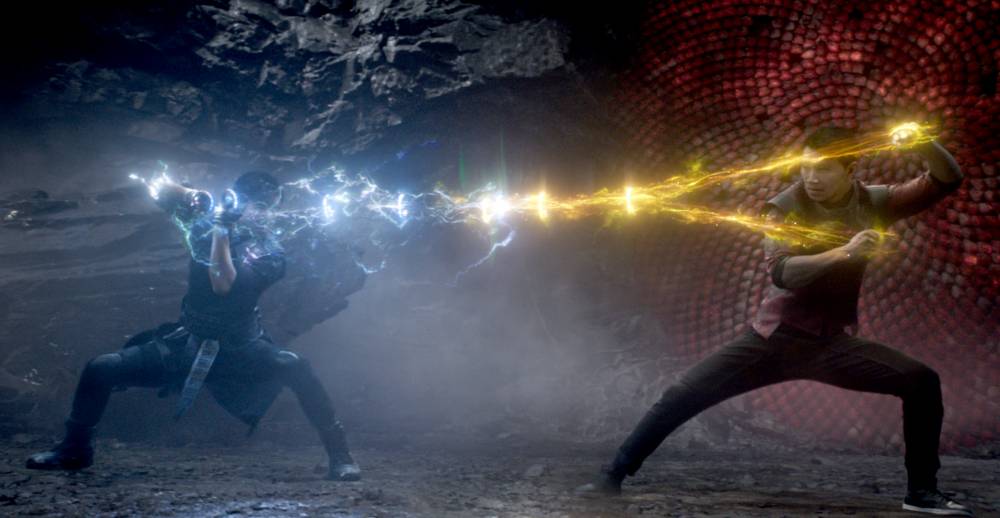
It all builds up to the finale, which might be Marvel’s weakest climax to date. And that’s saying a lot for a franchise known for notoriously bad third-act problems. While the initial setup is pretty cool, involving a martial arts battle against two opposing armies utilizing ancient magical weapons, things soon take a turn for the worse as things slowly grow more and more tedious and consistently shatter any semblance of logic and order. Which would be bad enough as it is, but this climax goes on and on. A note in my journal currently states “This climax is 40 minutes long and I’m tired,” and I cannot for the life of me remember if I actually timed this or was making some sort of snide joke.
And to cap it all off, Shang-Chi, our hero, the character we are meant to follow and idolize…during this final world-threatening battle, he almost lets the world die. Twice. And he does this solely to prove a point that, at base level, seems wildly incompatible with his morals and beliefs. It takes a lot to make me want to walk out of a film involving a giant dragon battle, but here we are.
I also want to take a moment to comment on the absurdity of the synergy currently at play. Now, in an ideal world, one would critique and study a film based solely on its own merits, not based on the world at large. But considering so much of Marvel filmmaking is now about setting up for future installments and connecting to the overall brand, the subject must be explored. Because once you acknowledge that these films impact the world you’re currently inhabiting, it shades and impacts everything else you will see. Which is especially troubling when it clouds your ability to suspend your own personal disbelief. For example, how many times can we, as an audience, in this exact same franchise, accept that there are secret realms and universes within our world protected by secret societies. This has been the plot for Guardians of the Galaxy, Black Panther, Doctor Strange, Captain Marvel, WandaVision, and beyond.
How many secret worlds are there currently possessing cataclysmic, world-ending threats? How threatening can these worlds be if just one or two superheroes are necessary to stop it? Where are the stakes? The more they try to expand this world, the closer we get to making the concept of “saving the world” feel boring and pedantic. Oh, and in case you’re wondering if Disney tries to shoehorn themselves into the production, the very first song performed during a karaoke scene involves a duet to Aladdin. Get it? Because Disney owns everything? We love our corporate overlords, folks.
All of these issues and aggravations and missteps are all the more frustrating because, as a whole, there is a lot to like here. The cinematography by William Pope is gorgeous to look at, and when the editing by Nat Sanders, Elisabet Ronaldsdóttir, and Harry Yoon can get out of its own way and just embrace the wuxia, it actually is pretty cool. There’s one sequence involving wuxia flirting that is ultimately rather impressive, and a later fight sequence down the side of a building is an improvement on the earlier bus fight – it is better staged, better shot, and all-around great filmmaking. The CGI work on the dragons and Morris, a no-faced dog creature are expertly executed, as are the effects on an ever-changing forest maze.
And honestly, out of all the Marvel films to date, this is the one I enjoyed the characterizations in the most. I love the idea of a superhero who’s happy just living the stoner’s life and drinking with his friends. And speaking of, I’m incredibly happy that Awkwafina’s character is characterized as a friend and sidekick, as opposed to a girlfriend. It makes more sense for the character, avoids the genre’s lazy cliches, and is ultimately a funnier dichotomy. Oh, and while it wasn’t intentional, the post-credits sequence is one of the most ironically humorous in all of Marvel’s canon. It’s not supposed to be, but I’ll give them credit for it anyway.
The film also manages to succeed, if ever so slightly, on the back of its actors. This is a competent cast all willing to do their jobs efficiently. Simu Liu doesn’t have the charisma yet of other heroes who have burst onto the scene, but I did enjoy his balance between tough and dorky. Meanwhile, Awkwafina is a brilliant bit of casting because it makes absolutely no sense for her – or her cinematic counterpart – to be in a Marvel movie. She is perhaps the only instance of an actor being so ridiculously miscast that they come out the other side as good again. Chinese actress Meng’er Zhang has a real superstar quality that she brings to the role – she’s certainly more entertaining than her assistant played by Yuen Wah. Pen15’s Dallas Liu plays Katy’s younger brother, which is mostly only funny if you watch Pen15. Oh, and in terms of cameos from other Marvel properties, I’m never going to complain when Benedict Wong pops up in something – he’s great at everything he does.
However, Shang-Chi is carried by three actors, and three actors in particular. First, there’s Ben Kingsley, reprising his iconic Iron Man 3 role and bringing actual comedy to the film. Shocker, if you hire a talented actor and let him actually act, it creates actual comedy. Next, we have Michelle Yeoh, a superstar at all she does, even if her role here as Aunt Nan is to show up and deliver exposition. And then there’s Tony Leung as Wenwu. Leung is already one of China’s most prominent actors, thanks to his sex symbol status in films like In The Mood For Love, Chungking Express, Lust Caution, Hard Boiled, and Infernal Affairs – that assortment alone makes up some of the sexiest, most romantic, most action-packed films in the history of the medium.
So it comes as no surprise that Leung is dazzling in this role, filling it with equal parts menace and pathos as a man who had a shot at redemption, only to lose it with tragedy. He sells his tragic moments, his sinister moments, and his warm moments with equal aplomb, the way we’d hope a talented actor would. And it’s worth noting that while they don’t look alike, there is enough resemblance between Simu Liu and Leung that they make a convincing father-son pairing. It certainly helps add to the believability of the relationship.
I so desperately wanted to like Shang-Chi. And there is a lot to like, I suppose. But at the end, I didn’t feel the sense of enjoyment that I normally do after a fun action movie. Nor did I feel angry, or lacking. I just felt empty. In fact, the most telling thing to me about this film after I saw it is that, after stopping at the grocery store on the way home from the screening, I had forgotten I’d been at the theaters until a friend texted to ask how it was. It’s the epitome of average. I suppose I can recommend the film easily enough as a typical night at the movies, but I do so with ulterior motives. I recommend Shang-Chi in the hopes that the wuxia influences you to see Hero or Crouching Tiger, or that the martial arts inspires you to see Police Story or Drunken Master, or that Tony Leung’s hotness inspires you to see In The Mood For Love. In short, Shang-Chi will be a success if it helps you open the door to the wonderful world of Chinese Cinema. Everything else is a wash.
B-
Shang-Chi and the Legend of the Ten Rings is currently exclusively playing in theaters. It will debut on Disney+ November 12th


Add Comment