
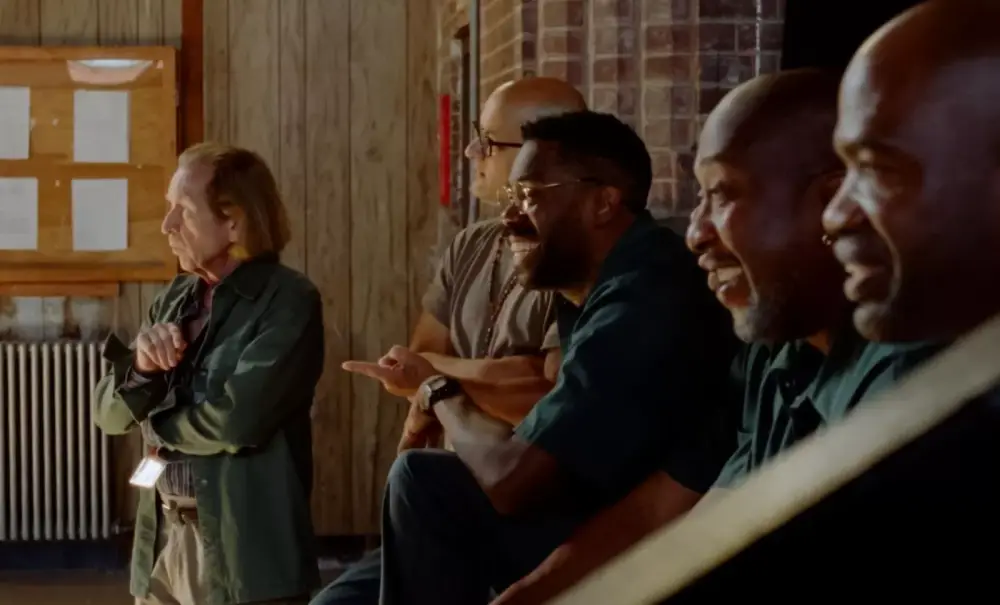
It’s hard not to view Sing Sing as a “gimmick” film. Based on the real-life Rehabilitation Through the Arts program, which both attempts to rehabilitate inmates in Sing Sing prison as well as teach them a craft for their lives outside prison walls, Greg Kwedar’s intimate drama makes the bold and unique choice to cast actual members of the program as themselves, in order to more honestly tell the story. It’s the type of move that feels designed to give the film an angle or “wow” factor. And yet, it primarily serves to both underline the film’s notion of redemption and compassion as well as allow for a litany of fresh faces to grace our screens and open our hearts.
Divine G (Colman Domingo) is serving a life sentence at Sing Sing Correctional Facility for a crime he did not commit. His only source of solace is the Rehabilitation Through The Arts program – a former writer, he writes their plays and often stars in the leading roles. As he prepares for an upcoming exoneration trial, he faces a surprise obstacle: a new member named Divine Eye (Clarence “Divine Eye” Maclin, playing himself), whose raw energy and proposed original comedy idea take the group by storm. However, as both men reflect on their life choices, the life they imagine beyond the walls, and the escape that the theater can bring them, an unlikely friendship is formed.
The central notion at the heart of Sing Sing is fairly simple, and pretty much proof in practice: the redeeming nature of art. This is a story about men who turned to crime because they felt there was no other path, who find an outlet for their emotions and a craft they didn’t know before, and manage to find redemption and become the men and the examples they long to be for their children. Yet Kwedar’s script goes far deeper than such notions about healing art. Instead, he’s crafted a film about the relationships men form under hardship, of bonds that better and further each other, and can renew a sense of life and passion, even when stripped of one’s freedom.
The core dynamic of the film is how these men come together, and their friendships. After all, the guards aren’t abusive, but they have become desensitized in their role to the point they see the inmates less as men and more as inconveniences, while the parole board only sees them as potentially irredeemable criminals. The inmates have to take care of each other, and push each other to grow on their own. Primarily this involves Divine G and Divine Eye, men who are initially at odds thanks to Divine Eye’s performative bravado and the fact he steals the role of Hamlet away from the trained thespian. Against all odds, and despite their initial grievances, the two men connect over their passion for the play and their desire to better themselves.
While it’s easy to connect with Divine G’s story of wrongful imprisonment, the passion for the art and for change is far more relatable in Divine Eye’s story. He is a man so caught up in his own masculinity that he watched his son follow in his footsteps and end up incarcerated himself. It sparks a desire to change in Divine Eye, and we find ourselves rooting for him as he finds pride in their Waiting For Guffman-esque show (apparently based on a real play the inmates wrote). It allows us to see the humanity the parole board infuriatingly cannot: that these are human beings, with the potential to grow and change, trapped in a system favoring punishment over recidivism.
Kwedar underlines these themes – of freedom, growth, change, etc. – through subtlety and quiet reflection. He simply lets his camera linger and slowly push without overwhelming the senses, letting the actors and the story speak for itself. In fact, his most ostentatious moments come simply through establishing shots. Oftentimes the camera finds itself outside the prison walls, capturing trees, and rivers, and trains. It establishes a world we take for granted that these men haven’t seen in years, and may never see again. And in doing so, it helps us, like the members of the troupe, appreciate the small beauties found in life.
The performances on display are lived-in, primarily because, well, they are. The majority of the performers are released or exonerated members of the program, playing themselves and giving performances that feel real and honest and raw, whether comic relief or deeply wounded. One of the film’s best moments simply shows the actors’ auditions for the play – you see the joy in their eyes as they bring their characters to life. Of the bunch, Maclin is the standout, telling his own story as “Divine Eye” and finding a real catharsis in his own journey.
Equally strong are the professionals who add gravitas to the mix. Domingo is always a revelation in every role he takes on, and his wrongly-convicted poet with a vanity streak is no exception. He carries the film on his shoulders, and when coupled with the raw talent of someone like Maclin, it feels like magic onscreen. Paul Raci is also great as the program’s director – it’s a subtle turn, and perhaps one even greater than his much-acclaimed work in Sound of Metal. I also want to shout out Sean San José as Mike Mike, Divine G’s best friend behind bars. A renowned theater actor, San José provides an excellent foil to Divine G’s self-seriousness and Divine Eye’s bravado, turning an excellent, solid turn as the group’s comedic relief.
Sing Sing speaks volumes in its quiet empathy. It pops without being flashy, it educates without preaching, and it entertains without losing its humanity. This is a smartly acted, sharply written, subtly directed film, one with more heart and humanity than many of its contemporaries. Yes, the gimmick of its casting gives the illusion of homework, of “great import.” Yet the quality of the acting, the intelligence of the direction, and the humanity of the story elevate it to something deeper, far more entertaining and cathartic than many filmmakers could imagine or audiences would expect. It is sharp filmmaking, and a film not to be missed.
A-
Sing Sing will re-release in theaters in January 2025


Add Comment