
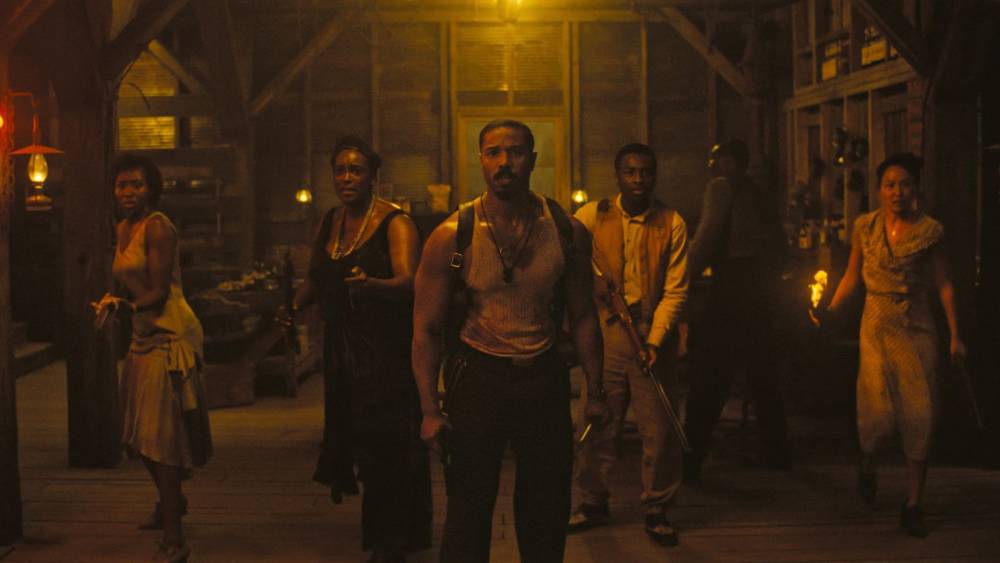
Cinema is designed, as a medium, to make us feel. It is to help replicate and demonstrate our human desires and instincts, to help us better understand ourselves and others become better, more emotionally rich people. While not considered art, this is often especially true in blockbusters, and in particular horror. What human emotions are more raw or honest than thrills, chills, and sexuality?
So it goes with Ryan Coogler’s historical vampire action-horror Sinners. At this point, it goes without saying that Coogler is one of our greatest working directors – from intimate films like Fruitvale Station to blockbusters like Creed and Black Panther, few directors are as gifted at blending the commercial and art. But it takes a real talent to take as many audacious swings (narratively and technically) as Coogler does here and still dazzle and amaze audiences.
In 1932 Mississippi, twin brothers Smoke and Stack Moore (Michael B. Jordan in a dual role) return from Chicago to fulfill their dream of opening a juke joint. Flush with cash and illegal booze they stole off the Chicago Mob, the Moore brothers purchase an old sawmill and fill it with the best blues players in the county. This includes their young cousin “Preacher Boy” Sammie (Miles Caton), the son of a local preacher.
Sammie’s talents are so vast that he serves as one of the storytellers of old, whose music can traverse the past and present. Unfortunately, this talent catches the eye of Remmick (Jack O’Connell) an ancient Irish-American vampire looking to create his own vampiric brood. And a juke joint full of drunk, dancing sharecroppers is an all-you-can-eat buffet…
Few directors are as gifted at blending the thematic and the narrative as Coogler. Sinners, like Coogler’s former blockbusters, weaves into its tapestry deep, lingering questions about culture and identity, race, loss, and cyclical trauma. They are an inherent part of the story. Yet his films are so smartly structured narratively, it never feels the weight of its own import. This is a fun story about vampires and history, and the fact it also has something smart to say is an added bonus.
Coogler has structured the film perfectly. He hints at the violence to come early on before flashing back to show the hiring process of every major character working at the joint. These interactions, while simple, play a particular purpose: by introducing three-dimensional characters with backstories, struggles, needs, and desires, we find ourselves liking and relating to them, and makes their eventual struggle for survival and potential slaughter all the more harrowing.
The film’s three-act structure grows from there. He allows for one act to meet and fall in love with the characters. The second act shows them free of their inhibitions and high on ecstasy (dancing, drinking, f*cking, etc.), only to bring it crashing down with a new threat. And then a final act that places our heroes in a terrifying, action-soaked showdown. And yes, the dialouge is occasionally overwrought, and the film meanders as it attempts to move from Act 1 to Act 2. But when the destination is as juicy as this one, who cares?
Of course, perhaps grander than the story itself is the sheer spectacle Coogler has placed before us. Not only are Coogler’s experimental flares still prominent, but he has pushed himself forward as a filmmaker in every capacity, transforming Sinners into a cornucopia of the senses. In particular, visual and audial. Working with an IMAX 70mm camera, Coogler and cinematographer Autumn Durald Arkapaw have crafted one of the most gorgeous films of the decade, exploring every lush image in grandiose scale. When the camera opens up to full effect before the final fight…it’s magical.
And then there’s the score by Ludwig Göransson, arguably the greatest cinematic composer since John Williams. The two-time Oscar winner not only brings to life a litany of blues songs both real and fictional, but he also infuses the score with an amalgamation of genres and influences. It makes the film feel like a party, a nightmare, and a soulful Gothic experience all at once. It is effective, invigorating work that also plays with the film’s thematic bounds, at one point mixing sound effects and voiceover into the work to act out a monologue performed by Delroy Lindo, emphasizing the importance of music as a storyteller.
All of this culminates in one of the year’s finest sequences, involving Sammie’s first live performance at the juke joint. I don’t want to spoil it here, but I do want to emphasize the emotions it evokes. During the sequence a bold thematic and narrative choice is made, one that threatens to break the logic of the film, yet is essential to the plot. And when it starts, it is, admittedly, goofy to look at. Yet Coogler plays it so earnestly, and the fascinating one take’s camera moves so fluidly as the score swells, it becomes transcendent. It’s the culmination of what great filmmaking can accomplish.
The ensemble, across the board, is stellar. Jordan is a commendable lead, and has a great time playing the stoic Smoke and the flamboyant Stack, and works well in both parts. Lindo is always a great addition to a film, and works here both as comic relief and as a character with a cathartically emotional core. Caton is a find, and Jayme Lawson proves that the camera just loves her. Omar Miller and Li Jun Li are also stellar – both take roles that would be throwaways in other films and turn them into three-dimensional, empathetic human beings.
But the film’s three most memorable performances come from Wumni Mosaka, Hailee Steinfeld, and O’Connell. Mosaka’s character – who also serves as narrator – most effectively reflects the film’s emotional core – funny, tragic, smart, and just an absolute joy to watch onscreen. Steinfeld, meanwhile, plays Mary, Stack’s white-passing girlfriend. It’s the first truly great performance of Steinfeld’s adult career, warm and sexy and terrifying – an effective leading lady. And then there’s O’Connell’s Remmick, the greatest villain we’ve seen onscreen in perhaps a decade. He is f*cking incredible, milking the role for all its worth.
Sinners is a bold, striking work from a master in the making. It’s a visual and aural cornucopia, dazzling all five senses for the audience. It’s a little long in the tooth, sure, and not every choice works. But every choice feels bold and singular in its vision, and the question remains: if it didn’t bother me as a critic, and its $200 million haul proves it didn’t bother or confuse audiences, then who cares? This is why we go to the cinema: to laugh, cry, scream, cheer titillate, and marvel at great stories well told.
B+
Sinners is now playing in theaters nationwide


Add Comment