
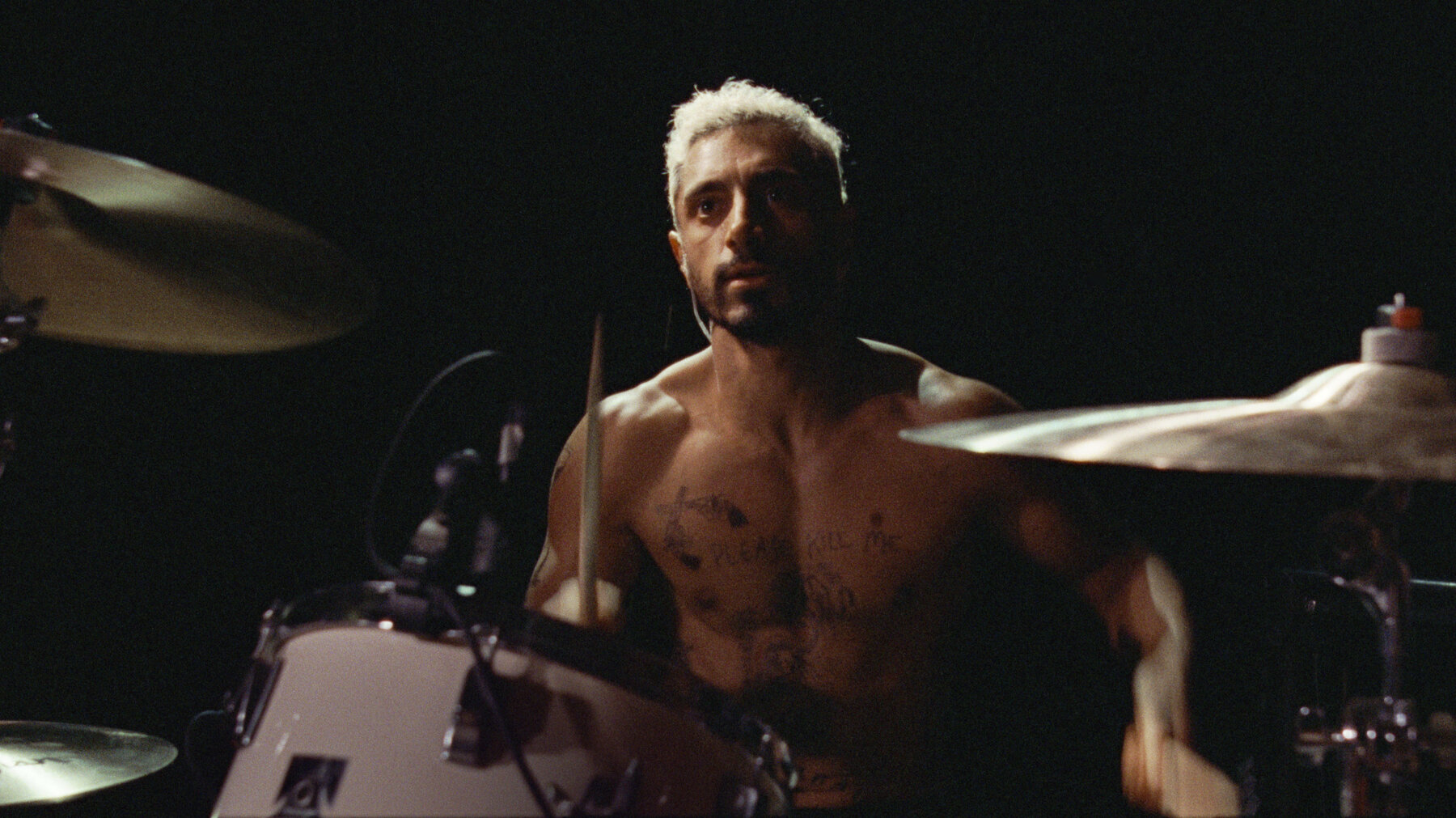
I’m debating if it’s even worth the time to review Sound of Metal. It’s not that the film isn’t good – that would be an easier decision, and an easier review to write. It’s just…how do you review a film filled with a handful of impressive elements that’s just overall underwhelming? For outside of the film’s impeccable sound design and Riz Ahmed’s truly astonishing central performance, Sound of Metal has very little you haven’t seen before, almost beat-by-beat.
Ruben (Ahmed) is the drummer in the punk rock band Blackgammon. When not onstage, he’s living in an RV with his bandmate and girlfriend Lou (Olivia Cooke), and spending each day mastering his four-year sobriety from heroin. One morning, after a particularly intense show, Ruben comes to realize that his hearing is going – suddenly, and then all at once. Realizing that his entire livelihood – and the one thing that helped him stay sober – is on the line, Ruben checks into a rehab designed specifically for deaf people. And with the aid of his fellow patrons, as well as the camp’s leader Joe (Paul Raci), Ruben begins to take the first steps in accepting his new reality.
The greatest hurdle that Sound of Metal faces is the general predictability of the plot. There’s very little that separates this from the average Issues Movie of the 80s and 90s. It’s a stereotypical story about addiction and handicap, portrayed by an able-bodied actor who resorts to The Method instead of trusting an actual deaf person to play the role (the all-time great here is still Marlee Matlin’s honest portrayal in the iconic Children of a Lesser God). Sound of Metal is a collection of stereotypical indie drama beats hodgepodged into one collective viewing experience. There’s the addict trying to fight off the relapse, the able-bodied person realizing they have a disease that Just So Happens to directly correlate to their career/passion, and the long journey of overcoming. I mean, even if the film isn’t exactly a bummer or downer, it even emphasizes the narrative that due to his affliction and his inability to cope with it, he’s going to lose literally everything in his life – his relationship, his career, his sobriety, everything. While I give the film credit for only portraying deafness as a handicap in Ruben’s mind, and not in the overall context of the film, it still draws from the same cliches that have driven this genre since the dawn of cinema.
That said, the film is still a more than adequate version of its predictability, mainly because of the way it handles its material. Raci’s Joe states at one point that “Being deaf is not a handicap. It’s not something to fix,” and what separates Sound of Metal from so many films in the same genre is that it actually believes this. It is also abundantly clear that director Darius Marder understands the art of subtlety, helping to drive the film’s emotional core. I greatly appreciate the fact that the film never openly dives into Lou’s own struggles with mental illness, instead implying it through Ruben’s behavior and subtle shots of Lulu’s scarred arms. Similarly, whereas an actor like, oh, say, Sean Penn might milk the performance for a big, cathartic moment of triumph, complete with slow-mo and an overly-expressive facial reaction, Ruben’s progress is mostly portrayed through quiet moments of reflection, like rekindling his love of music through the vibrations he drums on a slide. By consciously avoiding the tropes and Big Moments that ruin films like this, Sound of Metal is able to escape its own issues to craft a smarter, sleeker film.
Of course, Marder’s greatest success here is the sound design. Honestly, the film may earn its positive grade on the strength of the sound mixing here alone. From the start of Ruben’s deterioration, the film finds new ways to both amplify Ruben’s condition and create a new reality for both protagonist and audience. Marder makes this clear from the first scene, where he subtly demonstrates the little clinks and grunts of Ruben’s morning routine, so when the sound disappears the following morning, it is noticeable to the audience. Equally impressive is the way the sound cuts in and out, muffling whenever it needs to, or even distorting when Ruben samples cochlear implants near the third act. One of the best examples of the sound mixing’s brilliance comes when Ruben first moves into the commune. The sound cuts out completely when we’re in his first-person POV, emphasizing the silence he currently resides in, before cutting to a wide shot of restored sound, filled with clattering plates and the occasional sign language display. The decision not only emphasizes the realities of hearing loss in a non-judgemental or condescending way, but also shows Ruben’s isolation from the community at large – while they also remain deaf to the sounds around them, their ability to work with their hearing loss has helped them fully adapt to their new reality. Simply put, this is some of the best sound work not just of the year, but in the history of sound design.
With all that said, Sound of Metal doesn’t work without Riz Ahmed’s convincing, stunning central performance. Not since Bohemian Rhapsody has a film placed so much effort on the shoulders of its lead. Ahmed fully channels the scrawny, nervous energy of that former addict you’ve most likely met at a rock concert, and he allows us into Ruben’s very soul from the jump. Ahmed works in tandem with Marder’s script to find Ruben’s very core personality – a wiry ball of energy that cannot handle being out of control for even a moment. Ahmed’s face invites us into the mind of a person who has spent so long regaining control of his life that the earth-shattering new reality he faces throws him completely off-course. He invites us into Ruben’s life, his struggles, his successes, and his emotional state at every turn, and it is a masterful performance. In fact, it’s so powerful that no matter how hard the great Olivia Cooke, Mathieu Almaric, or actual veteran/ASL teacher Paul Raci try (and they all give excellent performances), they are all ultimately overshadowed by Ahmed’s overall charisma.
Sound of Metal is one of those films that’s a straight double. Despite some improvements on the story’s central angle and messaging, there’s nothing here you haven’t seen before. The only reason the film is worth seeing is Ahmed’s leading performance. But with that being said, what a performance there is. And honestly, there’s nothing wrong with seeing a predictable movie-of-the-week – LifeTime’s made a career out of it. So if you’re looking for two hours to fill with a moving, weepy drama, then look no further than Sound of Metal. You could do a lot worse in the exploitative genre that is “Issues Filmmaking.”
B-
Sound of Metal is now streaming on Amazon Prime


Add Comment