
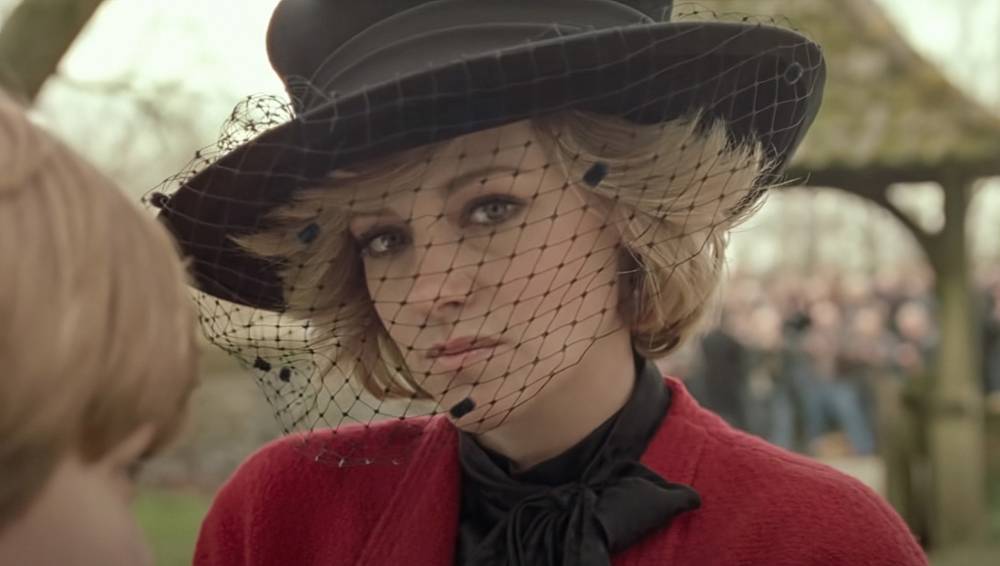
In 2016, Pablo Larraín released Jackie, a deep psychological exploration of fame, power, and the creation of myths involving one of the United States’ most famous First Ladies. It was an acting tour-du-force, brilliant and insightful and exquisite. So when it was announced that Larraín had directed Spencer, a similar fable about a real-life icon – this time Diana, Princess of Wales – and starring superstar Kristen Stewart, the idea seemed like a slam dunk. After all, there’s certainly enough material to make for an incredible story about the corrupt nature of the monarchy and the suffocating, destructive nature of strict traditionalism. So I’m not sure where it specifically goes wrong. Perhaps Stewart, normally a master of the screen, tries to do too much. Perhaps it’s Steven Knight’s cloying script. Or perhaps it is the fact that Diana has been so thoroughly explored there’s nothing new to say. However, despite Larraín’s mastery of the craft, Spencer finds itself falling flat, again and again and again.
In December of 1991, the royal family gathered at Sandringham Estate for their annual Christmas festivities. The traditions have been set in stone for centuries: the annual weigh-in, fancy dinners that require several outfit changes, and the annual pheasant hunt. But this year, the royal family has a new set of concerns. The marriage between Prince Charles (Jack Farthing) and his popular wife Diana (Kristen Stewart) has long grown cold. Charles’ long-running affair is constantly in the news, and Diana is allegedly on the verge of going insane or insisting on a divorce – not that there’s much of a difference to the family. And so, with sons William (Jack Nielen) and Harry (Freddie Spry) in tow, Diana shows up at the estate, feeling utterly alone, constantly watched by the staff led by Equerry Major Alistair Gregory (Timothy Spall), and struggling with her emotions as the stuffy atmosphere constantly pushes her to the brink.
It’s hard to deny that, on the surface, Spencer is an impressive film. Larraín is one of the best actors working today, and nobody understands how to compose a shot like him. Larraín works with cinematographer Claire Mathon to craft some of the most beautifully unsettling shots imaginable. Using uncannily symmetrical staging, Mathon gives every shot a discomforting ambiance, to help place viewers in Diana’s mindset. There’s foggy moors and peeping eyes – a shot of Camilla staring into the camera from a distance is one of the best of the year. There’s luxurious gowns and giant hallways that still present an air of claustrophobia. And no matter how big a swing Larraín tries to take, Mathon is down to match it – the ghostly appearance of Anne Boleyn is entirely thrilling, even if the gimmick feels well worn after its first appearance. Jacqueline Durran works her own bit of magic on the costumes, recreating Diana’s sumptuous royal dresses with aplomb. And who can forget Johnny Greenwood’s score? Easily one of the best composers working today, Greenwood’s score is ever-present, constantly overbearing each scene and instigating a mini-mental breakdown of its own. In terms of direction, staging, craftsmanship, and opulence porn, Spencer really is top-notch.
However, as pretty as all the window dressing may be, it’s still got to build up to a story of some substance. And therein lies the problem with Spencer. As the story of Diana’s pain and struggles unfolds before us, it’s hard not to ask oneself, “Wait…don’t we already know this?” There’s nothing new in Spencer that we don’t already know from the tabloids, or the thousands of books written about her, or the several movies made about her life, and so on. We know about the infamous dual pearls given to her and Camilla. We know the Royal Family hated her. We know that she was unhappy with the choices she made that thrust her directly into the spotlight. Steven Knight’s script (clearly more in Serenity mode than Locke mode) is violently overwritten, jumping from cliched textual commentary to cliched textual commentary as if subtext were a vulgar word. Oh, the trauma made her bulimic? Just show her throwing up forty times in a two-hour timespan!” (Admittedly, Charles nastily mocking her for her illness may be one of the film’s few perceptive moments). “Oh, she was the People’s Princess? Have her take her kids through a KFC drive-through! Make sure she poignantly gives the name Spencer, both because it’s a metaphor and because it’s the title!” Even the film’s largest narrative jumps –the ghost of Anne Boleyn, nightmares about eating necklaces, eerie flashbacks and suicide attempts – are things we’ve seen before, stolen so blatantly from Hitchcock as to challenge the use of the word homage.
There could have been depth here. The film opens with a commentary on the aggressive opulence on display from these heinous people, as military caravans carry boxes of food to Sandringham as if they were WMDs, whilst servants are scolded with the expression “Keep noise to a minimum. They can hear you.” And one scene in particular, portraying Diana and Charles arguing across an ever-expanding pool table, offers some depth inside their mental states and deteriorating relationship. It is easily the film’s best written and best shot scene, with Charles using young William being forced to participate in the pheasant hunt as a metaphor for miserably having sex with Diana when he’s really in love with Camilla. Yet there are so few scenes like it, it stands out as an exception to the rule, as opposed to proof of the film’s greatness. Instead of this incisive commentary or intellectually stimulating character study, we jump from scene to scene that rehashes the stereotypical “woe is me” undercurrent, never exploring the vast dichotomy between the progressive Diana and the aggressively conservative royals to the point of aggravation.
All of this may, in fact, be worth it if Stewart just nails her performance. After all, Portman’s work in Jackie was so mesmerizing it carried 90% of that film. And yet Stewart cannot stick the landing as Diana. She kind of looks the part. She certainly has the emotional range. In fact, it has nothing to do with her talent as an actor – in spite of the Twilight days she longs to eschew, Stewart has grown into a rather remarkable actor, with award-winning, all-time great work in films like Clouds of Sils Maria, Personal Shopper, even the vastly underrated rom-com Happiest Season. Yet here, she remains a mishmash of tics and impersonations uttered through a try-too-hard accent and a constant breathy stutter. It’s the epitome of “impersonation acting,” where an actor and director assume that looking and sounding like a famous person is the same as a performance. It’s the exact reason Rami Malek received so much criticism for Bohemian Rhapsody in 2018. The best performances are the ones where you can’t see the actors working, and Stewart’s trying so hard you can almost see the sweat through the screen.
Amongst the other performances, everyone gives an admirable job, if not entirely noteworthy. Timothy Spall, predominantly a terrific character actor, isn’t given much to do other than creepily watch and lurk, or give monologues about the importance of duty. He’s in better shape than the great Sally Hawkins, Diana’s dresser whose entire role is reduced down to “lesbian in love with Diana,” as is revealed in one painfully written sequence. I enjoyed the work of Sean Harris as the over-the-top Royal Chef, as well as Jack Farthing as a rather socially inept, self-loathing Prince Charles. As far as child actors go, Nielen and Spry do an adequate job – the film is at its best whenever they’re onscreen. And I love Nielen’s portrayal of Prince William as a piece of sh*t daddy’s boy. It seems very apropos to real life.
But if there’s one performance that needs to be talked about, it’s Stella Gonet as Queen Elizabeth. Gonet is a marvelous Elizabeth, and has a terrific monologue about how they consider royalty to be a form of currency – “The only photo that matters is the one on the ten-pound note,” she declares. However, this performance, not to mention this monologue, are a reminder of the film’s general incompetence. This is the first and only time we see Diana interact with members of the royal family. It comes about an hour into the film. And it ultimately feels anticlimactic. This divide in views, and sense of undaunting duty should be the heart of this film, with Gonet’s smart performance as the focus. And yet, one scene is all we get. It’s a wasted ensemble in a wasted movie.
Spencer is a cornucopia of missed opportunities. It could have been great. It had all the pieces. It had the cast, it had the themes, it had the director. There are moments that are great – I’ve never seen Diana play with her kids onscreen before, and it spoke greater volumes than any Diana movie released to date. But it just couldn’t bring everything together to tell us anything new. And because it fails to tell us anything new, there is nothing to become invested in. That might be the greatest failure, at the end of the day. Spencer had no reason to not be great. It had everything it needed to thrive, and it just…doesn’t. It remains as lifeless as the ghost of Anne Boleyn, with its potential for greatness constantly haunting the edge of the frame, promising a film that never comes. C’est la vie.
C+
Spencer is now available to rent on VOD; it is also playing in theaters nationwide


Add Comment