
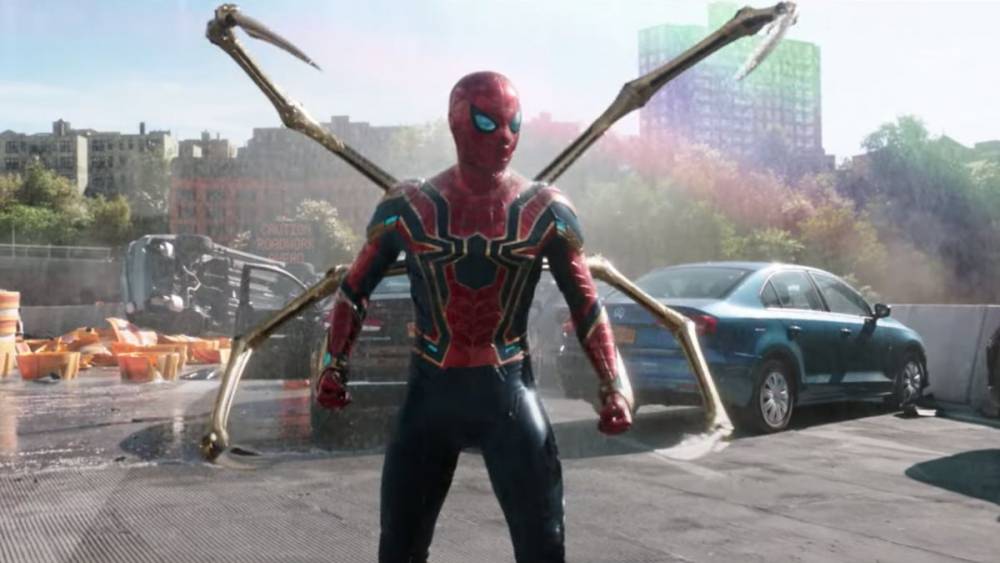
The reason a superhero movie works is relatively simple: it finds the best aspects of our morality, and it amplifies it on a massive scale. Because there are so many Marvel movies at this point (indeed, an industry-crushing amount), this message and these themes tend to get lost in the shuffle. It is precisely this reason I’ve found myself waning on the most recent entries in the franchise; Black Widow, Shang-Chi, and Eternals all gradually improved on an inherently broken formula, to middling effect. However, Spider-Man has always been different, thanks to his innately aspirational nature. And it is this genuine sense of fun and pathos, along with an entirely game group of performers, that Spider-Man: No Way Home delivers as a worthy blockbuster and the year’s best Marvel movie by far.
Ed. Note: There’s a great deal of talk surrounding the nature of spoilers with this film. I won’t talk about anything not already seen in the trailers, but if even that’s too much for you, well…reader be warned
In the wake of Spider-Man: Far From Home’s shocking reveal of Peter Parker’s (Tom Holland) secret identity, the teenage webslinger’s life has grown out of control. Branded a controversial vigilante, Peter can’t go anywhere without being recognized – or worse, should the citizen follow J. Jonah Jameson’s (J.K. Simmons, because of course) conspiratorial blog. When the revelations begin ruining the lives of best friend Ned (Jacob Batalon) and girlfriend M.J (Zendaya), Peter turns to his former ally, Doctor Strange (Benedict Cumberbatch) to try to fix things. However, Strange’s spell backfires, and instead causes a rip in the universe, bringing a variety of strange visitors from other dimensions to Peter’s world – visitors who claim to have fought Spider-Man in the past, and possessing weapons like metallic arms, the ability to control sand and electricity, and spherical explosives. In order to fix the universe, Peter’s going to need all the help he can get.
No Way Home works because it serves as a reminder (not that we necessarily needed it) of why we love Spider-Man, as a character and as a story. Obviously, this relates to the cool action associated with a character who can climb walls and do flips and swing on skyscrapers. An opening chase through the streets of New York is pretty exciting, and there’s a fight on a bridge that feels truly innovative for a character with eight solo entries and three crossovers with The Avengers. But it’s deeper than that. Director Jon Watts demonstrates an understanding of this character inside and out. No Way Home is a testament to Spider-Man’s silliness, as well as his heart. The Spider-Man franchise is crazy, filled with characters with over-the-top names, absurd science, and villains who want to turn the population into lizards. This saga has been crazy and childish and playful and fun, and No Way Home pays tribute to the insanity of that journey (to say more would be to spoil not only the plot, but some great jokes).
More importantly, however, is the film’s understanding that what makes Spider-Man a great hero and character is the heart at the film’s core. Spider-Man is an ordinary kid forced into extraordinary circumstances, which makes his altruistic use of his powers so poignant (it’s why the Spider-Man 2 train scene is arguably the best superhero moment of all time). In the MCU, this empathy is derived from his youthfulness, which allows him to approach situations with an optimism and empathy that the grown-up heroes do not. And therein lies the intelligence of No Way Home: the way it approaches its villains.
Whilst the alternate universe rogues’ gallery on display here all met gruesome ends in their time, No Way Home reminds us of what those films carefully established: they were never traditional villains. They were almost entirely goodhearted men transformed into monsters (oftentimes by forces outside of their control); men who feared what they became and are terrified of the prospect of death. This Spider-Man, armed with the motto “When you help someone, you help everyone” (along with some forgettable line about something something great responsibility or whatever), approaches his mission not with the goal of defeating these villains. His mission is to save their souls. And with that simple twist to the formula, this is already the most interesting superhero movie in years.
Ironically, the person who deserves the most credit for No Way Home’s intelligence is Sam Raimi. This film is a testament to what Raimi accomplished with his original trilogy almost twenty years ago. He saw a beauty in this character when no one else did, and put him on the big screen with honesty and earnestness. Furthermore, he filled his films with actors who could manage goofiness, menace, and pathos, all at the same time. And it is the effort he put into these characters and his casting that left a bedrock of stability that carries into this film today. Alfred Molina is still ingenious casting as Doctor Octopus, even if he never reaches the same level of charisma he did in the perfect Spider-Man 2. Thomas Haden Church was a terrific Sandman, and while Raimi had no role in the Amazing Spider-Man series, I do want to shout out Jamie Foxx as Electro (although I wish they’d let him go as weird as his Stan-inspired turn in Amazing Spider-Man 2).
However, if there’s one actor to single out before continuing onward, it’s Willem Dafoe as Norman Osborne. Dafoe has surpassed his own performance in the original Spider-Man. He has taken a character he’s already made iconic and taken him to a whole new level, running circles around every other Marvel villain to date. Dafoe dives deep into the character’s haunting Jekyll and Hyde situation in a way he never got to in the original, when Raimi was working out his own kinks, and creates a character who is simultaneously tragic and haunting and terrifying, all at the same time. There is one scene in particular, where Dafoe waxes poetically about the terror of waking up in a new universe and possessing a voice of pure evil that you cannot control, that is so moving and so beautiful, I refuse to believe a Marvel scribe wrote it. Clearly Dafoe was speaking from the heart and they just kept the cameras rolling. At any rate, this character and this performance is the key to the film’s success, and should be studied by every Marvel writer going forward.
Nevertheless, because there is no such thing as a perfect Marvel movie, there are some glaring issues holding the film back. Beyond the fact that the film, admittedly, feels like a retread of the smarter, cooler film Spider-Man: Into The Spider-Verse, it just never manages to justify its own existence. So much of the film is reverse engineered from the idea “What if all of the villains from the past films appeared at once?” It’s a cool concept, but it needs to justify itself in a way other than fan service. And it doesn’t always work. Furthermore, because the entire concept is reverse-engineered, the ultimate climax feels as though it’s going through the motions – not to mention it’s way too complicated. Oh, and if you were secretly hoping that this was the film where the Marvel writers’ room finally figured out how to lay off the hacky material, I’m sorry to say you were wrong. Steel yourselves for a handful of bad jokes and self-aware references that will undercut the stakes every chance they get.
Also glaringly distracting are the effects, which easily feel as some of the weakest Marvel’s done to date. Certainly a great deal of this has to do with the extensive use of de-aging technology; normally used as a gimmick for a handful of scenes in past projects, here de-aging plays a pivotal part to the film, as actors need to be transformed into their 2002, 2004, and 2007 selves, respectively. It never looks right, and oftentimes creates an uncanny valley effect that it doesn’t mean to. Furthermore, the film serves as a surprising blow in the battle of practical vs. digital effects. Want proof? Compare the Goblin’s glider in the 2002 Spider-Man, constructed of real materials and transported on wire, to the CGI abomination floating around here. Feel the menace of Doc Ock’s puppetered appendages vs. this film’s flimsy attempt for animation. Any sense of terror inside of these villains has vanished underneath the green screen, and it hurts the film’s ability to inspire awe, terror, or joy, in any sense.
Yet despite these flaws, this is still a film it’s hard to hate. And much of that is owed to the cast. Every actor brings their A-game here – and I don’t just mean the above-mentioned villains. Everyone is putting in the work. Holland continues to nail the emotional bits as well as the jokes, and he is amplified every step of the way by real-life girlfriend Zendaya. The duo have real chemistry, and there are several moments in the film that remind you that, “Oh yeah, this 25-year-old has a well-deserved Emmy.” Batalon has less to do this time around, but he still manages to earn his laughs. Amongst the adults, Marisa Tomei is still inspired casting as Aunt May, while Jon Favreau continues doing everything in his power to stay in this franchise until his dying day (honestly, his sense of comedic timing is enough to justify the decision).
Benedict Cumberbatch only has a handful of scenes, but come on. Has he ever given a bad performance? And I can’t forget to mention a handful of performers that equally won me over. Succession’s Arian Moayed has a small role at the beginning of the film that is a force of nature, stealing the film in its opening seconds. Angourie Rice continues making me angry that she hasn’t been given more to do in this series. #JusticeForRice. Oh, and at one point, they just stop the action to put Martin Starr, JB Smoove, and a conspiracy theorist Hannibal Burress onscreen together. I’ll have you know the movie never tops this moment. Obviously, there are more performers than this, but anything more and I would ruin the fun. And I wouldn’t want to do that.
Spider-Man: No Way Home possesses heart and hope in a way that keeps Marvel fatigue from fully setting in. It’s a reminder of why audiences love Spider-Man, and of the journey fans have taken with the character over the years. It understands why this character is beloved, and chooses to amplify those qualities rather than customize or improve upon them. It’s imperfect, yet wears its heart on its sleeve. And thanks to some expertly staged moments and a series of great actors, it reminds us of the magic of Spider-Man. I don’t know where the character goes from here, especially with the Marvel-Sony negotiations so tempestuous. Yet even if, in some fluke cosmic event, this were the last Spider-Man film we ever had, it would be well worth it. As a beginning, middle, or ending for the character, No Way Home delivers its goods.
B
Spider-Man: No Way Home is now playing exclusively in theaters


Add Comment