
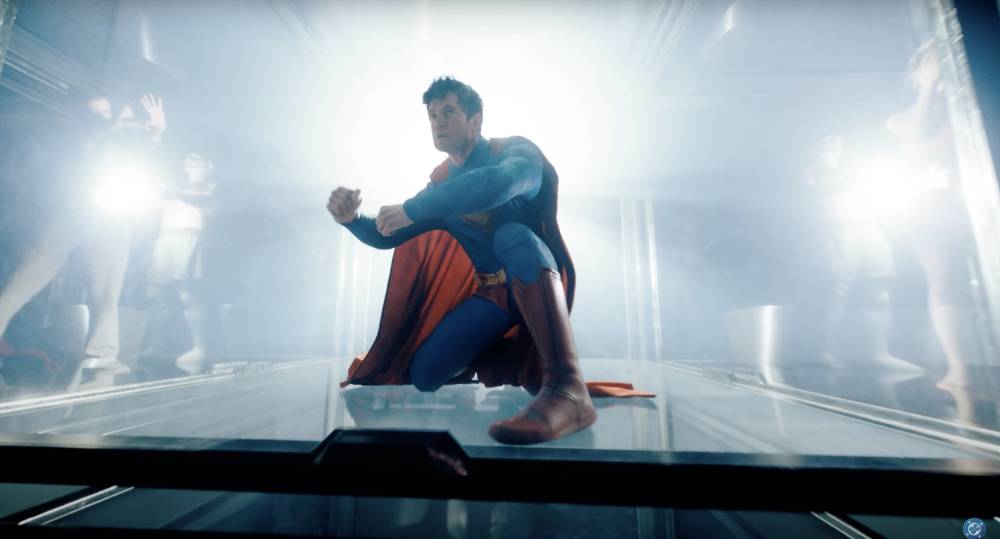
Out of every comic book character Hollywood wants to milk on the big screen, Superman is perhaps the hardest. It’s not the boyhood innocence and perpetual goodness that presents a challenge. It’s that an all-powerful hero who attempts to save everyone and solve every global conflict cannot translate from his 1930s origins to a complicated modern world as easily as, say, film noir detective Batman or small-scale local hero Spider-Man. Even in the perfect 1978 film, Superman had to essentially be transplanted in the 1940s to make the film work.
So how does one take on the Man of Steel in a new era? Well, James Gunn offers two solutions in his attempt to kick off the DC answer to Marvel’s Cinematic Universe. The first is to address the eternal question of Superman’s goodness and inherent humanity right off the bat, and how that looks in the 21st century. The second is to lean into the nature of comic book lore, in all its campy, silly glory. The result isn’t exactly perfect, as Gunn’s Guardians of the Galaxy cynicism finds itself at odds with the film’s inherent optimism. But it’s a strong enough story to more than entertain the entire family.
Three years ago, Kryptonian alien Kal-El, aka Kansas boy Clark Kent (David Corenswet) emerged to the world as Superman, the most powerful example of the recent upswing of metahumans (humans and aliens with extraordinary powers). He is beloved worldwide for his actions. However, after a recent intervention in a scaling conflict between the nation of Borovia and its neighboring Jarhanpur, as well as secrets and machinations by tech billionaire Lex Luthor (Nicholas Hoult), Superman finds his belief in doing good challenged, pushing him to his brink.
The story itself lends itself well to both the 21st century and to the character. Gunn’s Superman finds its story in what it means to be a goodhearted hero in the modern world. How does one continue to not only choose good, but be good when your social media criticizes your every move, the nation you choose to serve is allied with (and looks the other way for) commits acts that are, on a baseline morality level, rather heinous, and the other heroes simply look to defeat threats rather than protect innocent lives? These are worthwhile questions, and give the otherwise fuddy-duddy hero an actual dilemma to grapple with.
For the most part, Gunn does so well. It lends to both the humor and the heart of the story. Action sequences now involve Superman having to save civilians from a giant space creature in increasingly inventive ways while a billionaire-funded superhero team simply kills the creature. Jokes formulate as Superman’s inerhent dorkiness is juxtaposed with the cynicism of Lois Lane (Rachel Brosnahan) and the selfishness of his fellow heroes. Yet even in using this juxtaposition for jokes and thrills, we still find ourselves – like the other heroes – won over by the heroism and humanity of our protagonist.
Of course, Gunn’s shift from his space outlaws and reformed villains to the most purehearted of protagonists isn’t quite smooth sailing. Two issues hold him back from making a good movie a great one. First and foremost, Gunn’s personal style. The reason previous superhero outings have worked so well for the director is the exploration of his own sense of jaded humanism: characters who are deeply flawed but desire to be better. In a world this optimistic about human nature, his wicked sense of humor and Troma-honed sex and violence inspirations don’t necessarily gel.
His second shortcoming is a slavery to the comic book aesthetic. The idea of kicking off this franchise in a world already immersed in superhero culture does add to the comic book aesthetic he’s developing. Characters just show up, already fully formed, as heroes and destruction run rampant (the way it would work in a comic). Yet the world is so big, Gunn has to resort to ugly scrolls of information, exposition-dumping monologues, and beyond to make it work. Add to that an overly saturated lighting situation, meant to evoke a colorful comic and instead appearing garish and dull, and it all feels like the actions of an unsure director finding himself.
Still, Gunn finds himself aided by a cast dedicated to creating fully-formed characters out of comic book icons. Corenswet is very good at capturing Superman’s goodness and Clark’s affability, the best since Christopher Reeve. He is only outshone by the duo of Brosnahan and Hoult, the best to ever take on Lois Lane’s fatalistic spunk and Lex Luthor’s brilliant malicousness. Isabela Merced and Edi Gathegi are both strong as rival heroes, while Nathan Fillion feels like a Gunn stand-in as a cocky Green Lantern.
Skyler Gisondo has a terrific arc as the previously under-utilized go-getter Jimmy Olson – hell, most of the cast of the Daily Planet bring the iconic comic characters to life. Gunn also brings in beloved 70s character Eve Tessmacher, brought to life by Sara Sampaio and cleverly updated to a 21st-century influencer. Special attention should be paid to Pruitt Taylor Vince and Neva Howell as Ma and Pa Kent, characters who start as jokes and grow into the story’s heart. Oh, and not technically a character, but Krypto the Super Dog is great visual work, a great running joke, and a great character overall.
Superman is a worthwhile summer blockbuster and superhero film. As the launch of a franchise, it offers great promise (and highlights ways to grow). As the reboot of a beloved character desperately seeking a facelift, it does its job adequately. And most importantly, as a standalone story, we are able to feel the stakes and like the characters enough to feel invested over the course of two hours. It’s not the best superhero film Gunn has ever made, nor is it the best Superman story we’ve seen. But it feels refreshing to have a film this lighthearted, exciting, and entertaining to make us hopeful again.
B
Superman is now playing in theaters nationwide


Add Comment