
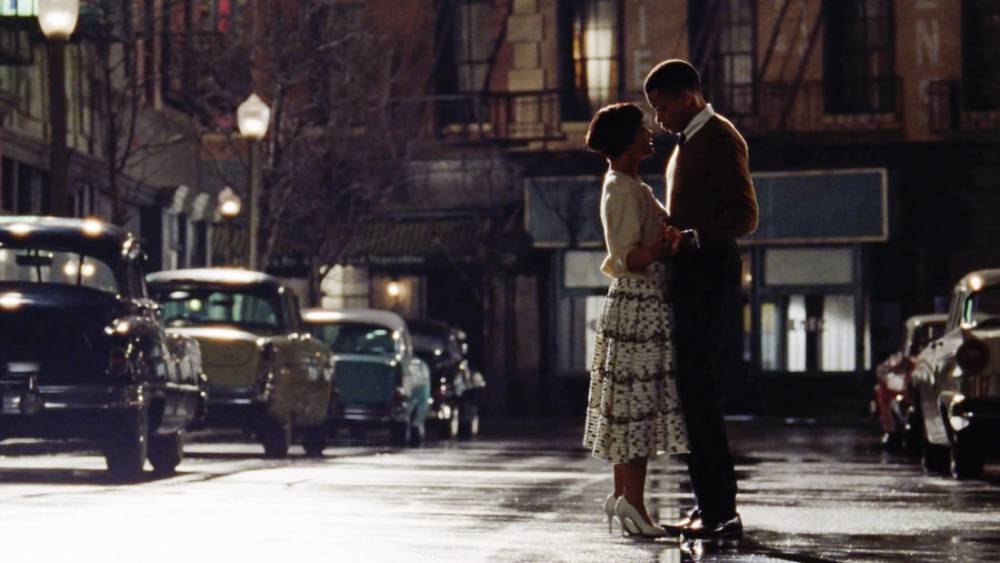
There’s just something magical about watching a genre film done right. Whereas drama and comedy possess so many subcategories underneath their broad umbrella, a great genre film, like horror, sci-fi, or romantic comedy stands out as all the more impressive. Eugene Ashe’s Sylvie’s Love is the latest entry in the “melodrama,” a long-thought dead style of theatricality that utilizes intentionally over-the-top plot turns paired with strong performances and sumptuous backdrops to elicit an emotional response from audiences. Classic examples include the works of Fassbinder and Wyler; more recent examples include The Notebook and, in a better sense of the word, Todd Haynes. And not only is Sylvie’s Love a terrific entry into this fine oeuvre of films, but it stands tall as one of the best films of 2020, thanks to impeccable acting, writing, directing, and overall filmmaking.
It’s the late 1950s in New York City, and Sylvie (Tessa Thompson) is waiting for her life to begin. She dreams of marrying her fiancé Lacy (Alano Miller), who is off fighting in the Korean War, and becoming a television producer. But for now, she works in the family record shop for her father Herbert (Lance Reddick), and experiences chiding at home from her strict mother Eunice (Erica Gimpel). However, everything changes for Sylvie upon meeting Robert (Nnamdi Asomugha), a young jazz musician who comes into the shop looking for work. The two immediately take to bickering in that way people do when trying to mask their emotions, and soon they begin a passionate summer fling. However, with lacy returning and Robert receiving an offer to play jazz in Paris, they are forced to go their separate ways. But fate has a funny way of intervening, and five years later, when the two are on the verge of success in their respective fields, they reconnect again. The only question: is their love strong enough to withstand everything else in their way?
Sylvie’s Love is the purest, straightest melodrama I’ve seen since the 1970s, perhaps even earlier. Writer/director Eugene Ashe has followed in the footsteps of great romances like An Affair To Remember, The Way We Were, and the films of Douglas Sirk. The complications and roadblocks to Sylvie and Robert’s relationship are fairly commonplace in drama – a mother who believes that a partner is “beneath her daughter’s station” (it’s The Notebook!), burgeoning careers and dreams that present once-in-a-lifetime opportunities, complicated love triangles, and ramifications of a perfect summer fling. These are staples of the genre, and audiences do not and should not care. All that matters is if the films make these checklist plot points feel fresh and if the leads can hide the rest with their crackling charisma. In terms of the first requirement, I’d dare say Sylvie’s Love does an adequate job, as I still felt invested even as I guessed beat after following beat. And as for the chemistry…well, watch Thompson and Asomugha onscreen together and you will have your answer within 30 seconds. These two fill each frame with a raw, sexual dynamic that can be equally romantically chaste all at the same time. This is a film where the gentleman gives the lady his coat, and quotes Shakespeare to woo her, even if he only knows a few phrases.
In the smartest, sexiest decision of all, Ashe allows the two to fall in love through the sensuality of pop culture. Sylvie and Robert are pop culture nerds – she knows movies and TV, he knows music – and their knowledge serves not only as a baseline to their verbal sparring, but as a tool for their flirting. Watching them engage in a meet-cute while she devotedly studies the Chocolate Factory scene from I Love Lucy is adorable, and few films stand out in my mind all year more than a silent moment where he fawns over her (and lovingly teases her) as she passionately explains her love for TV and movies. It is an honest, beautiful moment that feels more raw and real than 100 Hallmark movies put together. I could take the time to reflect on the script’s few bland moments and unnecessary twists, or a melodramatic twist that the actors are forced to sell to the best of their abilities, or even that the math of the Korean War makes absolutely no sense in the realm of this universe. But ultimately, I just don’t care. It sold me on the romance, and that’s the greatest hurdle a film like this has to clear.
Of course, it’s easy for me to willingly hand myself over to this story when the filmmaking is so impressive. Melodramas are often remembered for the lavish detail afforded to every frame – the first thing audiences think of when they hear the name “Douglas Sirk” is his emphasis on costumes and technicolor. Sylvie’s Love is no different, as the only two films in recent memory to achieve this level of classical beauty are If Beale Street Could Talk and La La Land. Ashe knows this film is about sexy people falling in love and overcoming obstacles, and he lets his cinematographer Declan Quinn capture his stars in all their beauty. This film comes laced with gorgeous, sumptuous, retro imagery that elevates each look, touch, and caress the camera beholds – hell, there’s even some seductive street dancing just to drive it all home. In fact, I’d dare say every member of the crew aids Ashe in his quest to lace this film with romance and atmosphere. Fabrice Lecomte’s lovely jazz score permeates each frame, setting the mood for the characters and Ashe’s direction. The production design by Mayne Berke captures the nostalgic glow of New York in the 1950s, while Phoenix Mellow’s costumes emphasize every perfect feature on every character in a way modern costumes never accomplish. Hell, even Dana Congdon’s editing adds a layer of atmosphere, thanks to a pitch-perfect recreation of the melodrama’s iconic third-act montage of romantic moments. From the top down, this is an incredibly crafted, emotionally rich film of love, passion, and drama.
However, what’s most important about what Ashe has achieved here is his ability to tell a Black story in a historically white genre without ever resorting to Suffering stereotypes. We’ve seen millions of films like this about white characters, from The Women to Carol, but it’s rare to see a film like this emphasize Black characters undergoing similar struggles. And when we do see stories like this about Black characters, it’s almost inevitable that racism is going to rear its ugly head and ruin everything (most likely someone’s gonna get killed). While race is never ignored – Sylvie is skeptical about her chances of getting ahead because of her race and gender, and white characters make casual comments about not knowing Lacy is Black because of the way he talks on the telephone – it is never the source of suffering for its characters. Through sultry filmmaking and pure charisma from its leads, Sylvie’s Love tells a film about Black excellence with unrivaled passion. And he does it all without sacrificing his leading lady’s agency – as much as the title may refer to Robert, the eponymous Love is just as applicative to Sylvie’s quest to utilize her passions and knowledge to not only create the television programs she so adores, but to help mold and improve them in the process. Ashe captures this journey emotionally and honestly, and by balancing the film’s emphasis between romantic and career love, it gives this film the edge it both needs and deserves.
In terms of the performances, I cannot heap enough praise upon the two central protagonists. Thompson is almost always a welcome addition to an ensemble, from Dear White People to Creed to Thor: Ragnarok. However, I do believe she’s accomplished her greatest performance here, bringing Sylvie to life with all the passion and charisma and intelligence you want from both a melodrama star and a romantic lead. Meanwhile, I’m not much of an NFL fan, so I wasn’t familiar with Asomugha before this film, but let me say this may be the greatest athlete-turned-acting performance in film since Jim Brown left the NFL in 1965. He has powerful leading man chops, and he pairs perfectly with Thompson. He also helps sell one of my favorite character beats – a nerdy, eager young man buried beneath a swaggering charisma, best seen when he humorously leaps up a flight of stairs when Sylvie offers a good night kiss. These two have the grace of the stars of the Golden Age, and I hope this film opens the door of opportunity for them wider than it has in the past.
But Sylvie’s Love is far from a two-hander ensemble, like, say, La La Land. Every member of the cast is memorable, from the top down. Aja Naomi King and Regé-Jean Page both steal scenes as the “supportive best friends” that every rom-com deserves, with King in particular crackling in every sequence. Ryan Michelle Bathe oozes elegance and swagger as Sylvie’s boss at the local television station, while Lance Reddick is an enjoyable, if overlooked presence in his few moments of screentime. Amongst the white characters, Jemima Kirke from Girls has a small role as Robert’s manager, and mainly just fits the era (I don’t have enough to say about her one way or the other), while Wendi McLendon-Covey is hysterical as the television star whose show Sylvie works on. In fact, the only performance that strikes me as odd is Eva Longoria’s cameo as Robert’s landlord. It’s not that she’s bad in the role, it’s just confusing that she shows up for five minutes in a role that has little bearing on the plot in any significant way.
Sylvie’s Love is that magical kind of throwback that reminds us of why we love movies. It places its emphasis on the magic of cinema, and brings the audience along for the ride. Like any great melodrama, you’ll undergo the gamut of emotions: you’ll laugh, you’ll cry, you’ll swoon, you’ll sigh. And you’ll walk away not only wanting to sing its praises to those around you, but to see the next brilliant project from Ashe, or Thompson, or Asomugha, or anyone who helped make this film what it is. It is pure art and pure entertainment in its finest form, and I cannot emphasize enough my most earnest dream that this becomes the next romantic classic.
A-
Sylvie’s Love will premiere on Amazon Prime on December 25th


Add Comment